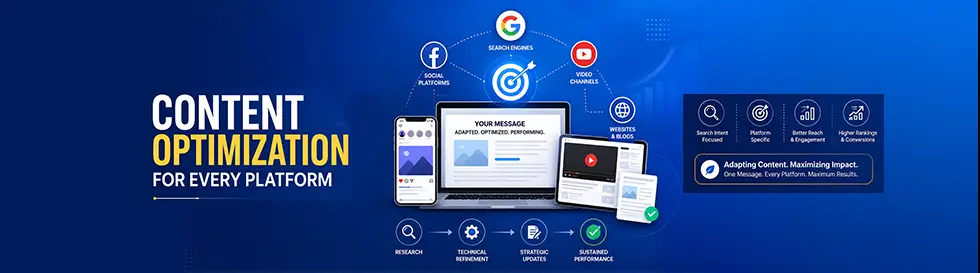
Content today is no longer created for a single destination. It moves across search engines, social platforms, video channels, and websites. This makes content optimization for every platform a critical part of any modern marketing strategy.
Yet many businesses still follow a “create once, publish everywhere” approach. The result? Content that underperforms across channels. The reason is simple, each platform has its own user behavior, algorithms, and expectations.
To succeed, content must adapt without losing its core message. This is where an organic SEO agency can ensure content optimization by aligning high-quality content with search intent through rigorous research, technical refinement, and strategic updates.
Content Optimization for Every Platform: Why It Matters
Content does not fail because it is bad. It fails because it is misaligned with the platform it appears on.
Every platform serves a different intent:
- Search engines are intent-driven
Users actively look for answers. They expect structured, detailed, and keyword-optimized content. This is where long-form blogs and guides perform best. - Social platforms are attention-driven
Users scroll quickly. Content must grab attention within seconds. Short formats, strong hooks, and visual elements matter more than depth. - Video platforms are retention-driven
Success depends on how long users watch. A weak opening can lead to immediate drop-offs, regardless of content quality.
This shift highlights the need for a strong digital content strategy. Instead of treating all platforms the same, businesses must align content with how users behave on each one.
content quality vs. content quantity and how to strike the right balance.
How to Optimize Content for Multiple Platforms
Optimizing content for multiple platforms requires a shift from content creation to content adaptation.
The process starts with a core asset and then evolves across channels.
- Build a strong foundation first
- Use AI tools to identify high-value keywords and trends
- Structure content with clear headings and logical flow
- Focus on solving a real user problem
Before thinking about distribution, content must be solid at its core.
AI helps speed up research and structure. But human input ensures the content actually makes sense, flows well, and delivers value.
- Adapt, don’t duplicate content
- A blog post can become multiple LinkedIn insights
- Key statistics can be turned into visual posts
- Detailed explanations can become short-form videos
One of the biggest mistakes is copying the same content across platforms. Instead, reshape it based on context.
This approach allows one idea to travel across formats while staying relevant. It is the foundation of effective cross-platform marketing, where consistency in message meets flexibility in execution.
- Optimize metadata and presentation
- Search engines rely on title tags and meta descriptions
- Social platforms depend on captions and preview text
- Image formats vary across platforms
Metadata is often overlooked, but it directly impacts visibility and engagement.
What works in one place may fail in another. For example, a vertical infographic may perform well on Pinterest but become unreadable on platforms that favor square formats.
Optimization here is not just technical, it is contextual. It should reflect both platform requirements and audience expectations.
- Match content with the user journey
- A search user is often solution-focused
- A social media user may need more context and education
Not all users are at the same stage when they see your content.
This difference should shape how content is presented.
For instance, a landing page for search traffic may focus on direct answers and conversions. The same topic, when shared on social media, may need storytelling or simplified explanations to build interest first.
The Role of AI in Cross-Platform Content Optimization
AI has changed how content is created and distributed. It allows businesses to operate at scale without losing speed.
Here’s where AI adds real value:
- Data-backed decisions
- Content variation at scale
- Performance prediction
- Optimization insights
AI analyzes large datasets to identify what topics, formats, and keywords perform best across platforms.
It can generate multiple versions of the same content for different platforms quickly.
AI tools can estimate how content might perform based on historical data and trends.
It helps refine headlines, structure, and even posting times.
In social media optimization, AI can track engagement signals and suggest improvements. It can identify which formats drive more interaction and which ones fail to connect.
However, AI works best as a support system, not a decision-maker.
Why Human Expertise Still Matters
AI can process data, but it does not fully understand context. That gap makes human input essential. Here’s where humans make the difference:
- Context and nuance
- Storytelling and clarity
- Brand voice consistency
- Accuracy and trust
AI may miss subtle cultural or industry-specific details that affect how content is received.
Humans shape narratives that connect with audiences on a deeper level.
Maintaining a distinct tone across platforms requires human oversight.
Especially in industries like healthcare, content must be carefully validated.
AI can generate content faster, but human validation ensures that the content actually works.
Best Practices for Cross-Platform Content Marketing
A structured approach makes content optimization more effective and scalable.
- Start with intent, not format
- Keep the message consistent
- Choose formats strategically
- Track meaningful metrics
- Continuously refine your approach
Understand why users are on a platform before deciding what to post. This ensures relevance.
While formats change, the core idea should remain the same. This builds brand recognition.
Blogs, videos, and short posts each serve different roles. Use them based on platform behavior.
Engagement, click-through rates, and conversions provide insights into what works and what doesn’t.
Optimization is not a one-time effort. It requires constant testing and improvement.
Common Mistakes That Limit Performance
Even with the right intent, execution mistakes can reduce impact.
- Using identical content everywhere
- Over-relying on AI tools
- Ignoring user experience
- Focusing only on keywords
This ignores platform differences and reduces engagement.
Without human review, content may lack depth and accuracy.
Content should not just rank, it should be easy to consume and useful.
Keywords drive discovery, but value drives engagement and conversions.
Avoiding these mistakes can significantly improve content performance across channels. Content optimization today is not about creating more; it is about creating smarter.
Content success today depends on more than just publishing regularly. It requires a thoughtful approach that aligns content with platform behavior, user intent, and performance metrics.
While professional SEO services help build a strong foundation for search visibility, true impact comes from extending that content across platforms in the right way. This means adapting formats, refining messaging, and continuously optimizing based on data.
AI plays a key role in scaling and improving this process, but human expertise ensures that content remains meaningful, accurate, and engaging. Together, they create a balanced approach that drives better results.
FAQs
- What does it mean to optimize content for every platform?
It refers to adapting the same core content for different platforms based on user behavior, format requirements, and algorithm preferences. Instead of duplicating content, businesses reshape it to match how audiences consume information on search engines, social media, and video platforms.
- Why can’t the same content work across all platforms?
Each platform has different user intent and engagement patterns. For example, search engines prioritize structured, keyword-rich content, while social platforms favor short, engaging formats. Without adapting content, it may fail to perform or connect with the audience.
- How does AI improve cross-platform content optimization?
AI helps analyze user behavior, identify trends, and generate content variations quickly. It can suggest format changes, optimize headlines, and improve timing. However, human input is still required to ensure accuracy, tone, and contextual relevance.
- What role do professional SEO services play in content optimization?
Professional SEO services go beyond keyword placement. They help structure content for search visibility, optimize metadata, improve internal linking, and align content with search intent. They also ensure that content created for search can be effectively adapted for other platforms.
Ready to make your content work on every platform?
Start optimizing smarter with the right mix of AI and expert strategy.
Contact Us