
The way patients search for medical information has changed significantly with the rise of artificial intelligence in the digital landscape. Instead of relying solely on search engines or personal referrals, many now turn to AI-powered search tools such as Google AI Overviews, Gemini, and ChatGPT to find answers, compare providers, and make healthcare decisions. This shift is transforming how healthcare information is accessed, evaluated, and trusted.
AI is making search more direct and personalized. Patients can ask detailed questions and receive summarized responses without browsing multiple websites. This reduces search time while increasing expectations for quick, relevant, and reliable answers.
This change goes beyond technology—it affects how patients discover services, what influences their decisions, and which sources they trust. Understanding this shift is essential for maintaining visibility and staying relevant in an evolving search landscape. For healthcare providers, collaborating with AI-powered healthcare digital marketing services ensures that their content is structured, distributed, and aligned with user intent across digital platforms.
How AI Is Reshaping Patient Search Behavior
Traditional healthcare search was largely keyword-based. Patients entered simple terms, reviewed a list of links, and manually compared information. Today, AI has shifted the focus from navigating websites to demanding immediate, actionable answers.
AI is changing not just where patients search, but also how they interact with information during the search process. The structure of queries, the depth of information expected, and the speed of decision-making are all evolving.
- Conversational and context-driven queries: Patients are including symptoms, conditions, and preferences within a single query, expecting results that address their real concerns rather than generic information.
- Preference for direct, summarized answers: Traditional search involved comparing information across websites, reviews, and directories. AI-enabled search tools now consolidate and summarize this information, allowing for faster decision-making.
- Integration of multiple discovery channels: Search behavior now extends beyond search engines to include AI tools, voice assistants, and social platforms, creating a more connected discovery process.
- Higher expectations for relevance and accuracy: As AI delivers personalized responses, users expect results to be precise, up-to-date, and aligned with their intent.
These changes reflect a broader shift toward efficiency and convenience, where patients rely on AI to simplify the search process and support informed healthcare decisions.
The Role of AI in Delivering Healthcare Information
AI is changing how healthcare information is presented by shifting from link-based results to direct, synthesized responses.
- AI-generated summaries and overviews: AI tools compile information from multiple sources and present it as a single, cohesive response. This reduces the need for patients to compare different websites, as key details are already organized into a simplified format. For patients, this creates a more efficient way to understand conditions, treatments, and next steps.
- Personalization of search results: AI systems can tailor responses based on user behavior, location, and query context. This allows patients to receive responses that are more relevant to their situation, such as nearby providers or condition-specific guidance. As personalization improves, search results become more aligned with individual needs rather than broad general information.
- Voice search and AI assistants: With the increasing use of voice-enabled devices, patients are interacting with search in a more natural and conversational way. AI assistants process spoken queries and deliver direct answers, removing the need for manual browsing. This is useful for situations such as quick information access or when users are multitasking.
- Predictive and intent-based search experiences: AI can anticipate what a patient is looking for based on how a query is framed and what similar users have searched. This allows systems to present more refined results without requiring multiple follow-up searches. Over time, this reduces friction in the search process and supports faster decision-making.
These capabilities are redefining how patients consume medical information, shifting the focus from searching and comparing to receiving and acting on structured insights.
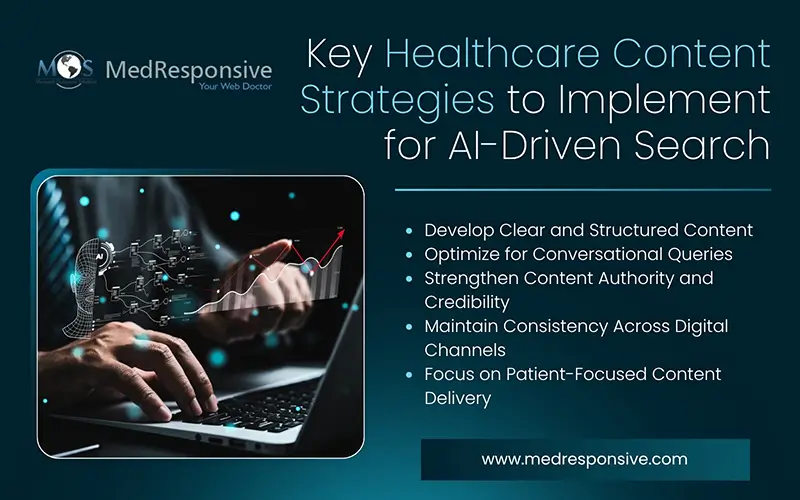
How to Adapt Healthcare Content Strategies for AI-driven Search Landscape
Healthcare content strategies need to evolve as AI transforms how knowledge is discovered and delivered. Content is no longer created solely for search engine rankings but also for AI systems that summarize, interpret, and present answers directly to patients. This requires a more structured, precise, and user-focused approach to ensure visibility and relevance.
- Develop Clear and Structured Content
- Concise headings that clearly define each section
- Short, focused paragraphs that address one idea at a time
- Logical flow that avoids overlapping points
- Consistent formatting to improve readability and indexing
Content should be organized in a way that makes it easy for AI systems to interpret and extract key details. Clarity, logical flow, and well-defined sections improve how material is processed and presented in AI-generated responses. Key structural elements include:
A well-structured approach improves visibility and increases the chances of being included in AI-generated outputs.
- Optimize for Conversational Queries
- Addressing common patient questions directly within the text
- Using natural language instead of rigid keyword placement
- Structuring responses in a clear, easy-to-understand format
- Anticipating follow-up questions within the same topic
- Incorporating long-tail phrases and symptom-based descriptors
- Developing FAQ-style segments to mirror voice-search intent
- Aligning content with the specific stages of the patient journey
As search behavior becomes more question-driven, content should reflect how patients naturally seek guidance. Queries are becoming longer and more specific, including symptoms, concerns, and context in a single search. Key considerations include:
This approach improves alignment with how AI systems interpret and respond to user intent.
- Strengthen Content Authority and Credibility
- Fact-based, well-validated data
- Clear and accurate representation of services and expertise
- Consistency across website and third-party platforms
- Up-to-date messaging that reflects current practices
- Verified clinical authorship or medical review markers
- Direct citations from reputable medical journals or organizations
- Transparent disclosure of healthcare credentials and affiliations
- Secure and privacy-compliant data handling practices
AI systems prioritize resources that appear accurate and trustworthy, especially in healthcare-related topics. Content must reflect reliability through both quality and consistency. Important elements include:
Strong credibility signals improve trust and increase the likelihood of being surfaced in AI-driven results.
- Maintain Consistency across Digital Channels
- Accurate practice names, locations, and contact details
- Consistent service descriptions across platforms
- Updated profiles on directories and listing sites
- Alignment between website content and external data sources
- Standardized terminology for specialized treatments and procedures
- Regular audits of third-party review sites and medical aggregators
AI tools pull facts from multiple sources, including websites, directories, and third-party platforms. Inconsistent information and figures can reduce visibility and create confusion in AI-generated responses. Key components to maintain include:
Consistency strengthens digital presence and improves how AI systems interpret healthcare provider information.
- Focus on Patient-focused Content Delivery
- Clear explanations of conditions, treatments, and next steps
- Simple language that avoids excessive technical terms
- Action-oriented copy that guides patients forward
- Readable formatting that supports quick understanding
- Accessibility features for diverse user needs
- Direct call-to-action for immediate next steps
Content should be designed to address patient concerns clearly and directly, without added complexity. Instructions that are easy to understand improve engagement and support better decision-making. Key elements include:
A patient-focused approach ensures the content remains relevant, accessible, and effective in AI-driven search environments.
Adapting to AI-driven Patient Search Behavior
AI is changing how patient’s access and act on medical information, shifting control from traditional search pathways to systems that deliver direct, filtered responses. For healthcare providers, adapting to this change requires a more strategic approach to content creation and distribution. Partnering with healthcare content marketing services helps ensure that content remains relevant, accessible, and positioned effectively within AI-driven search environments, supporting both patient engagement and long-term digital presence.
Transform how patients find you with smarter healthcare digital marketing strategies.