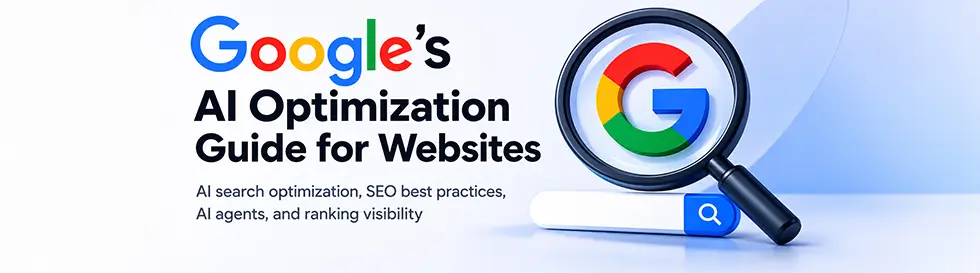
Google published a new AI optimization guide for websites on 15 May, 2026. The documentation outlines the best practices website owners can follow to optimize for generative AI features, such as AI Mode and AI Overviews. This latest page is a consolidation of Google’s existing recommendations for AI-powered search experiences that also clarifies which optimization practices are unnecessary for these features. The tech giant made the following announcement on LinkedIn:
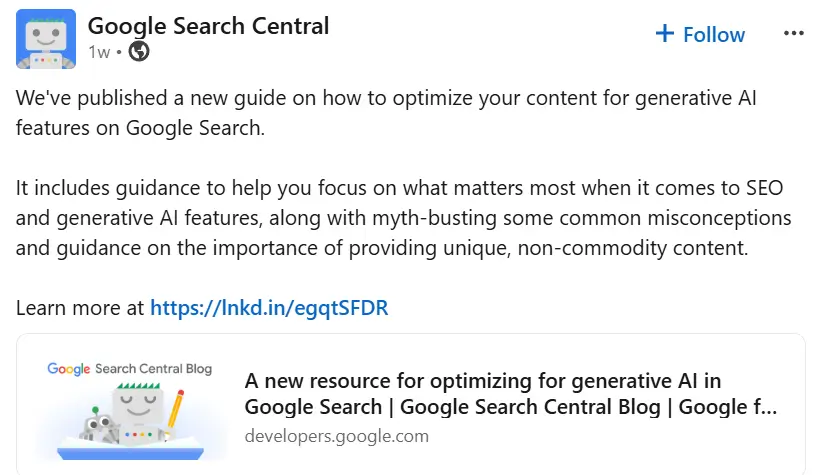
Image source:
The update serves as a new reference point for website owners, digital marketers, and SEO professionals adapting to AI-driven browsing environments.
Google Clarifies AI Search Optimization is Still SEO
In the new documentation guide, Google explains that optimization for generative AI features remains part of standard search engine optimization. The company states that practices described as Answer Engine Optimization (AEO) and Generative Engine Optimization (GEO) are not separate from SEO when applied to Google Search.
“From Google Search’s perspective, optimizing for generative AI search is optimizing for the search experience, and thus still SEO.”
Google states that its AI-powered search features continue to rely on the same core ranking and quality systems used in traditional search. Additionally, they rely on AI techniques given below to surface content from indexed results,
- Retrieval-augmented generation (RAG): Uses information from Google’s search index to generate AI responses supported by relevant and up-to-date webpages.
- Query fan-out: Generates multiple related searches simultaneously to gather additional information relevant to a user’s query.
This means that established SEO fundamentals remain relevant for content appearing in AI-generated result pages.
SEO Best Practices to Follow for AI Search Optimization
The tech giant’s guidance emphasizes creating valuable, non-commodity content that’s helpful, reliable, people-first, and goes beyond common knowledge. It highlights the importance of original insights, practical expertise, and timely information.
- Provide unique, first-hand perspective based on unique experience
- Maintain a clear site structure using paragraphs, sections, and headings
- Add relevant, high-quality videos and images
- Meet the Search technical requirements
- Follow crawling best practices
- Using semantic HTML where appropriate
- Applying JavaScript best practices
- Reduce duplicate content
- Deliver a strong page experience
For local businesses and ecommerce websites, Google also recommends maintaining accurate business information through tools such as Google Business Profile and Google Merchant Center.
What Google Says Website Owners Can Ignore
The guide includes a section that addresses commonly promoted AI search optimization tactics that Google says are not required for its generative AI features.
Google clarified that website owners do not need to:
- Create llms.txt files or separate AI-readable files
- Break content into smaller sections specifically for AI systems
- Rewrite content differently for AI-based search
- Add special schema or markup solely for AI-generated results
- Seek inauthentic mentions or link-building across websites or online discussions
Google notes that its systems can interpret context, language variations, and multiple topics on a page without requiring separate formatting specifically for AI visibility
New Guidance for AI Agents
The documentation also introduces early guidance related to agentic experiences. It describes AI agents as systems that can complete tasks on behalf of users, such as comparing products or making reservations.
Google notes that these systems may interact with websites by analyzing interfaces, reading page structures, and interpreting accessibility elements. The company presents this area as exploratory and primarily relevant for businesses that may benefit from future AI-assisted customer interactions.
Key Takeaway
Google’s new guide brings together its recommendations for AI search visibility into a single reference for website owners and SEO professionals. By clarifying that generative AI optimization remains part of traditional SEO, the company has also addressed several assumptions around newer AI-focused tactics. Businesses working with professional SEO services can better align their content and technical strategies with evolving AI search experiences across the platform.
Future-proof your online presence with SEO strategies built for AI-powered search experiences.