
In modern digital marketing, the debate around content quality vs. content quantity has moved beyond theory into a practical business decision that directly affects visibility, lead generation, and brand credibility. Search engines no longer reward sheer publishing volume, and audiences expect information that is precise, relevant, and immediately useful. Businesses that rely on high output without substance struggle to sustain rankings, while those that publish too infrequently limit their reach across search queries. This has made it essential for content creation services to evaluate how quality and quantity contribute to measurable performance.
A clear pattern has emerged across high-performing websites. Brands that dominate search results do not rely on either extreme. They combine depth with consistency through structured planning and disciplined execution. Understanding how this balance works in practice is critical for building a strategy that delivers sustained results.
Understanding Content Quality and Content Quantity
Content quality reflects how effectively a piece of information satisfies user intent while demonstrating expertise and clarity. It includes depth of explanation, factual accuracy, structure, readability, and alignment with audience needs. High-quality material does more than present information. It anticipates questions, addresses concerns, and guides readers toward informed decisions.
Content quantity refers to the volume and frequency of published material. It determines how widely a website covers topics and how frequently it appears in search results. A higher output increases opportunities for visibility, but only when supported by consistent standards.
This distinction is critical. Quality determines whether material performs. Quantity determines how far that performance can scale.
Content Quality vs. Content Quantity in Real-World SEO Performance
The discussion around content quality vs. content quantity becomes more meaningful when examined through actual performance patterns rather than theory.
Consider two common approaches. One organization publishes dozens of short blog posts each month, each targeting a different keyword with minimal depth. Another publishes fewer but more comprehensive articles built around core topics, supported by internal linking and periodic updates.
The first approach may generate initial impressions due to volume, but most pages struggle to achieve strong rankings. Engagement remains low, and visibility is inconsistent. The second approach produces stronger engagement signals, attracts backlinks, and steadily improves rankings. Over time, these pages capture a larger share of high-intent traffic.
This pattern reflects a broader industry reality. Depth and relevance drive ranking stability, while volume alone rarely sustains visibility.
Why Content Quality Determines Competitive Advantage
Depth Creates Differentiation
High-quality material stands out because it goes beyond surface-level explanations. It provides context, structured insights, and clarity that competing pages fail to deliver.
Stronger Ranking Stability
Search engines prioritize information that satisfies user intent. Pages that provide comprehensive answers maintain rankings more effectively, even as algorithms evolve.
Higher Conversion Potential
Visitors who engage with detailed and relevant material are more likely to take action. Clear and informative writing reduces uncertainty and supports decision-making.
Compounding Returns Over Time
Well-developed articles continue to generate traffic and engagement long after publication. This cumulative effect reduces dependence on constant production.
Where Content Quantity Still Plays a Critical Role
While quality remains central, quantity contributes to growth in specific ways.
Expanding Search Coverage
A broader publishing base increases visibility across long-tail and related keywords, enabling brands to reach users at different stages of the search journey.
Building Topical Authority
Search engines evaluate topic ecosystems, not just individual pages. Publishing consistently within a theme strengthens authority and improves overall ranking potential.
Supporting Internal Linking
A larger library improves internal linking structures, which enhances navigation and distributes ranking signals effectively.
These benefits depend on maintaining a consistent quality baseline. Without it, increased output weakens performance.
Organizations that prioritize output without structure encounter predictable challenges. Articles become repetitive, engagement declines, and search engines struggle to identify authoritative pages. This leads to dilution, where increased volume reduces overall effectiveness. A focused approach that builds depth within specific topics produces clearer signals and stronger results.
The Operational Reality: How High-Performing Teams Balance Both
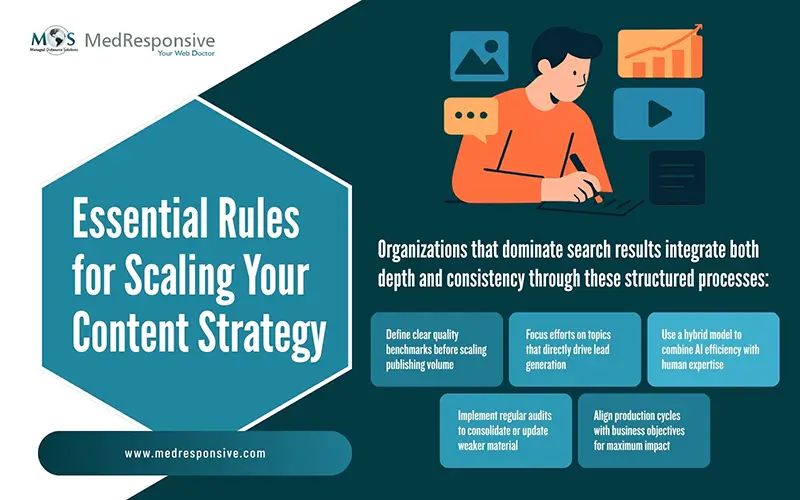
Achieving balance requires structured execution rather than intuition. High-performing teams rely on clearly defined processes that guide both production and quality control. These typically include:
- Topic prioritization based on business objectives
- Editorial standards that define depth, clarity, and structure
- Topic clusters that connect related areas
- Regular performance reviews and updates
This disciplined approach ensures that scaling efforts do not compromise effectiveness. Many organizations rely on SEO blog writing services to maintain this balance while increasing output.
Reasons why Quality Fails to Achieve Expected Outcomes
High-quality material does not always perform as expected. In most cases, underperformance results from misalignment rather than lack of depth. Common causes include:
- Targeting keywords with limited demand
- Misinterpreting search intent
- Weak internal linking
- Lack of integration within a broader strategy
These factors highlight an important principle. Quality must align with strategy to deliver results.
Measuring What Actually Matters
Effective strategies rely on measurable outcomes rather than assumptions.
Indicators of Quality Impact
- Time on page
- Scroll depth
- Backlinks from authoritative sources
- Engagement actions such as inquiries or downloads
Indicators of Quantity Impact
- Growth in indexed pages
- Expansion of keyword rankings
- Increase in organic impressions
- Distribution of traffic across multiple pages
Research from HubSpot and Backlinko shows that comprehensive material generates stronger engagement and backlinks, while consistent publishing supports cumulative growth.
Maintaining both depth and consistency requires significant resources. Businesses must manage research, writing, optimization, and performance tracking in parallel. This complexity has led many organizations to rely on content creation services that provide structured workflows and editorial expertise. These services support scalability without compromising quality.
Content as a Long-Term Asset
Published material delivers the greatest value when treated as an evolving asset rather than a one-time effort. High-performing organizations continuously:
- Update articles with new insights
- Expand coverage to include related topics
- Improve structure and clarity
- Strengthen internal linking
This approach extends lifespan and reduces the need for excessive new production.
The Impact of AI on Content Quality and Scale
AI-driven tools have reshaped production by enabling rapid output at scale. This shift has intensified the discussion around content quality vs. content quantity, as businesses now have the capability to produce more material than ever before.
However, speed does not guarantee effectiveness. AI-generated output can lack depth, context, and originality without proper oversight. It may follow predictable patterns that limit engagement and differentiation.
High-performing organizations integrate AI into structured workflows rather than relying on it entirely. They combine automation with human expertise to ensure accuracy, clarity, and strategic alignment. This approach typically includes:
- Data-driven topic research
- Human-led structuring
- Editorial refinement for tone and accuracy
- Continuous optimization based on performance
Search engines continue to prioritize relevance and usefulness, regardless of how material is produced. As a result, low-value output will not perform, even if generated quickly. This reinforces a critical insight. Technology can accelerate production, but it cannot replace strategic thinking or subject matter expertise.
How to Decide the Right Balance for Your Business
While the principles behind quality and quantity are clear, their application depends on business goals, industry conditions, and available resources. A fixed formula rarely produces optimal results. Organizations need a structured approach to determine how much to publish and how much depth each piece should carry.
Businesses with limited digital presence typically require broader topic coverage to build visibility. In such cases, increasing publishing frequency becomes necessary, but each piece must still meet defined quality standards.
More established organizations benefit more from improving existing pages than simply increasing output. Enhancing clarity, updating insights, and strengthening internal links can lead to measurable ranking improvements.
Industry competition also shapes this decision. In competitive sectors, fewer but more authoritative articles tend to perform better. In less competitive niches, moderate increases in publishing frequency can improve visibility when supported by consistent quality.
Resource availability remains a key factor. When resources are constrained, focusing on high-impact material delivers better outcomes than maintaining high output with inconsistent standards.
Aligning decisions with business objectives ensures measurable impact. Whether the goal is lead generation, awareness, or engagement, strategy must reflect clear priorities.
The Real Answer to the Debate
The debate between content quality and content quantity is not a matter of choosing one over the other. As providers of SEO blog writing services know, it is a matter of execution.
Quality determines whether material builds trust, engages readers, and sustains rankings. Quantity determines how widely that material reaches and how consistently it supports visibility.
Organizations that focus only on output risk producing work that lacks impact. Those that focus only on depth limit their ability to scale. The most effective strategies integrate both elements through structured planning and continuous evaluation.
In a competitive digital environment, success depends on how strategically material is developed, distributed, and refined over time.
Balance quality and consistency to strengthen your digital presence.