
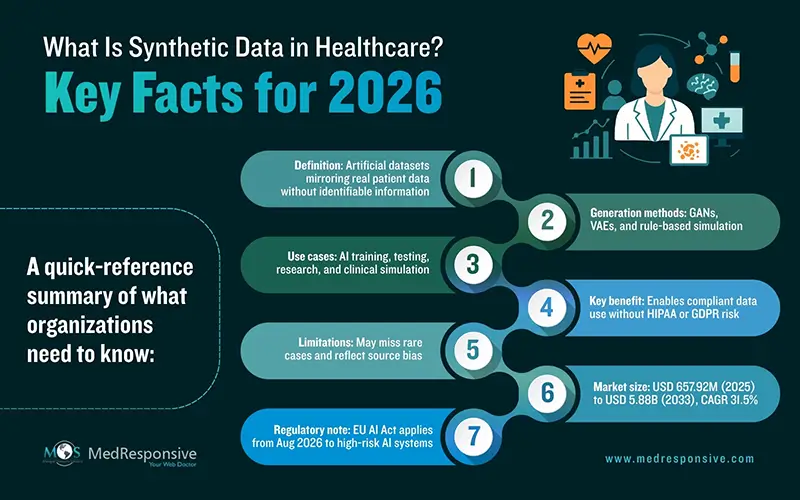
Real patient records are among the most sensitive assets a health system manages. Sharing them for research, testing, or AI model training carries significant legal and ethical risk. Synthetic data in healthcare offers a practical alternative. It refers to artificially generated datasets that replicate the statistical properties of real patient information without exposing any identifiable details. This capability is particularly valuable in EHR application development, where realistic but fictitious records are needed at every stage of the build cycle. According to DataIntelligence, the global synthetic data in healthcare market reached USD 657.92 million in 2025. It is projected to reach USD 5.88 billion by 2033, growing at a CAGR of 31.5%. This trajectory reflects how quickly the sector is embracing privacy-preserving alternatives to real-world clinical records.
How Synthetic Data in Healthcare Is Generated
Artificially generated datasets are not simply fabricated records. They are created using mathematical models trained on real patient data.
The most common generation methods include:
- Generative Adversarial Networks (GANs): Two AI models work against each other. One generates records. The other evaluates their realism. The process continues until the output is statistically indistinguishable from real data.
- Variational Autoencoders (VAEs): These compress real data into a simplified representation and then reconstruct new records from it. The output preserves statistical patterns without reproducing actual patient details.
- Rule-based simulation: Predefined clinical rules and probability distributions generate records that reflect realistic patient profiles. This method is more transparent but less flexible than neural network approaches.
Each method produces output that mirrors the structure, distribution, and correlations of the source dataset. The key distinction is that no real patient can be identified from the result.
Why Healthcare Organizations Use Synthetic Data
The primary driver is privacy compliance. HIPAA in the United States and GDPR in Europe impose strict limits on how patient records can be shared or used. Artificially generated records are not subject to the same restrictions. They carry no personally identifiable information.
This opens several practical use cases:
- AI and machine learning model training: Clinical AI systems require large, diverse datasets to perform reliably. Real patient records are difficult to access at the required scale. These generated datasets provide a scalable, compliant alternative.
- Software testing and quality assurance: Developers building clinical platforms need realistic data to test functionality. Using real records for testing creates unnecessary compliance risk. Generated records eliminate that risk entirely.
- Medical research and collaboration: Researchers at different institutions can share synthetic datasets freely. This accelerates collaborative studies without triggering data-sharing agreements or regulatory approvals.
- Staff training and simulation: Clinical and administrative staff can practice using systems populated with realistic but fictitious patient records. This reduces onboarding risk without exposing real patient information.
The Role of Synthetic Data in EHR Development
Electronic health record systems sit at the center of clinical data infrastructure. Building, testing, and upgrading these systems requires access to realistic patient records at every stage of the development lifecycle.
This is where artificially generated datasets deliver significant operational value.
In EHR application development, developers need realistic records to validate data models, test workflow logic, and assess interface performance. Real patient records introduce compliance complexity at every stage. Synthetic datasets provide the same technical utility without the regulatory overhead.
For organizations investing in EHR development, the ability to run comprehensive testing cycles using privacy-safe records reduces time to deployment. It also lowers the risk of exposing sensitive information during pre-production phases.
Teams delivering EHR services to health systems use synthetic datasets to demonstrate system capabilities to prospective clients. Realistic but fictitious patient records make product demonstrations and proof-of-concept evaluations far more credible than placeholder data.
Limitations and Quality Considerations
Artificially generated records are not a perfect substitute for real clinical data in every context. Several limitations deserve careful consideration.
Statistical fidelity: Generated datasets preserve population-level patterns but may not capture rare clinical events accurately. A dataset trained on a general patient population will underrepresent uncommon conditions. This limits its utility for research focused on rare diseases.
Bias propagation: If the source dataset contains demographic or clinical bias, the generation model will reproduce that bias in the output. The output inherits the limitations of the data they are built from.
Regulatory acceptance: Not all regulatory bodies accept these records as equivalent to real patient data for clinical trial submissions or regulatory filings. Organizations must verify acceptance criteria before building workflows that depend on synthetic substitutes.
Validation requirements: Before using a synthetic dataset in a production context, organizations must validate that it accurately represents the statistical properties of the source population. This validation process requires expertise and adds time to the deployment cycle.
How AI Is Transforming Synthetic Data Generation in Healthcare
Artificial intelligence is not just a use case for synthetic datasets. It is also the primary technology driving advances in generation quality and clinical applicability.
AI-powered generation models now produce records that are statistically indistinguishable from real patient data at a population level. Syntegra, a San Francisco-based company founded in 2019, has built a generation architecture that independent validation studies confirm produces output with statistically indistinguishable properties from HIPAA-protected source data, according to DataIntelo’s 2026 market analysis.
AI-driven bias detection tools evaluate generated outputs for demographic and clinical imbalances before deployment. This adds a quality control layer that was not feasible with earlier generation methods.
AI-assisted validation frameworks compare generated output against source distributions automatically. This reduces the manual effort required to confirm that a generated dataset is fit for its intended purpose.
AI-enabled differential privacy techniques add mathematically calibrated noise to generation models. This provides formal privacy guarantees while preserving statistical utility. It addresses regulatory concerns about re-identification risk more rigorously than earlier anonymization approaches.
The intersection of advanced generation models and AI-driven quality controls is raising the bar for what synthetic datasets can achieve in clinical and research settings.
Regulatory Landscape and Compliance Considerations
The regulatory treatment of artificially generated clinical records is evolving. It is not yet uniform across jurisdictions.
In the United States, the Office for Civil Rights has acknowledged that properly de-identified synthetic records fall outside HIPAA’s definition of protected health information. However, organizations must be able to demonstrate that re-identification is not reasonably possible.
In the European Union, GDPR’s definition of personal data is broad. Synthetic records generated from personal data may still fall within scope depending on the generation method and the risk of re-identification. Organizations operating under GDPR should seek legal guidance before assuming synthetic records are automatically compliant.
The EU AI Act, which begins applying obligations from August 2026, sets data governance requirements for training, validation, and testing datasets used in high-risk AI systems. Organizations using such datasets to train clinical AI tools will need to satisfy these requirements explicitly.
Frequently Asked Questions
1.Is synthetic data in healthcare 100% anonymous?
No generation method can guarantee absolute anonymity. However, well-designed synthetic datasets produced using differential privacy techniques make re-identification extremely unlikely. Organizations should validate privacy risk formally before deploying any generated dataset in a production environment.
2. Can synthetic datasets replace real patient data entirely?
Not in every context. Generated datasets work well for AI model training, software testing, and staff simulation. However, regulatory filings, clinical trial submissions, and research focused on rare conditions still require real patient records in most jurisdictions.
3. Which healthcare organizations are currently using synthetic data?
Pharmaceutical and biotechnology companies, large hospital systems, and contract research organizations are among the primary adopters. These organizations use synthetic datasets to train clinical AI models, run software testing cycles, and accelerate drug discovery workflows without exposing real patient records.
4. How is synthetic data different from de-identified or anonymized data?
De-identified data is derived from real patient records with identifiers removed. Synthetic data is generated algorithmically and contains no real patient records at all. This distinction makes synthetic datasets less susceptible to re-identification attacks than de-identified equivalents.
5. What validation steps are required before using synthetic datasets in production?
Organizations must verify that the generated dataset accurately reflects the statistical properties of the source population. This includes checking distribution alignment, correlation preservation, and bias levels. Validation should be conducted by qualified data scientists before any production deployment.
Understanding Synthetic Data in Healthcare and Its Strategic Value
Synthetic data in healthcare is not a temporary workaround. It is a strategic capability that enables health systems, researchers, and technology teams to work with realistic clinical information without compromising patient privacy. As AI adoption deepens across the sector and regulatory pressure on data use intensifies, the ability to generate, validate, and deploy high-quality synthetic datasets will become a core competency for organizations building the next generation of clinical tools. Providers of EHR services that embed synthetic data capabilities into their delivery frameworks will be better positioned to accelerate deployment, reduce compliance risk, and meet the demands of an increasingly regulated data environment.
From EHR application development to AI-powered data strategy, expert teams are ready to support every stage of the build.
Explore results-driven digital health solutions today.