Healthcare organizations continue to face increasing pressure to improve care coordination, maintain regulatory compliance, and manage growing volumes of patient information. Traditional paper-based records and fragmented information systems create inefficiencies that directly affect clinical workflows and patient outcomes. Within this environment, EHR services have become an essential component of modern healthcare infrastructure, helping providers improve documentation accuracy, streamline administrative processes, and strengthen care continuity. As healthcare technology evolves, organizations increasingly rely on intelligent digital systems, while custom EHR development initiativeshelp providers build more connected and operationally aligned patient care environments.
Why Digital Health Records Matter in Modern Healthcare
Healthcare providers generate and process large volumes of clinical information every day. Patient histories, laboratory reports, prescriptions, imaging results, treatment plans, and billing details require accurate organization and timely access.
Traditional record management methods create several operational challenges:
- Delayed access to patient information
- Increased documentation errors
- Fragmented communication across departments
- Reduced visibility into patient history
- Administrative inefficiencies
Digital health record systems improve how organizations manage information by centralizing patient data and improving information accessibility across departments.
According to the Office of the National Coordinator for Health Information Technology, 96% of non-federal acute care hospitals adopted certified EHRs by 2021, up from just 28% in 2011, reflecting the growing importance of digital documentation systems in care delivery.
This shift demonstrates how healthcare organizations increasingly prioritize connected information ecosystems to improve efficiency and patient outcomes.
EHR Services: Core Functions and Strategic Value
Modern EHR services support much more than digital documentation. They function as integrated healthcare information ecosystems that improve coordination, accessibility, and clinical decision-making.
Core functions generally include:
- Patient information management
- Clinical documentation and charting
- Prescription management
- Laboratory and diagnostic integration
- Billing and claims coordination
- Regulatory compliance support
Healthcare organizations increasingly use digital record systems to strengthen communication between care teams while improving information consistency.
Rather than functioning as isolated repositories, modern clinical platforms improve workflow continuity and support better-informed treatment decisions.
Organizations that invest in scalable systems position themselves to improve operational performance while supporting more coordinated care delivery.
Key Benefits for Providers and Patients
The growing reliance on digital healthcare systems stems from measurable operational and clinical benefits.
Improved Access to Patient Information
Providers gain faster access to clinical records, reducing delays during diagnosis and treatment planning.
Faster information retrieval supports:
- Better treatment continuity
- More informed clinical decisions
- Reduced duplication of medical tests
- Stronger coordination across departments
Enhanced Documentation Accuracy
Digitized clinical records reduce inconsistencies associated with handwritten notes or fragmented documentation systems.
Structured workflows improve:
- Data consistency
- Record accuracy
- Clinical visibility
- Regulatory reporting quality
Better Patient Engagement
Digital healthcare ecosystems increasingly include patient portals that improve communication and information access.
Patients may gain visibility into:
- Test results
- Prescriptions
- Treatment plans
- Appointment schedules
Improved communication strengthens patient participation and supports better care experiences.
Operational Efficiency
Administrative teams benefit from reduced paperwork and streamlined processes.
Benefits include:
- Faster claims processing
- Reduced administrative workload
- Better scheduling coordination
- Improved workflow visibility
Healthcare organizations seeking long-term scalability increasingly prioritize digital care infrastructure to support operational resilience.
Essential Features to Evaluate in Digital Health Record Systems
Selecting the right platform requires careful evaluation of both technical and operational requirements.
Healthcare organizations should prioritize features that support usability, scalability, and compliance.
Interoperability
Systems should support communication between providers, laboratories, pharmacies, and external healthcare platforms.
Interoperability improves:
- Information accessibility
- Care coordination
- Workflow continuity
- Administrative efficiency
Security and Compliance
Healthcare systems manage highly sensitive patient information.
Organizations should evaluate:
- Encryption capabilities
- Access control frameworks
- Audit trails
- Regulatory compliance standards
User Experience and Workflow Design
Poor usability creates inefficiencies and increases clinician frustration.
Organizations should prioritize platforms with:
- Intuitive navigation
- Minimal workflow disruption
- Efficient charting systems
- Reduced administrative burden
Scalability
Healthcare organizations evolve over time.
Systems should support:
- Growing patient volumes
- Multi-location operations
- New integrations
- Expanding service requirements
Analytics and Reporting
Advanced reporting capabilities improve visibility into operational and clinical performance.
Healthcare administrators increasingly depend on insights derived from centralized patient information systems.
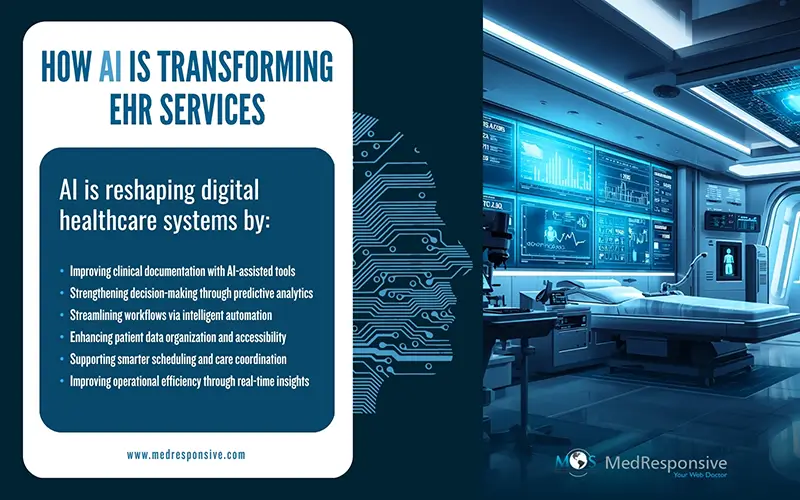
How AI Is Transforming Digital Health Records
Artificial intelligence is changing how healthcare organizations manage patient information and clinical workflows.
Rather than functioning solely as digital storage systems, modern healthcare platforms increasingly incorporate AI-enabled capabilities that improve efficiency and decision support.
AI-Assisted Clinical Documentation
Documentation represents a major administrative burden for healthcare providers.
AI-assisted systems increasingly support:
- Automated note summarization
- Clinical transcription assistance
- Documentation standardization
- Reduced administrative workload
These capabilities help providers spend more time focusing on patient care.
AI-Driven Predictive Analytics
Healthcare organizations increasingly use predictive intelligence to identify risks earlier.
AI-driven systems support:
- Risk stratification
- Readmission prediction
- Treatment optimization insights
- Population health analysis
Intelligent Workflow Optimization
AI-enabled workflows improve operational coordination through:
- Smart scheduling support
- Administrative automation
- Intelligent triage prioritization
- Resource optimization
McKinsey estimates AI could save the U.S. healthcare industry $200–$360 billion annually (5–10% of spending) through productivity gains, operational efficiency, and clinical support, driving widespread adoption among healthcare organizations.
This demonstrates how intelligent technologies increasingly support both administrative and clinical decision-making.
How to Choose the Right Provider
Healthcare organizations should evaluate technology providers strategically rather than focusing solely on cost.
Several criteria deserve careful consideration.
Industry Experience
Providers with healthcare-specific expertise better understand compliance requirements and clinical workflows.
Organizations evaluating custom EHR development initiatives should prioritize teams with proven healthcare implementation experience.
Integration Capabilities
Technology ecosystems rarely operate in isolation.
Organizations should evaluate compatibility with:
- Billing systems
- Laboratory platforms
- Imaging systems
- Telehealth solutions
Security Standards
Patient data security should remain a top priority.
Healthcare organizations should assess vendor capabilities in:
- Data protection
- Compliance readiness
- Access governance
- Infrastructure resilience
Long-Term Scalability
Healthcare needs evolve over time.
Scalable solutions support future operational growth without requiring major platform redesign.
Organizations investing in EHR development should prioritize flexibility alongside technical performance.
Common Implementation Challenges
Despite significant benefits, digital health record adoption introduces operational challenges.
Staff Training Requirements
Healthcare teams require onboarding to adapt to new systems and workflows.
Insufficient training reduces efficiency and adoption rates.
Workflow Disruption
Transition periods may temporarily affect productivity.
Organizations should prepare phased implementation strategies.
Data Migration Complexity
Historical patient information requires careful migration.
Poor migration practices may create information inconsistencies.
Change Management Concerns
Successful adoption depends on organizational alignment.
Leadership teams must communicate objectives clearly and support transition efforts.
Healthcare organizations that proactively address implementation barriers generally achieve stronger long-term outcomes.
Representative Scenarios of Digital Health Record Implementation
Healthcare organizations increasingly explore intelligent record systems to improve care coordination, streamline workflows, and strengthen patient engagement. The following examples illustrate how healthcare providers may use modern digital systems to address operational challenges.
Multi-Specialty Clinic Coordination Scenario
Consider a multi-specialty healthcare clinic seeking to improve communication between physicians, laboratories, and administrative teams. A centralized digital record platform may help consolidate patient histories, diagnostic reports, prescriptions, and appointment records into a unified system.
Potential operational improvements may include:
- Faster access to patient information
- Better coordination across departments
- Reduced duplicate testing
- Improved treatment continuity
This type of implementation may help providers strengthen operational efficiency while improving care consistency.
Hospital Workflow Optimization Scenario
Consider a hospital system managing high patient volumes across multiple departments. An AI-enabled clinical information platform may support appointment coordination, documentation workflows, and patient tracking through intelligent automation and predictive insights.
Potential improvements may include:
- Reduced administrative inefficiencies
- Improved scheduling coordination
- Better visibility into patient records
- Faster documentation workflows
These representative scenarios demonstrate how healthcare organizations may strengthen care delivery through connected and intelligent digital systems.
Future Trends in Digital Healthcare Records
Modern healthcare increasingly depends on connected systems capable of improving care coordination, operational efficiency, and patient outcomes. EHR services continue to play a central role in helping healthcare organizations strengthen documentation, improve accessibility, and support more informed clinical decision-making.
Healthcare technology continues evolving rapidly. Several trends are expected to shape future systems:
- Greater AI integration into clinical workflows
- Improved interoperability standards
- Expanded predictive analytics capabilities
- Increased patient engagement functionality
- Smarter automation across healthcare operations
AI-enabled capabilities continue reshaping digital care environments by improving documentation, predictive analysis, and workflow coordination. Future healthcare ecosystems will increasingly depend on intelligent technologies that improve both provider efficiency and patient experiences.
As healthcare technology advances, providers must evaluate systems not only for functionality but also for scalability, interoperability, and long-term adaptability. Organizations that invest strategically in intelligent healthcare infrastructure and scalable EHR development initiatives position themselves to improve operational performance, strengthen patient experiences, and build more resilient care delivery models for the future.
Frequently Asked Questions
What are EHR services in healthcare?
EHR services refer to digital systems and related support functions used to manage patient medical records, clinical documentation, scheduling, prescriptions, and healthcare workflows through centralized digital platforms.
How do digital health record systems improve patient care?
These systems improve care by providing faster access to patient information, reducing documentation errors, improving coordination between providers, and supporting more informed clinical decisions.
How is AI transforming healthcare record systems?
AI-assisted capabilities improve documentation, predictive analytics, workflow automation, and patient risk identification. AI-enabled systems also help reduce administrative burden and improve operational efficiency.
What features should healthcare organizations prioritize when selecting a system?
Healthcare organizations should evaluate interoperability, compliance readiness, security controls, scalability, usability, and analytics capabilities before implementation.
What challenges arise during implementation?
Common challenges include staff training requirements, workflow disruption, data migration complexity, integration concerns, and organizational resistance to change.