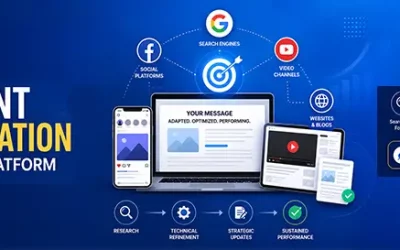
Businesses invest heavily in blogs, videos, white papers, case studies, podcasts, webinars, and social media assets, yet many still struggle to generate measurable business impact. The issue often lies not in content quality, but in distribution. Even highly valuable material produces limited results when it fails to reach the right audience at the right stage of the decision journey through the right channels.
In increasingly competitive digital ecosystems, visibility is no longer driven by publishing volume alone. Sustainable growth depends on how effectively organizations amplify, distribute, personalize, and optimize content across multiple audience touchpoints.
Many businesses continue to assume that publishing alone naturally generates traffic and engagement. However, search engines, social networks, email environments, industry publications, and AI-powered discovery systems operate under significant attention constraints. Discoverability now depends on strategic delivery rather than publishing frequency alone.
For example, a healthcare organization may invest substantial resources creating educational patient materials yet struggle to improve appointment inquiries if those resources never reach prospective patients during key research stages. Similarly, B2B organizations may publish highly valuable reports that fail to influence pipeline growth because distribution remains fragmented and inconsistent.
This distinction explains why high-performing organizations prioritize content distribution strategy alongside content creation itself. Businesses investing in Healthcare Content Marketing and professional healthcare marketing services increasingly recognize that visibility planning, audience targeting, and amplification are essential for sustainable digital growth.
Why Valuable Content Fails without Visibility
Many organizations evaluate success based on publishing output rather than business outcomes.
Publishing more articles or videos does not automatically produce stronger engagement, higher conversion rates, or improved authority. Visibility depends on whether target audiences actually encounter, consume, and interact with information.
Several common issues limit performance:
- Weak audience targeting
- Poor channel selection
- Inconsistent publishing schedules
- Limited repurposing frameworks
- Minimal post-publication promotion
- Lack of audience segmentation
Businesses frequently invest substantial time and resources creating valuable materials only to distribute them through one or two channels before shifting attention elsewhere.
This “publish and forget” model creates inefficiency.
A report may contain strong industry insight, yet without systematic amplification through email campaigns, search optimization, partnerships, social promotion, retargeting, and repurposed formats, its reach remains limited.
Organizations must therefore evaluate distribution as an operational process rather than a promotional afterthought.
Content Distribution Strategy: Why Reach Determines Results
A structured Content Distribution Strategy determines how businesses connect valuable information with relevant audiences across multiple touchpoints.
Rather than asking:
“What should be published next?”
High-performing organizations increasingly ask:
“How will the right audience repeatedly encounter this information throughout the decision journey?”
A strong distribution framework evaluates:
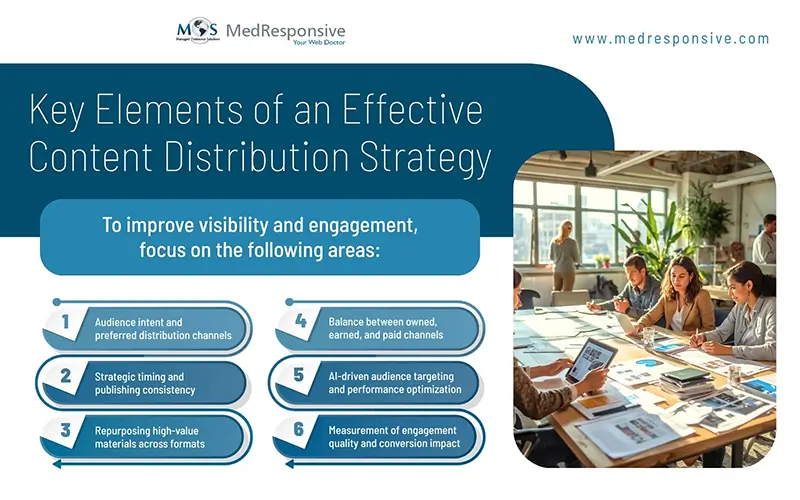
- Audience intent
- Channel effectiveness
- Timing and frequency
- Platform-specific message adaptation
- Engagement quality
- Conversion contribution
- Multi-channel discoverability
For example, a healthcare provider publishing educational resources about chronic disease management may distribute information differently depending on audience segment:
- Email newsletters for existing patients
- Search-optimized educational pages for treatment research
- Short-form educational videos for awareness building
- Paid promotion for localized reach
- Social media snippets for engagement
- Webinar discussions for deeper education
This targeted approach strengthens discoverability while improving audience relevance.
The strongest-performing organizations recognize that value creation and value delivery require equal strategic attention.
The Difference Between Creation and Distribution Economics
Content creation and content distribution operate under different economic realities.
Creation requires investment in:
- Research
- Writing
- Design
- Subject expertise
- Production resources
Distribution determines the return on that investment.
Without systematic amplification, organizations risk underutilizing valuable intellectual assets.
For example:
A company may spend weeks producing an industry report that receives limited engagement because it was shared only through a single announcement.
In contrast, another organization may repurpose the same report into:
- Executive summaries
- Short-form videos
- Email campaigns
- Search-focused articles
- Webinar discussions
- Social insights
- Podcast discussions
- Infographics
This multiplies audience exposure without requiring repeated production investment.
The economic implication becomes clear:
Businesses that prioritize visibility planning improve efficiency by extracting greater long-term value from existing content resources.
Owned, Earned, and Paid Channels: Where Businesses Go Wrong
Effective distribution depends on understanding the distinct roles of owned, earned, and paid channels.
Owned Channels
Owned channels are platforms businesses control directly.
Examples include:
- Company websites
- Email newsletters
- Blogs
- Podcasts
- Customer portals
- Mobile applications
Owned environments help organizations build long-term audience relationships.
Earned Channels
Earned channels involve third-party visibility.
Examples include:
- Media coverage
- Industry mentions
- Backlinks
- Guest contributions
- Public relations exposure
Earned visibility strengthens credibility and authority.
Paid Channels
Paid channels involve financial investment for targeted exposure.
Examples include:
- Search advertising
- Sponsored social campaigns
- Retargeting efforts
- Display advertising
- Influencer partnerships
Problems emerge when organizations depend too heavily on one category.
For example:
- Overreliance on social platforms creates algorithm dependency
- Sole reliance on search limits speed
- Exclusive dependence on paid promotion increases long-term acquisition costs
Balanced diversification improves resilience and visibility stability.
Audience Intent and Channel Alignment
Different audiences consume information differently.
Businesses weaken performance when identical formats and messaging are distributed uniformly across every platform.
For example:
- Executives may prefer concise insights and reports
- Consumers may prefer educational visuals and short-form videos
- Patients researching treatment options may prioritize medically credible guidance
- B2B decision-makers may require in-depth analysis and case studies
This distinction becomes especially important in regulated sectors.
Strong healthcare content marketing depends on understanding patient behavior across awareness, treatment research, provider evaluation, and appointment readiness stages.
Organizations that align messaging with audience behavior improve both trust and engagement quality.
Why Timing and Format Matter More Than Volume
Many businesses assume publishing more content automatically produces stronger visibility.
In reality, timing and format frequently influence performance more than volume alone.
A detailed industry report may underperform when introduced without supporting promotion, while short-form educational assets tied to relevant audience timing may generate significantly stronger engagement.
Businesses should evaluate:
- Audience activity windows
- Platform behavior differences
- Decision-making timelines
- Seasonal demand shifts
- Format suitability by channel
Repurposing becomes especially important.
Instead of continuously producing entirely new assets, organizations can extend visibility through:
- Infographics
- Podcasts
- Video explainers
- Email insights
- Webinar discussions
- Executive summaries
This strengthens efficiency while improving discoverability.
How AI Is Transforming Distribution Strategy
Artificial intelligence is increasingly reshaping how organizations manage visibility, audience targeting, and content amplification.
AI-Assisted Audience Segmentation
AI-assisted systems analyze behavioral signals to identify audience preferences, engagement patterns, and content consumption trends.
This improves targeting precision.
AI-Enabled Personalization
AI-enabled systems personalize delivery based on user behavior, engagement history, and interests.
Different audience groups may receive tailored messaging despite originating from the same underlying content asset.
AI-Driven Predictive Distribution
AI-driven systems forecast which channels, timing windows, and formats are most likely to improve engagement.
This improves efficiency while reducing wasted promotional spend.
As AI-powered search ecosystems continue evolving, organizations increasingly compete not only for clicks but also for visibility within AI-generated answers, recommendations, and summaries.
Research from HubSpot highlights that marketers increasingly use artificial intelligence to improve campaign efficiency and audience targeting. Businesses investing in AI-supported amplification frameworks strengthen long-term discoverability and audience reach.
Common Distribution Mistakes Businesses Make
Several recurring mistakes reduce visibility performance.
Common issues include:
- Prioritizing publishing over promotion
- Ignoring audience intent differences
- Using identical messaging across channels
- Measuring impressions instead of business outcomes
- Failing to repurpose high-performing assets
- Underestimating repeated audience exposure
Many organizations also underestimate the importance of sustained visibility.
One announcement rarely creates measurable business impact.
Repeated exposure across relevant touchpoints improves familiarity, trust, and conversion potential.
Businesses seeking stronger visibility frequently adopt healthcare marketing services and broader digital strategies to improve channel coordination, audience targeting, and long-term engagement.
Building a Repeatable Distribution Framework
Strong visibility systems rely on repeatable processes rather than isolated campaigns.
Organizations should establish a framework that includes:
Audience Prioritization
Identify high-value audience groups and their preferred channels.
Format Diversification
Repurpose valuable assets into multiple formats.
Distribution Scheduling
Coordinate timing based on audience behavior, platform trends, and business objectives.
Performance Measurement
Evaluate:
- Engagement quality
- Lead contribution
- Conversion influence
- Audience retention
- Multi-channel visibility performance
This systematic approach improves efficiency while reducing fragmented execution.
Frequently Asked Questions
1. What is a content distribution strategy?
A content distribution strategy is a structured process for delivering information to the right audience through appropriate channels, formats, and timing. Businesses use coordinated amplification methods to improve visibility, engagement, and conversion outcomes.
2. Why does content distribution matter more than content creation?
High-quality material generates limited results when audiences fail to discover it. Distribution determines reach, discoverability, and engagement quality, helping organizations maximize the value of existing content assets.
3. Which channels are most effective for content distribution?
The most effective channels depend on business goals and audience behavior. Most organizations combine owned channels, earned visibility, and paid promotion to strengthen discoverability and engagement.
4. How can AI improve content distribution?
AI-assisted systems improve targeting, personalization, audience segmentation, predictive delivery, and performance optimization, helping organizations improve visibility efficiency across multiple channels.
5. How frequently should businesses review their content distribution strategy?
Organizations should review performance quarterly at minimum. Businesses operating in highly competitive markets or rapidly evolving industries may benefit from monthly evaluations.
Strategic Takeaway for Sustainable Audience Growth
Businesses should not assume that production alone guarantees visibility or business outcomes. A strong content distribution strategy ensures valuable information reaches the right audience through the right channels at the right stage of decision-making.
Organizations that balance content creation with amplification, audience alignment, AI-driven optimization, and strategic visibility planning strengthen discoverability, improve engagement quality, and support stronger long-term marketing performance.
Strong healthcare content marketing initiatives further strengthen these outcomes by helping organizations deliver relevant information to audiences across multiple decision stages.
Want to improve visibility and maximize the impact of your digital efforts?
Discover how a strong distribution approach can help your business reach the right audience and drive measurable growth.