The digital landscape is shifting from isolated keywords to interconnected concepts. For years, search engines ranked webpages by matching the exact words users typed into a query. SEO strategies focused on keyword placement, density, and variations to improve visibility.
As artificial intelligence reshapes how information is discovered and delivered, algorithms are prioritizing context, relevance, and relationships between concepts. Rather than evaluating pages based on repeated phrases, AI-driven search systems interpret content through entities — clearly identifiable people, brands, locations, technologies, and other distinct concepts.
This evolution forms the foundation of entity-based SEO. Today’s algorithms analyze how entities relate to one another within broader knowledge frameworks. They assess whether your content demonstrates depth, clarity, and topical authority—not just keyword placement.
If your strategy still centers only on keyword optimization, you risk losing competitive positioning in increasingly intelligent search environments. To remain relevant, businesses must structure content around defined entities and the relationships that connect them. Businesses that want to move beyond traditional optimization can rely on SEO consulting services to develop entity-focused SEO strategies that strengthen relevance and support sustainable digital growth.
What Entity-based SEO Is and How It Differs from Traditional Keyword Optimization
Entity SEO is an advanced optimization strategy that focuses on defining and connecting identifiable entities to help interpret context and topical authority. This evolution accelerated with the introduction of Google Knowledge Graph in 2012 — a sophisticated database designed to understand the meaning behind user queries by mapping relationships between billions of entities from trusted sources.
Consider a simple query such as “Apple revenue.” A user may be searching for data about the fruit industry or the financial performance of Apple Inc. A keyword-focused system might deliver mixed results. An entity-driven system distinguishes between these meanings based on contextual relationships and intent. This approach improves accuracy and supports enhanced features such as Knowledge Panels, AI Overviews, and rich results by aligning content with structured entity data.
While data defines entities, modern search ecosystems prioritize the first E in EEAT: Experience. Businesses can publish primary research assets — firsthand insights, original case studies, and proprietary data — to increase the likelihood that AI Overviews and generative summaries select your content. As AI-powered systems synthesize and summarize information, they are more likely to recognize your content as the authoritative source.
Why AI-powered Search Engines Prioritize Entities Over Keywords in Modern SEO
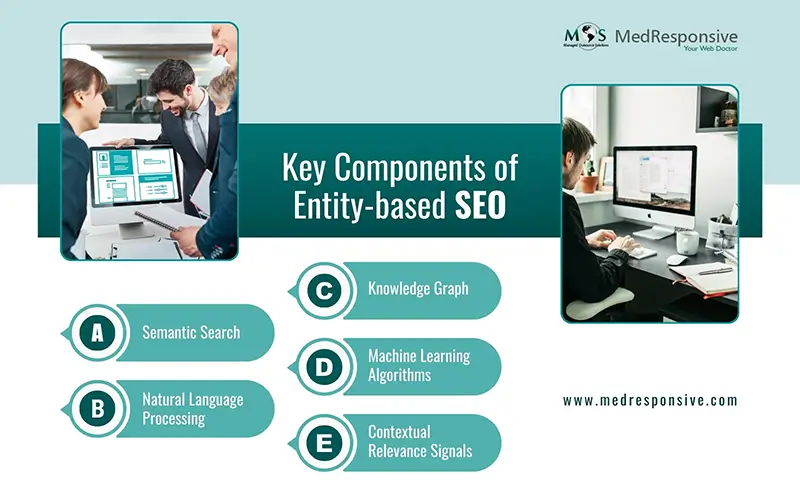
Artificial intelligence has transformed how search engines interpret and rank content. AI-powered algorithms evaluate multiple signals to determine whether your content demonstrates clarity, depth, and topical relevance. The following components demonstrate why entity-based optimization has become central to online performance:
- Semantic Search: Semantic search focuses on understanding the intent behind a query and the contextual relationships between concepts. It connects related terms, synonyms, and associated entities to determine relevance. For example, a query about “cardiac health” may also surface content related to heart disease, cardiovascular treatment, and preventive care.
- Natural Language Processing (NLP): NLP enables search engines to understand how words function within a sentence rather than viewing them as isolated terms. It helps algorithms interpret user intent, sentiment, and contextual meaning.
- Knowledge Graph: Search engines use expansive Knowledge Graph to map entities and their relationships. These connect people, organizations, technologies, and concepts within a structured framework. When your content clearly defines entities and explains how they relate to one another, it aligns with how search engines organize information. This structured clarity improves the likelihood of being recognized as authoritative within a topic.
- Machine Learning Algorithms: Machine learning systems continuously refine search results based on user behavior and engagement patterns. They analyze how users interact with content to determine whether it satisfies intent. Content built around well-defined entities and comprehensive topic coverage signals expertise and reliability.
- Contextual Relevance Signals: AI evaluates how thoroughly a topic is covered by analyzing supporting entities, related subtopics, and contextual depth. Pages that mention interconnected concepts demonstrate a stronger understanding of the subject matter. This broader coverage indicates credibility and relevance, strengthening topical authority.
As AI continues to shape the search ecosystem, businesses that structure their content around interconnected concepts are better positioned to maintain visibility.
Practical Steps to Implement Entity SEO
Implementing entity-based SEO requires a structured and strategic approach that organizes content around clearly defined concepts, relationships, and contextual depth. By aligning your website with how modern search engines interpret entities, you can improve visibility, strengthen topical authority, and remain competitive in AI-driven search environments.
Listed below are key steps to effectively implement entity-based SEO:
- Identify and Define Core Entities
- Determine your primary business entity (brand, organization, or practice)
- Identify core service or product entities
- Map industry-specific concepts connected to your offerings
- Research related entities that frequently appear in authoritative content
- Analyze competitor content to identify coverage gaps
The first step in entity SEO is identifying the primary entities relevant to your business, industry, and audience. These entities may include your brand, services, products, industry terms, technologies, and key topics associated with your expertise.
To define core entities effectively:
Clearly defining these entities ensures search engines can accurately interpret what your website represents within a broader knowledge ecosystem.
- Build Topic Clusters around Entity Relationships
- Developing pillar pages focused on core entities
- Creating supporting content that explores related subtopics
- Linking supporting articles back to the primary pillar page
- Addressing different aspects of the entity, such as benefits, challenges, comparisons and use cases
- Ensuring comprehensive coverage rather than isolated content pieces
Entity SEO requires demonstrating how related concepts connect within a subject area. Creating structured topic clusters strengthens contextual relevance and signals authority.
Best practices for building entity-driven topic clusters include:
This interconnected structure reflects how search engines map entities within knowledge graphs.
- Implement Structured Data and Schema Markup
- Using Organization schema for brand identity
- Adding Service or Product schema where applicable
- Implementing Article schema for blog content
- Including FAQ schema for informational pages
- Structuring local business schema if location-based services are offered
Structured data helps search engines explicitly recognize entities on your website. Schema markup clarifies relationships between people, organizations, products, and services.
Effective schema implementation involves:
Structured data strengthens machine readability and improves eligibility for enhanced search features such as rich results.
- Optimize for Context, Not Just Keywords
- Use semantically related terms naturally within content
- Address broader questions connected to the entity
- Include definitions and explanations of core concepts
- Avoid keyword stuffing or repetitive phrasing
- Focus on meeting user intent comprehensively
Keyword targeting should support entity clarity, not replace it. Content must demonstrate contextual depth and relevance.
To optimize for context:
Search engines prioritize pages that reflect subject matter understanding rather than simple phrase matching.
- Strengthen Internal Linking with Entity Signals
- Linking related content using descriptive anchor text
- Connecting service pages to supporting educational blogs
- Ensuring core entity pages receive the highest internal link value
- Avoiding orphan pages with no contextual links
- Updating older content to reflect new entity relationships
Internal linking plays a critical role in reinforcing entity relationships. Strategic linking helps search engines understand how different pages connect within your site architecture.
Best practices include:
A well-planned internal linking strategy enhances topical authority and crawl efficiency.
- Establish External Entity Validation
- Maintain consistent business information across directories
- Earn backlinks from reputable industry websites
- Publish guest content on authoritative platforms
- Encourage brand mentions in relevant publications
- Monitor brand consistency across online profiles
Search engines evaluate credibility through external signals. References from authoritative sources reinforce entity legitimacy.
To build external validation:
These external references strengthen trust and reinforce your entity’s presence within the broader digital ecosystem.
- Continuously Audit and Refine Entity Coverage
- Identifying content gaps within topic clusters
- Updating outdated materials
- Expanding coverage of emerging subtopics
- Monitoring search performance for entity-based queries
- Analyzing engagement metrics to assess topical relevance
Entity SEO is not a one-time initiative. As search algorithms evolve, content must be updated to maintain authority and relevance.
Ongoing optimization steps include:
Regular auditing ensures your website remains aligned with modern AI-powered search expectations.
Build Online Visibility for an AI-first Future
Search is no longer a system that simply retrieves matching words—it is an environment that evaluates meaning, relationships, and credibility. As AI-driven platforms continue to refine how information is interpreted and delivered, businesses must ensure their content reflects clarity, structure, and subject expertise at every level.
Businesses that utilize professional SEO services gain the strategic direction and technical insight required to implement entity-based optimization effectively. From identifying core entities and structuring topic clusters to implementing schema markup and refining internal linking, experienced SEO professionals ensure that every component of a website supports contextual clarity and search relevance. With a structured, AI-driven approach, these external agencies helps brands to strengthen topical authority, improve website performance, and adapt to evolving AI-powered algorithms.
Partner with our SEO specialists to build smarter, context-driven search visibility.