Today, organizations must stay aligned with emerging application development trends to remain competitive and resilient. Artificial intelligence, cloud-native systems, and cybersecurity transform how teams build and manage modern applications. For business leaders worldwide, these developments directly influence operational efficiency, customer experience, and long-term growth strategies.
Application Development Trends Redefining Digital Transformation
Today’s systems deliver more than raw development speed. They learn from user behavior, scale efficiently, and maintain strong security standards. Leading companies now organize around cross-functional teams that combine business goals with technical execution, delivering measurable results through continuous experimentation and rapid iteration. Business executives now focus on solutions that build agility, strengthen resilience, and create sustainable competitive differentiation.
Here are the key application development trends shaping the future of digital transformation:
- AI-Native and Intelligent Applications
- Generative AI integrated into enterprise workflows
- Predictive analytics driving smarter business decisions
- AI-powered chatbots and virtual assistants enhancing customer service
- Automated code generation accelerating development cycles
AI gives software systems the ability to simulate human intelligence processes like learning, reasoning, and decision-making. In recent years, AI has evolved from experimental innovation to a foundational component of enterprise software. Today, developers design AI-native applications with built-in intelligence rather than adding AI features later as enhancements.
Organizations can now automate complex tasks, improve accuracy, and generate insights without significant manual effort. AI is particularly transformative in customer service, predictive analytics, fraud detection, and workflow optimization.
Key developments include:
AI-native applications enable businesses to analyze large volumes of data in real time, personalize user interactions, and streamline internal operations. For businesses, the strategic value lies in improved productivity, faster decision-making, and scalable innovation. As AI capabilities mature, organizations that embed intelligence into their digital platforms will gain a measurable operational edge.
- Cloud-Native and Multi-Cloud Strategies
- Microservices-based architecture
- Containerization using orchestration platforms
- Serverless computing for cost efficiency
- Multi-cloud and hybrid-cloud environments
Teams build cloud-native applications specifically for cloud environments rather than simply migrating legacy systems to the cloud. Developers design these applications to leverage scalability, elasticity, and distributed computing from the start.
Modern enterprises increasingly adopt multi-cloud or hybrid-cloud strategies to reduce vendor dependency, enhance resilience, and optimize costs. Instead of relying on a single cloud provider, businesses distribute workloads across multiple environments.
Emerging patterns include:
Cloud-native application development improves agility and reliability with faster deployment cycles, seamless scaling during peak demand, and stronger disaster recovery. The cloud drives innovation, geographic expansion, and digital resilience.
- Low-Code and No-Code Acceleration
- Faster prototyping and deployment
- Reduced dependency on extensive coding expertise
- Increased collaboration between business and IT teams
- Lower development costs
Low-code and no-code platforms allow users to create applications with minimal manual coding by using visual interfaces and prebuilt components. These tools broaden application development by empowering non-technical teams to participate in digital innovation.
While traditional software engineering remains critical for complex systems, low-code platforms accelerate development timelines and reduce bottlenecks. They are particularly effective for internal business applications, workflow automation, and rapid prototyping.
Benefits include:
This trend enhances organizational flexibility. Departments can address operational challenges quickly without waiting for long development cycles. Yet strong governance and integration planning ensure scalability and security.
- Cybersecurity-First Development
- DevSecOps practices integrating security into CI/CD pipelines
- Zero-trust security frameworks
- Automated vulnerability scanning
- Enhanced API security
Teams integrate security measures into cybersecurity-first development at every stage of the application lifecycle. Rather than reacting to threats after deployment, organizations proactively design systems to resist attacks.
With increasing data breaches and regulatory requirements, enterprises must adopt structured security frameworks. Developers now embed security into pipelines through automated testing and continuous monitoring.
Important shifts include:
Cybersecurity-first application development reduces financial risk, protects brand reputation, and ensures compliance with evolving regulations. Secure digital systems build trust with customers and stakeholders, making security a core competitive advantage.
- API-Driven and Composable Architectures
- Improved interoperability across platforms
- Faster integration with third-party services
- Greater scalability and flexibility
- Modular, composable application design
An API (Application Programming Interface) allows different software systems to communicate with each other. API-driven development prioritizes creating modular, interoperable systems that can connect seamlessly with external services and internal platforms.
Composable architecture takes this further by allowing businesses to assemble applications from interchangeable components. Instead of building monolithic systems, organizations create flexible ecosystems.
Key advantages include:
This approach enables faster innovation because teams can modify or replace individual components without disrupting entire systems. For companies, composable architectures support rapid adaptation to market changes and emerging opportunities.
- Edge Computing and Real-Time Processing
- Reduced latency
- Real-time analytics
- Improved reliability in remote environments
- Enhanced customer experiences
With edge computing, teams process data closer to where it’s generated rather than relying solely on centralized cloud servers. This approach reduces latency and enhances performance for time-sensitive applications.
As connected devices and IoT technologies expand, real-time processing becomes increasingly critical. Industries that depend on instant data insights benefit significantly from edge computing strategies.
Edge computing supports:
For enterprises, this trend improves operational efficiency and responsiveness. Real-time data enables proactive decision-making, whether in supply chain management, predictive maintenance, or customer engagement.
- Enhanced User Experience (UX) and Human-Centered Design
- Personalization powered by AI
- Voice-enabled interfaces
- Accessibility-first design
- Seamless cross-platform experiences
User experience (UX) refers to how users interact with and perceive an application. Human-centered design prioritizes usability, accessibility, and intuitive interfaces.
Modern consumers expect seamless digital interactions across devices. Developers ensure applications function smoothly on mobile, desktop, and web platforms while maintaining consistent performance.
Trends influencing user experience include:
Investing in superior UX directly impacts customer retention and brand perception. Business leaders increasingly recognize that digital experience quality influences revenue growth and competitive positioning.
- Sustainable Software Development
- Energy-efficient coding practices
- Cloud optimization to reduce resource waste
- Monitoring carbon impact of digital infrastructure
- Sustainable data center strategies
Sustainable software development focuses on minimizing environmental impact through efficient resource usage and responsible infrastructure choices. As environmental concerns shape corporate strategies, organizations treat digital sustainability as an important consideration. Green application development relies on optimized coding practices and energy-efficient cloud usage.
Modern initiatives focus on:
Organizations pursuing ESG commitments achieve long-term responsibility goals through sustainable application development. They reduce operational costs by improving efficiency. Progressive companies now track software’s full lifecycle carbon footprint to prove these gains, from code execution to data storage. This data helps them meet investor expectations and regulatory reporting requirements.
- Data-Driven and Analytics-Integrated Applications
- Real-time dashboards
- Business intelligence integration
- Data governance frameworks
- Predictive modeling tools
Teams build data-driven applications with analytics capabilities embedded at their core. Rather than exporting data to separate systems, businesses integrate dashboards and reporting tools directly within applications.
This approach gives teams faster access to insights and supports evidence-based decision-making at all levels of the organization.
Core advancements include:
Companies embed analytics into strategies, so executives can monitor performance, spot trends, and respond to challenges proactively.
- Custom Application Development Services for Competitive Advantage
- Tailored functionality aligned with business objectives
- Greater scalability and flexibility
- Competitive differentiation
- Seamless integration with existing systems
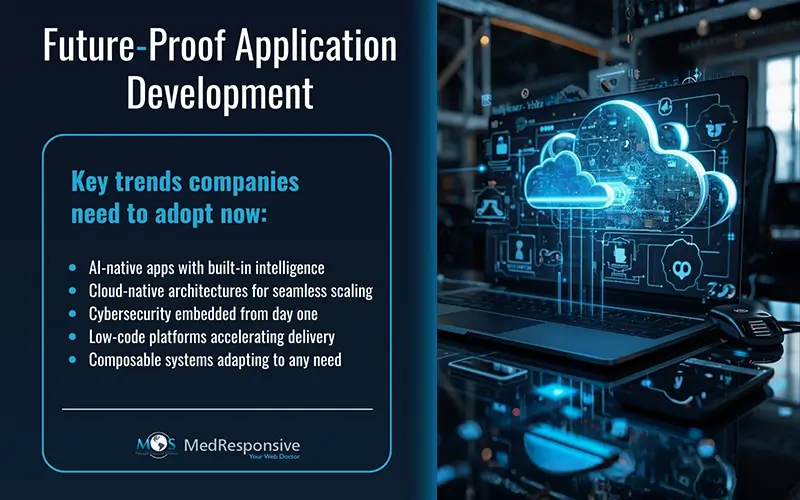
- Invest in AI capabilities to enhance automation and decision-making.
- Adopt cloud-native architectures to ensure scalability and resilience.
- Embed cybersecurity into development processes from the start.
- Leverage custom application development services to create differentiated solutions aligned with business goals.
- Promote cross-functional collaboration between technology and business teams.
- Prioritize user experience and sustainability as core strategic values.
Custom application development services enable businesses to develop software tailored specifically to their processes, goals, and customer expectations. Unlike generic solutions, custom applications address unique business requirements.
As industries grow more competitive, enterprises are increasingly investing in bespoke digital platforms to differentiate themselves. Custom solutions ensure:
These solutions also future-proof businesses against tech disruption. Teams can swap components as new technologies emerge. Leading firms report faster market response times after custom platform adoption. Custom application development ensures strategic alignment between technology and long-term vision. It allows organizations to innovate without constraints imposed by standardized platforms.
Companies must understand these trends and translate them into strategic action. Business leaders set clear objectives, track measurable KPIs, and foster cross-functional collaboration to guide digital transformation.
Teams should evaluate infrastructure, identify modernization opportunities, prioritize high-return investments, and align technology with corporate goals like growth and efficiency.
Actionable Recommendations for Businesses
As digital transformation accelerates, organizations must respond proactively to evolving application development trends. To stay ahead in today’s fast-moving market, business leaders should consider these actions:
Consistent execution across these actions builds lasting competitive advantage and positions companies ahead of rivals.
Turning Awareness into Execution
The future of application development lies in intelligent, secure, and adaptable systems that deliver measurable business value. Organizations that align their strategies with these evolving trends will be better positioned to innovate, grow, and lead in an increasingly digital world. Success now depends on turning awareness into execution by selecting the right trends, building the right capabilities, and moving decisively. Those who act will define the next decade of digital leadership.