The evolving world of search engine optimization (SEO) is driven by the changing algorithms of search engines themselves. Gone are the days when you could stuff a few keywords in to reach Google’s first page. Search engines are going smarter by the day and know how to reward those sites that demonstrate true expertise and thoroughness of a given subject. Because of this, topical authority is now the most important ranking factor for the sites aiming to dominate their niche in SERPs.
Webmasters and digital marketers are trying to figure out the concept of topical authority in SEO and how to implement it to radically improve their visibility online. This blog will help you understand everything you need to know about the topic and why it is more important than ever, and how to build a strategy for SEO success.
What is Topical Authority?
Topical authority is how well your site covers a specific subject or topic — both in depth and in quality.
Think of it as a measure of your expertise on a given subject, shown by your comprehensive coverage of every aspect of that topic with high-quality content.
While domain authority is how credible your site is overall and based on backlinks, topical authority is how much of an expert your site is on a niche / subject. When you have topical authority in search engines, they view your website as trustworthy for that topic and reward you with better rankings for several related keywords.
If your website is about digital marketing and you publish a few random articles, you’ll never quite be seen as an authority. However, if you consistently publish content covering all vital aspects of the topic then there is a high probability that search engines will start to recognize your website as a trusted resource for digital marketing information.
In 2013, Google’s Hummingbird update brought about a major change in search algorithms. Instead of focusing on matching keywords, Google began prioritizing semantics and content relevance. This helped Google in understanding the relationships between topics and subtopics thereby making topical authority as a critical ranking factor.
Why Does Topical Authority Matter?
Topical authority is no longer optional. It is a necessity for SEO success. Search algorithms evaluate semantic search optimization with surprising accuracy. Google AI now understands “relationships between topics, subtopics, and content clusters”.
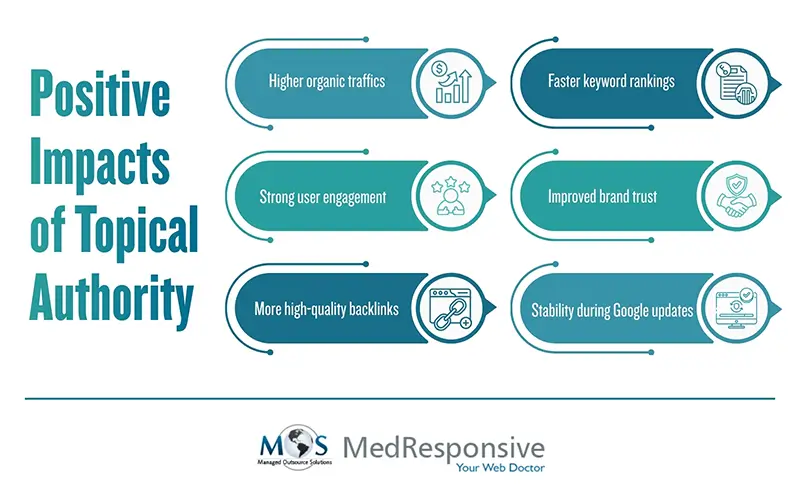
Here are some positive impacts of topical authority:
- More Organic Traffic: When you have topical authority you’re attracting visitors to your website as opposed to sending them off to someone else’s site. The more of an authority you are, the better your rankings, the more rankings, the higher the organic search traffic. Pages with content authority tend to gain meaningful traffic faster than pages that are less topical authoritative.
- Improved Keyword Rankings: Once your site is established as being good on a topic, even brand new content that you publish relative to that topic will rank faster and better.
- Better User Engagement: When visitors to your website find useful information they need, then they tend to stay longer. They won’t have to return to search results for finding other sources. The time spent on site and repeat visits are construed as signals telling search engines that the content on your site is useful, which eventually improves your ranking.
- Improved Brand Reputation: People begin to notice your website when it consistently ranks at top of the search results. They start to trust your brand and view you as an expert in the field.
- More Quality Backlinks: Other websites are more likely to link to content if they see you as an authority. Backlinks boost your domain authority and topical authority.
- Stable when Google updates: Websites with topical authority typically remain stable even if Google releases major updates. It’s because their content is built on true expertise and depth instead of optimization hacks.
How Search Engines Determine Topical Authority
Google doesn’t define topical authority, nor does it provide SEO professionals a way to measure it. But we know search engines assess it based on the following:
- Content Depth and Fullness: Apart from writing in a comprehensive manner, you need to address related queries as well. Doing so gives off an aura of expertise.
- Number of Ranking Keywords: The more keywords around a topic you rank for in general, the greater your authority.
- Internal Link Profile: If you have a strong internal link profile, that it means you probably have lots of different pages related to that topic, which is a signal to search engines.
- Domain Authority: If you happen to have good domain authority in general, you may also have good topical authority. This is because of the quality of links. But the latter is much more granular and is about individual subject areas.
- Freshness and Updates: If you are regularly updating and adding new content, it shows that you stay current with the topic. Search engines appreciate a site that regularly publishes content on its subject matter.
- Author Authority and Reputation: Does your content comply with Google’s E-E-A-T (Experience, Expertise, Authoritativeness, and Trust)? In a nutshell, this means content from recognized experts carries more weight.
The Relationship between Topical Authority and Semantic SEO
Semantic SEO is all about the “meaning” behind searches. Semantic Search Marketing or Semantic Optimization basically refers to a major trend in modern SEO which is giving less focus to exact string matching, and much wider focus in obtaining a thorough, comprehensive understanding of the wider meaning behind a query and addressing it.
- Semantic relationships: It’s not just about base keyword matching, but about the related semantically links, terms, concepts, subjects and entities that can be associated with the main topic. Essential semantic signaling will then help the actual page gain relevance to subtopics which relate to it. For instance, when writing about email marketing, terms like open rates, click-through rates, automation, and segmentation are some of the words and phrases which relate to the topic.
- Entity Recognition: By using entities (people/places/concepts) in association with a topic, helps search engines understand the topical relationship of that concept/entity to the other. Google understands this, so linking to recognized entities will help reinforce a connection to the subject matter at a basic level.
- Contextual relevance: Semantics words are not about using the keywords repeatedly. It is about covering the subject using related terms and concepts in a natural way. You can increase traffic and conversions even in highly competitive niches.
- LSI keywords: Use LSI keywords in a natural way to give context to your content. It helps search engines to understand your subject better.
The combination of topical authority and semantic SEO creates enormous ranking power. That is how search engines work. They understand meaning, not simply keywords.
Building Topical Authority
Here are some pointers that can help you build content authority:
Choose Your Core Topics
Select one or two core topics to build around. Choose areas that align with your business goals and known areas of expertise that your customers generally require. Don’t cover everything. Focus on areas where you can provide the most actual value. Your core topics should be broad enough to have subtopics to attract a strong audience.
For instance, instead of “health” choose “fitness for busy professionals” or “nutrition for athletes.” It is a core topic, but it is also quite broad.
Create Content Clusters and Pillar Pages
Your content needs to have a well-structured framework. It should consist of a pillar page along with cluster content that provide information on subtopics. You then need to inter link each piece and connect back to the pillar page. As the pillar page is the central hub, it must be comprehensive in content with at least 3000 to 5000 words or more. Your next task would be to add 30 to 60 cluster content around it.
A great example of this would be “Complete Guide to Digital Marketing.” You could build articles on social media advertising, campaign ideas and strategies for Email, content marketing, SEO, marketing tools for analytics tools and so on.
Understand and Match User Intent
Google’s algorithms have become smarter and more sophisticated at understanding the search intent of users. Considering this, your content strategy must be able to address if someone is looking for information, looking to make a purchase or searching for a website.
Before creating any content search your intended keyword on Google and assess the type of content that appears. Create content that matches the intent. If the searches are informational then create comprehensive guides and tutorials. If they are in search for a product, then create product pages and comparison articles to help them make buying decisions.
Comprehensive Keyword Research
You need to find every keyword and topic in your niche by conducting a comprehensive keyword research. You need to look for:
- Primary keywords with decent search volume
- Long tail keywords with lower search volume and competition.
- Questions people are asking (e.g. “People Also Ask” sections)
- Related search (terms that appear at the bottom of the results)
- LSI keywords
This in-depth research will help you find all that you need to showcase your expertise in your field.
Produce High-Quality, In-Depth Content
All the content you create must be high quality, well researched and comprehensive. Ensure your content:
- Answers questions thoroughly
- Provides unique insights or perspectives
- Includes examples, case studies, or data
- Is well-structured with clear headings
- Uses multimedia elements like images and videos when appropriate
- Is regularly updated to stay current
Avoid superficial content. Search engines reward websites which offer depth and detail.
Build a Strong Internal Linking Strategy
Internal linking is a highly important factor in building topical authority. All cluster content should interlink each other and include at least one link to the pillar page. This interconnection serves two purposes: it strengthens your content authority and helps Google understand the relationship between the pages.
Avoid using generic linking phrases such as “click here”. Instead, link to descriptive anchor texts with relevant keywords.
Build the Right Backlinks
While content is the foundation of topical authority, being linked to by other authority sites in your niche is key.
Here are some ways to get links from relevant sources:
- Guest blogging on other relevant industry sites
- Linkable assets such as research of your own, or major guides
- When you mention influencers in your content and/or build relationships with them
- HARO (Help a Reporter Out) gives you quality links when you serve as a source
- Turn your knowledge into tools or resources, making linking to them a natural act for others
Link quality matters. One authoritative link from a respected publication has more value than dozens from low-quality sites.
Publish Consistently
You must commit to publish content consistently. Publishing new articles, blogs, updating old content are efforts that strengthen your authority. A content calendar can help you maintain a consistent publishing schedule to support this long term strategy.
Role of Organic SEO Services
Many businesses find that their road to topical authority is smoother and quicker when they seek the help of professionals offering organic SEO services. Quality organic SEO services can aid with technical audits that find things on your site affecting its performance, exhaustive keyword research that reveals opportunities you would have missed, content strategy development drawing on content authority, and link building campaigns that land you quality backlinks from relevant sites.
Organic SEO services promote sustainable, long-term growth, not hacks and fast results. Selecting the right SEO partner is crucial to your business. Choose a firm that prioritizes content quality and has proven track record in providing organic search marketing.
Mistakes to Avoid
As you work towards building topical authority, be mindful of these common mistakes that could jeopardize your efforts:
Topic dilution. It is important to stay focused on your field of expertise. Covering extensive number of topics that are unrelated to your niche can weaken your authority signals.
Thin content. Short, shallow articles will not help build authority signals. Your content should show depth to please humans and search engines. Content-rich articles are far more valuable than short surface skimming articles and tips.
Internal linking. Not connecting your articles through relevant internal linking is another big mistake. Every article should mention and link to relevant pages on your site.
Ignoring updates. Publishing a well written article and neglecting it would reduce its relevance over time. Therefore, it is essential to update your content on a regular basis.
Keyword stuffing. Keywords in SEO do matter; including them selectively in your content is acceptable. But using keywords where they seem unnatural to read can prove to be disastrous. Therefore, use keywords in a natural and diligent manner.
Poor site structure. Search engines may struggle to interpret the main subject of your website if it is poorly structured. It is worth the effort to maintain a well-structured content hierarchy so that content can be grouped in categories.
Topical Authority: Your Path to SEO Success
Topical authority in SEO has become the cornerstone of SEO success. Your website and its pages will win rankings by demonstrating comprehensive knowledge of particular subjects through useful content, internal linking, and sheer consistent effort. The payoff is profound. You will notice improvement in pages rankings, gain of customers and loyal followers, and sustainable growth in the long term.
There are no shortcuts to this strategy. The process takes time and dedication. Reliable providers of organic SEO services will work with you in choosing your topics, constructing detailed content clusters, analyzing search intent of users, and generating valuable content that boosts your ranking.
Boost your website’s authority and visibility with our specialized SEO services.