
Building a digital product is a significant financial commitment, and mobile app development cost remains one of the most scrutinized line items in any technology budget. Industry data puts the median cost of building a custom application at approximately $171,450, a figure that can climb well beyond $300,000 for complex, feature-rich platforms. For startups and growing enterprises seeking custom mobile app development services, this reality demands a structured approach to cost management that does not compromise product quality or long-term scalability.
Reducing expenditure in this domain is not about cutting corners. It is about making disciplined decisions at every phase — from scoping and architecture to team composition and post-launch maintenance. Organizations that approach this systematically consistently deliver better products at lower costs than those that treat budgeting as an afterthought.
Why Mobile App Development Cost Spirals Out of Control
Understanding what drives budget overruns is essential before implementing cost-reduction strategies. The most common culprits include:
- Poorly defined project scope: continuous feature additions mid-build, commonly known as scope creep, are the single largest driver of budget overruns
- Platform indecision: attempting to build for iOS, Android, and web simultaneously without a phased roadmap inflates both cost and timeline
- Hiring mismatches: assembling teams with the wrong seniority balance or redundant skill sets wastes budget at every sprint
- Skipped discovery phases: jumping directly into development without requirement analysis virtually guarantees rework
- Underestimated post-launch costs: ongoing maintenance typically accounts for 15–20% of the original build cost annually, a figure many budgets fail to plan for
Each factor compounds the others. A project that begins without thorough scoping will almost certainly encounter hiring mismatches, extended timelines, and inflated testing cycles.
Start With a Rigorous Discovery and Scoping Phase
The discovery phase is among the highest-leverage investments a business can make before a single line of code is written. While it accounts for roughly 10–15% of the total project budget, organizations that skip or compress it consistently face disproportionate cost increases downstream.
A well-executed discovery phase produces:
- A detailed feature prioritization matrix separating must-have from nice-to-have functionality
- A technical architecture blueprint that prevents costly re-engineering later in the build
- Realistic timeline projections tied to specific, measurable deliverables
- Risk identification covering third-party integrations, compliance requirements, and data handling
- Vendor quote accuracy — organizations that invest in discovery report significantly more accurate bids and fewer mid-project change orders
The discovery investment pays for itself many times over through reduced rework, more accurate vendor quotes, and fewer mid-project scope surprises.
Choose the Right Development Approach for the Budget
One of the most consequential decisions in managing mobile app development cost is the choice between native, cross-platform, and hybrid development.
Native development — separate codebases for iOS and Android — delivers the best performance and deepest platform integration but essentially doubles the development effort and cost.
Cross-platform frameworks such as React Native or Flutter enable a single codebase to run on both major platforms. For the majority of business applications, this approach delivers near-native performance at roughly 30–40% lower cost than equivalent native builds.
Progressive Web Apps (PWAs) represent a further cost reduction option for use cases where a browser-based experience is acceptable, though they carry limitations around device hardware access and app store distribution.
The right choice depends on the product’s core functionality, target audience behavior, and long-term maintenance plans. Making this decision on technical merit — rather than team familiarity alone — is essential for keeping costs controlled.
Build a Minimum Viable Product First
Launching a fully-featured product on the first release is a costly and often unnecessary approach. A Minimum Viable Product (MVP) strategy involves identifying the smallest set of features that delivers genuine value to users and validates the core product hypothesis.
This approach produces several measurable financial benefits:
- Shorter time to market reduces the capital tied up during the build phase
- Real user feedback informs the roadmap before significant investment is made in secondary features
- Investor and stakeholder confidence is easier to build around a working product than a specification document
- Technical debt is minimized because architecture is designed for the validated use case rather than anticipated needs
- App store presence is established earlier, enabling organic discovery and user acquisition to begin while secondary features are still in development
An MVP should not be confused with an incomplete product. It must be functional, well-tested, and capable of representing the brand credibly in the market. The objective is controlled scope, not reduced quality.
How AI Is Transforming the Economics of App Development
Artificial intelligence is restructuring the cost structure of software development in ways that were not possible even two years ago. According to a PwC study, AI-assisted development can improve developer productivity by 20–50%, with 14% of software engineering organizations recording operational cost reductions of 11–19% over a twelve-month period due to generative AI adoption.
Here is how the integration of AI tooling into the development workflow is actively reducing build costs:
- AI-assisted code generation: Tools such as GitHub Copilot accelerate routine coding tasks, reducing hours billed for boilerplate logic and repetitive functions across both Flutter and React Native projects
- AI-powered testing frameworks: Automated test case generation and regression testing reduce QA cycles that traditionally consume 20–25% of project budgets
- AI-driven UI/UX prototyping tools: Wireframe and design variation generation compresses the design phase without sacrificing output quality
- AI-enabled project management: Bottleneck surfacing, schedule risk prediction, and sprint optimization reduce the cost of delays and misaligned priorities
- AI-assisted documentation: Auto-generated technical documentation during development eliminates a phase many teams defer and then pay heavily to reconstruct post-launch
For organizations working with custom mobile app development services, the integration of AI tooling into the development workflow is now a distinguishing factor between providers. Teams that leverage these capabilities consistently deliver faster and within tighter cost bands.
Make Strategic Decisions About the Development Team
Team composition is a primary driver of build cost. The three most common models are in-house teams, nearshore/offshore outsourcing, and hybrid engagement.
In-house teams provide the highest level of control and alignment with business goals but carry the highest fixed costs, including salaries, benefits, equipment, and management overhead.
Offshore teams in Eastern Europe typically charge $35–$70 per hour; South Asian teams range from $25–$45 per hour, compared to the US average of approximately $100 per hour. The trade-off involves time zone coordination, communication overhead, and quality control.
Nearshore models balance cost savings with time zone proximity, offering a practical middle ground for teams requiring regular real-time collaboration.
Key considerations when structuring the team:
- Avoid over-indexing on senior developers for tasks that mid-level engineers handle effectively
- Use specialized contractors for discrete phases such as UI design, security audits, or infrastructure setup
- Define clear communication protocols and milestone-based payment structures for all external engagements
- Consider a hybrid model — in-house product ownership with offshore execution — as a practical balance between control and cost efficiency
The goal is to match skill level and cost to task complexity, not to minimize team size at the expense of output quality.
Leverage Reusable Components and Third-party Integrations
Building every feature from scratch is a significant and often unnecessary cost driver. A mature ecosystem of pre-built components, APIs, and third-party services exists for common functionality. Integrating proven solutions reduces build time and introduces functionality already tested at scale.
Areas where third-party integrations deliver the strongest cost efficiency:
- Authentication and identity management (e.g., Auth0, Firebase Authentication)
- Payment infrastructure (e.g., Stripe, Braintree)
- Push notification delivery (e.g., OneSignal, Firebase Cloud Messaging)
- Analytics and crash reporting (e.g., Mixpanel, Firebase Analytics)
- Customer support and chat (e.g., Intercom, Zendesk SDK)
The build-versus-integrate decision should be driven by whether a feature is a core product differentiator. Commodity features should almost always be sourced externally. A useful rule of thumb: if the feature exists reliably in the market and does not define the product’s competitive advantage, build it only if no integration meets the requirement.
Plan for Post-launch Costs from the Start
A common financial miscalculation is treating the launch date as the cost endpoint. In reality, post-launch maintenance, updates, server costs, security patches, and feature iterations represent a sustained and significant ongoing investment. Industry data consistently shows annual maintenance expenditure running at 15–20% of the original build cost. For a $150,000 project, that translates to $22,500–$30,000 per year in baseline maintenance before any new feature development.
Organizations can reduce long-term costs by:
- Building on scalable cloud infrastructure from the outset to avoid expensive re-architecture as the user base grows
- Writing clean, well-documented code that future developers can maintain without extensive onboarding
- Establishing automated testing pipelines that reduce manual regression effort with each update cycle
- Phasing new features based on data rather than assumption, avoiding investment in functionality users do not adopt
- Negotiating post-launch support into the initial engagement contract, which typically delivers better total cost of ownership than managing maintenance reactively
Partnering with custom application development services that include post-launch support within their engagement model can significantly reduce the total cost of ownership compared to reactive maintenance approaches.
Managing Mobile App Development Cost with Precision
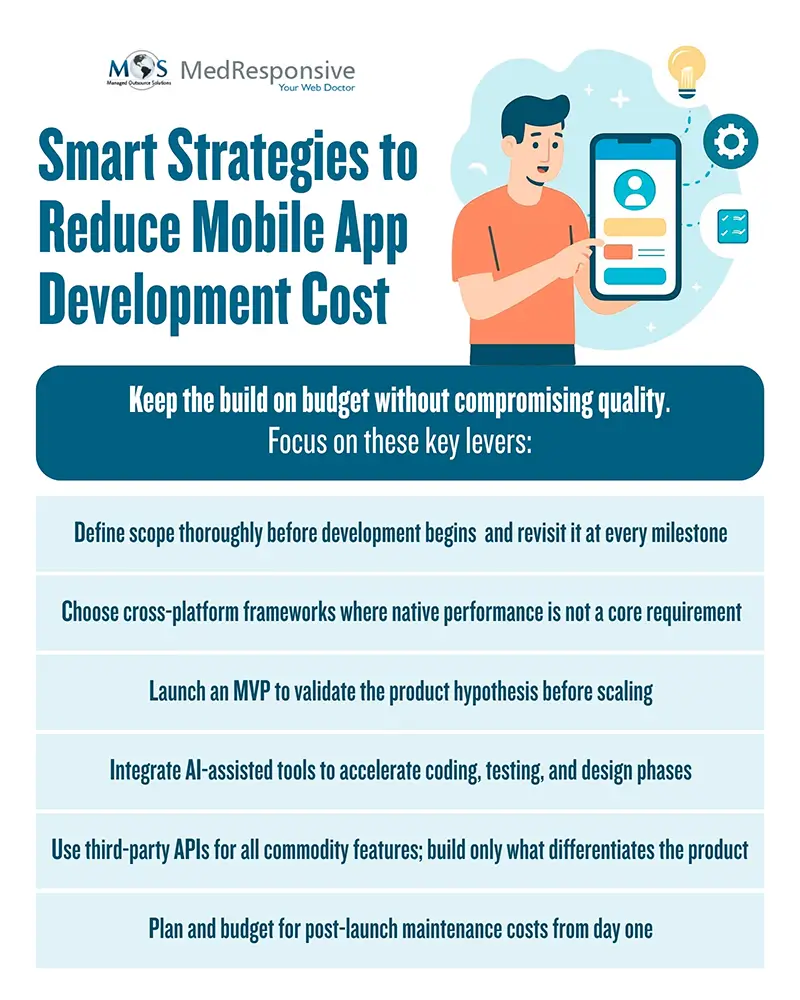
Every organization building a digital product faces the same fundamental tension: delivering a high-quality user experience while managing the financial investment required to do so. Reducing mobile app development cost is achievable, but it requires deliberate decisions at the scoping stage, disciplined scope management during the build, smart team structuring, and AI-powered tooling that compresses timelines without degrading output quality.
The organizations that build well within budget are not those that spend less. They are those that spend more precisely. With the right custom application development services partner and a well-defined strategic framework, it is possible to bring a competitive, scalable product to market at a cost structure that supports sustainable growth.
Optimize your build process with AI-powered tools and expert engineering.
Reduce timelines, control costs, and launch with confidence using our custom mobile app development services.