When it comes to today’s competitive, digital landscape, publishing content is no longer enough to stand out. Modern search engines prioritize content that is structured well, relevant to user intent, and enriched with value. With millions of posts competing for attention each day, SEO writers must understand how to strategically refine and improve their work to achieve meaningful visibility. This is where strong content optimization strategies play an essential role.
According to Dataintelo, the global content optimization as a service market was valued at around USD 4.7 billion in 2024 and is projected reach nearly USD 19.6 billion by 2033. driven by demand for intelligent content and AI-driven solutions.
Whether you are a writer crafting high-performing articles for clients or employed by an agency providing affordable digital marketing services, having a clear understanding of content optimization is the key to boosting search rankings, improving user engagement, and driving organic traffic.
In this post, we share effective content structure tips for higher SEO performance that can transform ordinary content into authoritative, search-optimized assets.
Understanding Content Optimization and Its Importance
Content optimization is the process of refining the quality, structure, relevance, and technical elements of your content so it appeals to both readers and search engines. This ensures that your content aligns with user intent, satisfies search engine expectations, and supports business goals.
Today, AI plays a key role in SEO content optimization by helping marketers create, refine, and optimize content more efficiently and accurately. AI tools analyze search intent, keyword relevance, competitor content, and user behavior to suggest topic coverage, semantic keywords, and content structure. They also help optimize on-page elements like headings, meta descriptions, internal links, and readability. Beyond creation, AI continuously monitors performance and recommends updates, ensuring content stays aligned with search engine algorithms and evolving user expectations. AI content optimization can help you attract the right audience, deliver value, build trust, and drive conversions — not just traffic.
Boost Your Rankings Today
Start Applying Smart Content Optimization Strategies Now!
Contact Us
Core SEO Content Writing Techniques Every Writer Should Follow
Below are the foundational techniques that should be part of every SEO writer’s workflow:-
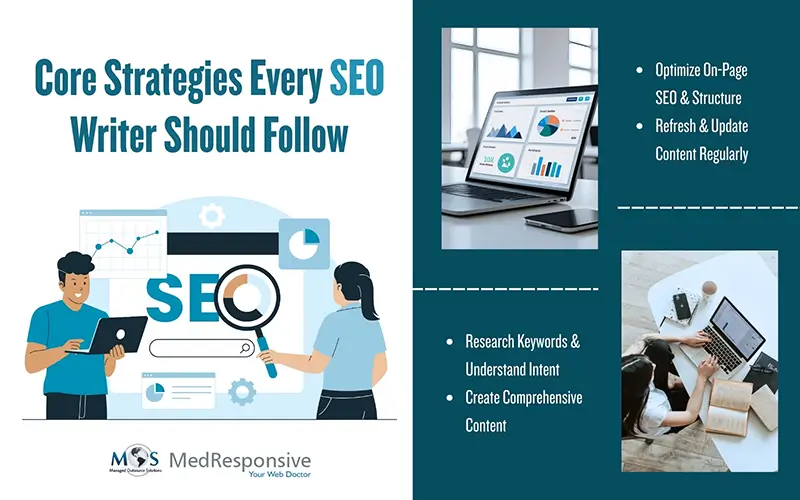
- Research Keywords and Understand Search Intent – Understanding how to research keywords and identify search intent foundational for creating effective SEO content. Before writing, SEO writers must analyze what their target audience groups are actively searching for. Also, you must determine the purpose behind those queries like – whether users want information, comparisons, solutions, or are ready to make a purchase.
Conducting thorough keyword research helps you uncover primary keywords, long-tail variations, and semantic phrases that align with your topic and audience needs. It is important to choose keywords that match your website’s authority level and provide a realistic opportunity to rank. Once selected, these keywords should be used strategically throughout the content — including in the title, headings, introduction, and naturally within the body. Aligning your writing with clear search intent and relevant keywords can ensure your content ranks better and genuinely satisfies user expectations. This ultimately leads to stronger engagement and improved SEO performance.
- Create Comprehensive, In-Depth Content – High-performing pages are often those that cover their topics thoroughly and comprehensively. To create comprehensive content –
- Review top-ranking pages and understand the subtopics they include
- Identify missing angles, questions, or data you can add
- Use H2s and H3s to organize these subtopics
- Include examples, statistics, definitions, steps, or expert insights
Comprehensive content increases your chances of ranking for multiple related keywords while also delivering better user value.
- Focus on On-Page SEO & Content Structure Optimization – Focusing on on-page SEO and strong content structure optimization is essential for creating content that performs well in search engines. On-page SEO involves optimizing key elements such as –
- Title tag and Meta description – Make them informative, concise, and optimized with your primary keyword.
- Headings and subheadings – Use headings to break down topics logically. This supports both readability and keyword variation usage.
- Readability and formatting – Short paragraphs, bullet points, spacing, and simple language help improve user experience and reduce bounce rate.
- Internal linking – Link to existing relevant content on your site to strengthen your site’s structure, improve crawlability, and guide users to additional helpful resources.
- Visual elements – Add images, charts, infographics, or videos to increase engagement and break up long text sections.
By combining strategic on-page optimization with a thoughtful content structure, SEO writers can create high-quality content that is both search-friendly and user-focused, leading to higher rankings and better engagement.
- Refresh and Update Older Content Regularly – Updating content helps maintain relevance, improves search visibility, and boosts ranking potential. It is important to periodically – update outdated information, expand sections with new insights or data, improve formatting, readability, and headings, add new internal links and align content with any evolving search intent. Refreshing content is often one of the fastest ways to gain ranking improvements with minimal effort.
Advanced Strategies for Higher SEO Performance
Once you have mastered the basics, these advanced tactics can help elevate your content even more.
- Build Topic Clusters and Content Hubs – Instead of creating isolated articles, develop clusters of related content centered around a main topic. This improves topical authority and helps users find deeper information easily. Search engines view well-structured clusters as more authoritative, which boosts rankings across your entire content ecosystem.
- Create Shareable, Expert-Backed Content – High-authority content earns backlinks naturally. To attract backlinks and shares –
- Include expert quotes or interviews
- Offer unique insights or original perspectives
- Create visual assets like infographics
- Publish data-backed, research-driven content
- Optimize for Conversions and User Experience – The content should not only attract visitors but also convert them. Therefore, it is important to focus on – strong and relevant calls to action, fast loading pages, mobile-friendly layouts, intuitive navigation and clear value propositions.
This in turn strengthens off-page SEO signals, improving your content’s authority.

Best Content Optimization Strategies for SEO Writers
- Keyword Research & Intent Matching – Effective keyword research ensures you are targeting terms your audience is actually searching for. Matching these keywords to the correct search intent – informational, commercial, or transactional – helps you create content that satisfies user needs. This alignment increases your chances of ranking higher and attracting quality traffic. When keywords and intent are in sync, both search engines and readers find your content more valuable.
- Comprehensive Content Coverage – Covering a topic in-depth helps your content stand out from competitors and improves your chances of ranking for multiple related keywords. Comprehensive content answers all related questions users may have, making your page a one-stop resource. This reduces bounce rates and encourages longer time on page. Search engines reward thorough coverage because it enhances user satisfaction and relevance.
- Optimized On-Page SEO – On-page optimization involves refining elements like title tags, Meta descriptions, headings, and URL structure to ensure SEO clarity. These elements signal to search engines what your content is about, improving indexing and ranking potential. Proper keyword usage in these areas helps reinforce relevance without over-optimizing. Strong on-page SEO makes your content more discoverable and easier for users to navigate.
- Strong Content Structure – A well-organized structure improves readability and helps users quickly scan and understand your content. Using clear headings, subheadings, bullet points, and short paragraphs creates a smooth flow and keeps readers engaged. Search engines also benefit from this clarity, as they better understand the hierarchy and importance of information. Good structure boosts user experience, which directly contributes to better SEO performance.
- Topic Clusters and Internal Linking – Building topic clusters helps you establish authority by connecting related articles around a central theme. Internal links strengthen your website’s structure, guide readers to additional relevant content, and improve session duration. This approach signals strong topical depth to search engines, boosting your overall domain authority. It also helps users easily navigate through interconnected topics, enriching their experience.
- Visual Enhancement – Adding images, charts, infographics, or videos makes your content more engaging and easier to digest. Visuals break up long sections of text and illustrate key points effectively. They also increase the likelihood of social shares, backlinks, and user interaction.
- Content Updates and Refreshes – Regularly updating your content ensures accuracy, relevance, and alignment with current search trends. Refreshing older posts with new insights, examples, or data helps maintain or improve rankings. Search engines prefer fresh content that reflects up-to-date information. This strategy often yields quicker SEO wins compared to creating entirely new articles.
- UX and Conversion Optimization – Optimizing user experience ensures your content is easy to read, navigate, and engage with, leading to lower bounce rates. Fast loading speed, clear formatting, mobile responsiveness, and intuitive design all contribute to better UX. Adding strategic CTAs helps turn engaged readers into leads or customers. Combining SEO with conversion-centered design maximizes both visibility and business impact.

Mastering SEO content writing techniques and optimization is essential for boosting SEO performance. Optimization is not a one-time activity – rather, it is an ongoing process. By consistently improving keyword alignment, structure, readability, depth, and user experience, you can build content that not only ranks but also creates real business value.