Organizations increasingly depend on digital systems to improve operational efficiency, strengthen customer engagement, and support long-term growth. As market expectations evolve, they require software tailored to their specific operational goals rather than standardized platforms. In this context, custom app development has become a strategic priority for companies seeking greater flexibility and competitive differentiation. As adoption expands, organizations investing in AI application development services increasingly seek tailored technology ecosystems aligned with operational priorities. At the same time, artificial intelligence (AI) is transforming how digital products are designed, engineered, tested, and optimized, creating new opportunities for efficiency and innovation across development lifecycles.
Why Tailored Digital Solutions Matter in Modern Business
Businesses across industries face unique operational challenges that generic software may not fully address. Standardized systems support common use cases but may struggle to align with specialized workflows, integration requirements, and customer expectations.
Tailored software solutions help organizations address challenges such as:
- Operational inefficiencies caused by disconnected systems
- Limited scalability in off-the-shelf platforms
- Poor alignment with industry-specific workflows
- Restricted integration with internal technologies
- Limited personalization capabilities for end users
As organizations expand digitally, the need for adaptable technology ecosystems continues to grow. Custom-built systems help businesses improve agility, streamline operations, and strengthen competitive positioning.
Gartner forecasts that 40% of enterprise apps will feature task-specific AI agents by 2026, up from less than 5% in 2025, driving organizations to prioritize AI-enabled software initiatives for productivity and business performance across digital ecosystems.
This shift reflects growing recognition that business requirements increasingly demand tailored technology strategies.
Custom App Development: How AI Is Transforming the Process
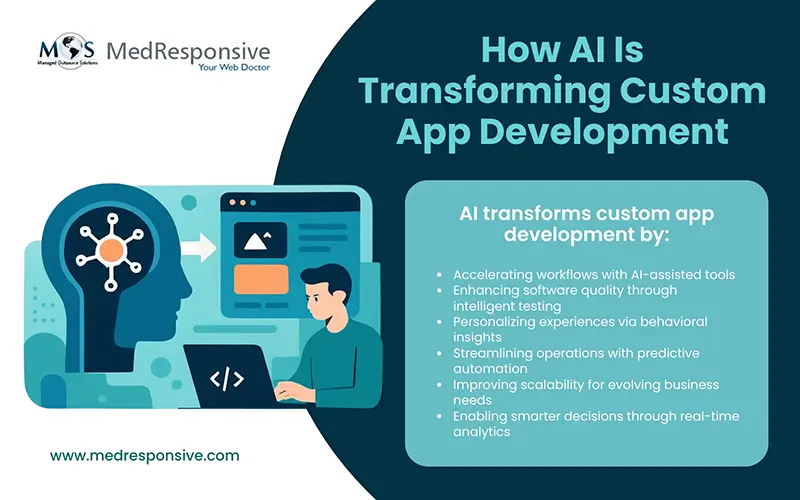
Artificial intelligence is changing how organizations approach custom app development, shifting processes from manual engineering models toward more intelligent and adaptive workflows.
Traditional development lifecycles relied heavily on repetitive coding, manual testing, and extended implementation timelines. AI-assisted systems now support multiple stages of engineering, improving efficiency without reducing the importance of human expertise.
Transformation is visible in several areas:
- Faster code generation through AI-assisted development tools
- Improved defect detection during testing cycles
- Enhanced personalization through behavioral analytics
- Predictive performance monitoring after deployment
- Smarter requirement analysis during planning stages
Rather than replacing engineers, AI-enabled systems improve productivity by reducing repetitive technical effort and improving decision support.
This evolution is reshaping expectations surrounding cost efficiency, scalability, and delivery timelines.
Emerging Trends Reshaping Digital Product Engineering
Artificial intelligence continues influencing how organizations design and deploy tailored digital systems.Several important trends are reshaping the development landscape:
Low-Code and No-Code Expansion
Businesses increasingly adopt low-code environments to accelerate delivery timelines.
These frameworks support:
- Faster prototyping
- Reduced engineering bottlenecks
- Improved collaboration between technical and business teams
While these systems support rapid execution, organizations still require experienced engineers for complex architecture and scalability requirements.
Hyper-Personalized User Experiences
Modern digital systems increasingly use behavioral intelligence to personalize experiences.
AI-driven personalization supports:
- Dynamic recommendations
- Context-aware interfaces
- Predictive user engagement strategies
- Personalized content delivery
This shift improves customer retention and engagement by making digital interactions more relevant.
Intelligent Automation in Operations
Automation capabilities continue expanding beyond workflows into predictive system management.
Organizations now implement:
- Automated monitoring systems
- Predictive issue detection
- Intelligent workflow orchestration
- Data-driven optimization processes
These capabilities improve reliability and operational efficiency across digital ecosystems.
Business Benefits of AI-Enabled App Development
AI integration introduces measurable operational advantages for organizations investing in tailored digital systems.
Faster Delivery Timelines
AI-assisted coding environments reduce repetitive development effort and improve implementation speed.
Engineering teams spend less time resolving routine tasks and more time focusing on architecture and innovation.
Improved Software Quality
AI-driven testing tools identify defects earlier in the lifecycle.
Benefits include:
- Reduced quality assurance delays
- Improved regression testing accuracy
- Earlier vulnerability detection
- Stronger release reliability
Better Decision-Making Through Data
AI-enabled analytics improve visibility into user behavior and platform performance.
This helps organizations:
- Identify friction points
- Improve customer engagement
- Optimize workflows
- Strengthen strategic planning
Enhanced Scalability
Modern systems increasingly adapt to changing operational requirements without requiring extensive redesign.
Scalable architecture supports business growth while reducing long-term infrastructure constraints.
The Role of AI Across the Development Lifecycle
Artificial intelligence no longer functions as an isolated enhancement. It increasingly shapes the entire engineering lifecycle.
Requirement Analysis
Planning traditionally depended on manual requirement gathering and documentation.
AI-enabled systems now support:
- User behavior analysis
- Requirement prediction
- Workflow mapping
- Feature prioritization
This improves planning precision before engineering begins.
Coding Support
Development teams increasingly use AI-assisted coding tools capable of:
- Suggesting optimized code structures
- Detecting syntax issues in real time
- Improving development speed
- Supporting documentation workflows
These capabilities improve efficiency while maintaining engineering oversight.
Testing and Quality Assurance
Testing environments increasingly incorporate intelligent automation.
Capabilities include:
- Automated defect detection
- Predictive bug identification
- Security vulnerability scanning
- Performance optimization insights
AI-driven testing reduces manual effort while improving reliability.
Maintenance and Optimization
Post-deployment optimization benefits significantly from predictive intelligence.
Systems now support:
- Real-time performance monitoring
- Predictive maintenance alerts
- User engagement analysis
- Infrastructure optimization recommendations
This improves long-term stability and performance consistency.
McKinsey’s 2025 State of AI survey shows 88% of organizations regularly use AI in at least one business function (up from 78% last year), yet nearly two-thirds have not begun scaling enterprise-wide, driving continued investment increases for productivity, automation, and decision-making. The growing adoption of intelligent systems demonstrates how AI increasingly influences enterprise technology strategy.
Challenges Associated with AI Integration
Despite clear benefits, organizations face several implementation challenges.
Data Quality Concerns
AI performance depends heavily on high-quality datasets.
Incomplete or inaccurate information weakens prediction accuracy and system reliability.
Integration Complexity
Organizations must ensure compatibility with existing infrastructure.
Legacy systems frequently require architectural adjustments before integration becomes feasible.
Security and Privacy Risks
AI-enabled systems process substantial amounts of operational and behavioral data.
Businesses must prioritize:
- Data governance frameworks
- Access control mechanisms
- Compliance requirements
- Cybersecurity protocols
Skill Gaps
Organizations increasingly require professionals capable of managing both engineering and AI-related workflows.
Investment in technical expertise remains essential for successful implementation.
Industry Adoption across Business Sectors
AI-enabled tailored software solutions now support organizations across multiple industries.
Retail
Businesses improve personalization, customer engagement, and inventory intelligence.
Finance
Financial institutions strengthen fraud detection, transaction monitoring, and operational automation.
Manufacturing
Organizations improve predictive maintenance and supply chain coordination.
Healthcare
Healthcare organizations increasingly invest in intelligent digital systems that improve patient communication, operational efficiency, and care coordination. Teams involved in application development support organizations seeking advanced healthcare experiences, while providers specializing in custom application development services help enterprises create scalable, regulation-aware technology ecosystems.
Representative Scenario of AI in Tailored Digital Systems
Organizations across industries increasingly explore AI-enabled technologies to improve operational efficiency, strengthen user experiences, and optimize workflows. The following example illustrates how tailored digital systems may support business objectives when aligned with operational requirements and supported by intelligent automation.
Consider a retail company operating across multiple channels that implements an AI-assisted recommendation engine within its digital platform to improve customer engagement. Instead of relying on generic product suggestions, the system analyzes browsing behavior, purchase history, and seasonal preferences to generate more relevant recommendations.
Potential business improvements may include:
- Better product discovery
- Higher customer engagement levels
- Improved inventory visibility
- More relevant purchasing experiences through behavioral insights
This type of implementation demonstrates how AI-enabled personalization may improve customer interactions while supporting stronger digital commerce outcomes.
Future Outlook for AI-Driven Software Engineering
Artificial intelligence will continue reshaping engineering priorities in the coming years.
Several developments are expected to influence future strategies:
- Increased automation across engineering workflows
- Smarter predictive maintenance systems
- Greater personalization capabilities
- Expanded use of generative AI in coding environments
- Stronger integration between analytics and product design
The evolution of intelligent technology is changing how organizations design, deploy, and optimize digital platforms. Custom app development increasingly reflects a shift toward smarter, more adaptive engineering models where AI-assisted workflows improve speed, quality, and operational efficiency.
As AI-enabled capabilities continue advancing, organizations will increasingly depend on intelligent application development strategies to create differentiated digital experiences that support growth, innovation, and long-term competitiveness. Organizations investing in adaptive technology ecosystems will likely gain advantages in efficiency, scalability, and customer engagement. However, long-term success depends on balancing automation with human expertise for strategic decision-making and architecture planning.
Frequently Asked Questions
1. How is AI changing custom software engineering?
AI improves engineering efficiency by supporting coding, testing, personalization, and predictive maintenance. AI-assisted systems reduce repetitive technical effort while improving speed and software quality.
2. What industries benefit most from tailored digital systems?
Industries such as healthcare, finance, retail, logistics, and manufacturing benefit significantly because tailored technology solutions align with specialized workflows and operational requirements.
3. Does AI replace software developers in custom projects?
No. AI improves productivity by supporting repetitive tasks and technical analysis. Human expertise remains essential for architecture decisions, business strategy, governance, and user experience planning.
4. What are the benefits of AI-assisted software development?
Key advantages include faster implementation timelines, improved quality assurance, predictive analytics, stronger personalization, and better operational scalability.
5. How should businesses decide whether tailored software is the right choice?
Organizations should evaluate operational complexity, scalability requirements, integration needs, and long-term business goals. Tailored digital systems are particularly valuable when generic platforms cannot support specialized workflows.
Leverage AI-driven custom app development to build smarter, scalable digital solutions for your business.