
Healthcare organizations increasingly depend on digital visibility to attract patients, strengthen trust, and support long-term engagement. Yet sustainable search performance rarely depends on publishing more pages alone. Many providers struggle because their digital ecosystem fails to address patient intent across the full healthcare journey.
This makes content gap analysis for healthcare websites an essential strategic process for identifying missing information, underrepresented services, and visibility weaknesses that limit patient acquisition.
As competition intensifies across hospitals, specialty practices, clinics, and telehealth providers, organizations must align digital resources with patient expectations, search intent, and business objectives. This becomes especially important for providers investing in healthcare digital marketing services and long-term healthcare content marketing initiatives.
Patients rarely make healthcare decisions immediately. Most individuals move through a multi-stage research journey involving:
- Symptom evaluation
- Treatment comparison
- Provider research
- Insurance considerations
- Trust assessment
- Appointment readiness
When healthcare organizations fail to support these pathways, visibility declines and patient engagement opportunities weaken.
For example, a clinic specializing in orthopedic treatment may rank well for branded searches while failing to appear for informational searches related to:
- Recovery expectations
- Treatment eligibility
- Non-surgical alternatives
- Rehabilitation guidance
These informational gaps reduce discoverability among high-intent audiences.
For healthcare providers, identifying missing coverage is not simply a search optimization exercise. It is a strategic process tied directly to patient education, digital trust, and conversion performance.
Why Information Gaps Reduce Visibility and Patient Trust
Healthcare search behavior differs significantly from traditional consumer browsing.
Patients actively seek reliable, medically credible information before making healthcare decisions.
When organizations fail to address relevant patient questions, several issues emerge:
- Reduced visibility for symptom and treatment searches
- Lower trust due to incomplete educational resources
- Weak engagement during early research stages
- Lost appointment opportunities to competing providers
- Fragmented digital experiences across treatment pathways
For example, a dermatology clinic may rank for treatment pages but fail to provide supporting educational information addressing:
- Procedure candidacy
- Side effects
- Recovery expectations
- Alternative treatments
This absence weakens trust and increases abandonment during patient research.
Search engines increasingly prioritize expertise, authority, trustworthiness, and helpfulness when evaluating healthcare information quality.
Organizations that overlook informational depth may struggle to maintain visibility despite strong clinical services.
This makes strategic digital evaluation essential not only for rankings but also for improving patient decision-making.
Content Gap Analysis for Healthcare Websites: A Strategic Framework
A structured content gap analysis for healthcare websites requires organizations to evaluate visibility from the perspective of:
- Patient intent
- Service-line coverage
- Search demand
- Competitive positioning
- Conversion readiness
rather than focusing on keyword presence alone.
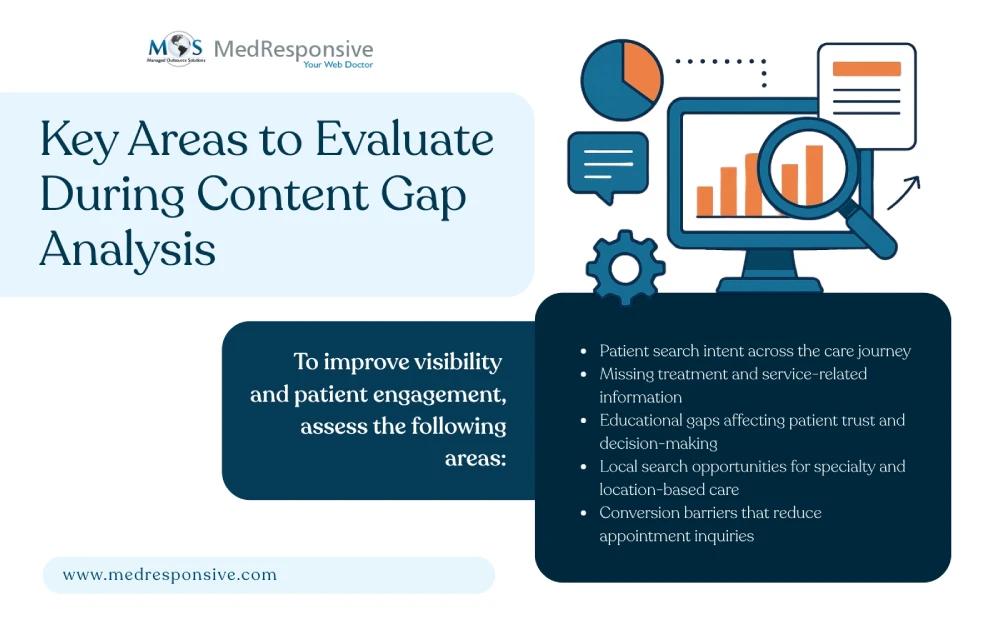
A practical framework includes evaluating:
- Missing patient education pathways
- Incomplete service-line visibility
- Search intent mismatches
- Local treatment-related opportunities
- Conversion-stage informational barriers
- Competitor visibility strengths and weaknesses
Healthcare organizations frequently make the mistake of reviewing only existing pages without evaluating what prospective patients actively search for.
For example, a cardiology practice may publish extensive procedural information yet overlook educational resources related to:
- Warning symptoms
- Prevention strategies
- Diagnostic preparation
- Treatment comparisons
These omissions reduce discoverability during earlier stages of patient decision-making.
A structured framework helps organizations identify where visibility loss originates and prioritize opportunities with the greatest patient acquisition potential.
Why Search Intent Matters More Than Keywords Alone
Modern healthcare visibility depends increasingly on intent alignment rather than keyword repetition.
Search engines now evaluate whether content genuinely helps users solve problems, answer questions, and navigate healthcare decisions.
Healthcare organizations therefore benefit from understanding:
- Informational intent
- Local treatment searches
- Appointment-stage queries
- Research-driven patient behavior
- Trust-building information needs
Organizations focusing exclusively on keyword placement without addressing real patient concerns frequently struggle to sustain visibility.
Strong healthcare content marketing strategies improve discoverability by aligning medically credible information with patient expectations throughout the care journey.
Map Patient Search Intent Before Evaluating Existing Pages
Healthcare organizations frequently begin audits by reviewing current website materials.
This approach creates blind spots because it evaluates internal priorities instead of actual patient needs.
A stronger process starts with intent mapping.
Patients typically search across several stages.
Symptom Awareness Stage
Searches often focus on symptoms and health concerns.
Examples include:
- Causes of persistent fatigue
- Signs of sleep apnea
- Knee pain treatment options
Treatment Research Stage
Patients compare procedures and care pathways.
Examples include:
- Surgical versus non-surgical treatment
- Recovery expectations
- Treatment eligibility criteria
Provider Evaluation Stage
Patients compare specialists and facilities.
Examples include:
- Specialist qualifications
- Success rates
- Location convenience
- Insurance compatibility
Appointment Decision Stage
Patients seek scheduling information and trust validation.
Examples include:
- Consultation availability
- Reviews and testimonials
- Contact information
Healthcare organizations that fail to support these stages create discoverability gaps long before patients reach appointment readiness.
Identify Missing Clinical, Service, and Local Search Coverage
Healthcare visibility depends on more than procedure pages.
Organizations should evaluate whether they address:
Clinical Education Gaps
Patients require medically accurate educational resources to support informed decisions.
Examples include:
- Treatment preparation guidance
- Post-procedure expectations
- Diagnostic explanations
- Eligibility considerations
Service-Line Visibility Gaps
Organizations frequently emphasize high-revenue specialties while overlooking supporting services that attract earlier-stage searches.
For example, an orthopedic practice may prioritize surgery pages while neglecting:
- Rehabilitation services
- Preventative care
- Pain management education
Local Discovery Gaps
Patients frequently search using geographic modifiers.
Examples include:
- Pediatric clinic near me
- Urgent care in [city]
- Dermatologist accepting insurance nearby
Organizations that overlook localized search behavior reduce visibility for high-intent audiences.
Analyze Competitor Visibility Without Copying Competitor Strategy
Competitor evaluation should focus on identifying opportunity gaps rather than imitation.
Healthcare organizations should assess:
- Which treatment topics competitors cover
- Educational depth across specialties
- Local search visibility strengths
- Patient question coverage
- Trust-building informational resources
The objective is not replication.
Instead, organizations should ask:
“What patient needs are competitors serving that remain underrepresented within existing digital resources?”
This distinction matters because blindly copying competitors leads to repetitive and undifferentiated positioning.
High-performing organizations identify overlooked educational opportunities and create stronger patient-centered experiences rather than duplicating existing approaches.
Evaluate Patient Journey Friction and Conversion Gaps
Search visibility alone does not guarantee patient acquisition.
Healthcare organizations must also evaluate whether informational gaps exist between discovery and conversion.
Common friction points include:
- Missing provider qualification details
- Limited treatment explanations
- Weak appointment pathways
- Insufficient insurance information
- Poor service navigation
For example, a patient researching physical therapy may abandon the process if treatment expectations remain unclear or appointment instructions are difficult to find.
Healthcare providers must therefore evaluate informational completeness through both discoverability and conversion readiness.
This becomes especially important for elective procedures where patient hesitation is higher and decision cycles are longer.
How AI Is Transforming Gap Identification in Healthcare
Artificial intelligence increasingly improves how healthcare organizations identify visibility weaknesses and patient intent opportunities.
AI-Assisted Search Pattern Analysis
AI-assisted systems evaluate large search datasets to identify recurring patient questions, symptom clusters, and emerging treatment interests.
This improves visibility planning while reducing manual research effort.
AI-Enabled Topic Discovery
AI-enabled tools identify underrepresented patient concerns across treatment journeys.
For example, systems may reveal growing demand for educational resources related to:
- Post-treatment recovery
- Preventative care
- Chronic disease management
AI-Driven Competitive Benchmarking
AI-driven systems compare visibility performance across healthcare providers and identify areas where organizations underperform relative to competitors.
This helps providers prioritize opportunities based on measurable demand rather than assumption.
As search ecosystems continue evolving through AI-enhanced discovery systems, healthcare organizations increasingly benefit from AI-supported visibility planning.
Google continues to expand AI capabilities across search experiences, influencing how informational relevance is evaluated.
Common Mistakes Healthcare Organizations Make
Healthcare providers frequently reduce digital evaluation to surface-level keyword comparison.
Common mistakes include:
- Prioritizing keywords over patient intent
- Ignoring educational search behavior
- Focusing only on service pages
- Copying competitors rather than identifying opportunity gaps
- Neglecting conversion-stage informational needs
These issues reduce discoverability and weaken long-term patient acquisition efficiency.
Many providers improve digital performance through healthcare digital marketing services that align visibility strategy with patient intent and treatment-specific demand patterns.
Similarly, strong healthcare content marketing initiatives improve authority by delivering medically relevant educational experiences that support patient trust and informed decision-making.
Turning Findings into a Prioritized Action Plan
Healthcare organizations should avoid treating visibility gaps as isolated observations.
Instead, findings should be prioritized strategically.
High Priority
- Missing high-intent treatment topics
- Weak appointment-stage resources
- Local visibility weaknesses
Medium Priority
- Educational enhancements
- Supporting treatment content
- Provider trust-building resources
Long-Term Opportunities
- Emerging treatment interests
- Seasonal healthcare demand shifts
- Preventative care education
A prioritized approach improves resource allocation while reducing fragmented execution.
Frequently Asked Questions
What is content gap analysis for healthcare websites?
Content gap analysis for healthcare websites is the process of identifying missing or underrepresented information that patients actively search for throughout the healthcare journey. The objective is to improve discoverability, strengthen trust, and support higher conversion potential.
Why is content gap analysis important for healthcare providers?
Patients frequently research symptoms, treatments, providers, and facilities before scheduling appointments. Organizations that fail to address these informational needs often lose visibility and patient acquisition opportunities.
How frequently should healthcare organizations perform a content gap review?
Most organizations benefit from evaluations every six to twelve months. Competitive specialties and rapidly evolving service lines may require quarterly reviews.
Can AI improve content gap analysis for healthcare websites?
Yes. AI-assisted systems identify emerging search behavior, patient intent patterns, underrepresented topics, and competitor opportunities more efficiently than manual analysis alone.
What are the biggest mistakes healthcare organizations make during content gap analysis?
Common mistakes include focusing only on keywords instead of patient intent, overlooking educational needs, neglecting local visibility opportunities, copying competitors, and failing to address conversion-stage informational requirements.
Strategic Takeaway for Long-Term Healthcare Visibility
Healthcare organizations cannot improve visibility through publishing volume alone.
A structured content gap analysis for healthcare websites helps identify missing patient education pathways, service-line weaknesses, conversion barriers, and discoverability gaps that reduce patient acquisition.
Organizations that align digital resources with patient intent, strengthen trust-building information, and incorporate AI-driven visibility insights position themselves for stronger long-term performance and sustainable growth.
Strong healthcare content marketing strategies further support this process by helping providers address patient concerns with credible, medically relevant information across the care journey.