Smartphones and wearable technologies have surged, making mobile apps essential across industries. Staying updated with the latest trends in mobile application development helps businesses build secure, user-friendly apps that meet evolving customer expectations and technology standards. From artificial intelligence to cross-platform technologies, new trends define the future of app creation and usability, setting new standards for performance, personalization, and reliability.
Build Smarter Apps.
Partner with our experts for cutting-edge mobile app development.
Latest Trends in Mobile Application Development: Key Drivers
Developers must build apps that anticipate user needs. These demands push rapid adoption of cutting-edge solutions across the industry. Companies embracing these changes deliver superior experiences that drive loyalty and growth. Here are the latest developments in the field that are optimizing outcomes:
Artificial Intelligence and Machine Learning Integration
Artificial intelligence (AI) remains the foundation of many current and future mobile app innovations. Developers now widely adopt AI-driven features such as adaptive algorithms, speech recognition, and image classification.
Several popular apps use AI effectively:
- Spotify curates playlists based on a listener’s habits using machine learning
- Google Maps adjusts route suggestions with real-time traffic and behavioral data
- Amazon’s Alexa demonstrates conversational AI that continuously adapts to voice inputs
AI helps apps deliver personalization for millions of users. For developers, this means creating smarter apps that analyze patterns, predict behavior, and automate decision-making. Machine learning models can also monitor app usage to prevent performance issues and security risks.
Example: In healthcare, predictive AI assists doctors in diagnosing diseases early by analyzing patient data within clinical apps. This shows how technology combines practicality with social benefit in medical app development today.
Cross-Platform Frameworks
Cross-platform development frameworks like Flutter, React Native, and Xamarin allow developers to build apps for both iOS and Android without creating separate codebases. This trend delivers cost efficiency, faster deployment, and greater user reach.
Advantages of cross-platform development:
- Shared codebase with platform-specific optimizations
- Real-time updates and faster testing cycles
- Reduced development costs and improved time to market
For instance, companies such as Alibaba and eBay widely adopt Flutter for its smooth animations and near-native performance. Cross-platform technology is not just about convenience. It promotes design consistency and reliability while speeding up innovation.
Cloud-Based Applications and Edge Computing
Cloud-integrated mobile apps promote scalability and real-time synchronization. Cloud computing offers flexible storage and data processing, while edge computing processes data closer to users to reduce latency. Together, they offer:
- Data security and backup through distributed systems
- Faster load times due to reduced network dependency
- Better scalability to accommodate fluctuating user demands
A good example is Netflix, which leverages cloud infrastructure to deliver seamless streaming experiences worldwide. Meanwhile, Edge computing powers apps for autonomous vehicles and IoT sensors that depend on instant data responses. This hybrid cloud-edge approach powers modern mobile solutions, especially for global enterprises.
Augmented Reality (AR) and Virtual Reality (VR)
AR and VR technologies transform user engagement across industries like entertainment, retail, and education. They bridge the gap between physical and virtual environments through immersive experiences.
Examples of AR/VR applications:
- IKEA Place lets users to visualize furniture in their home spaces using AR
- Snapchat filters create interactive and entertaining user experiences
- Unreal Engine-based VR modules assist in medical training scenarios, improving precision and retention
ARKit and ARCore simplify integration for developers. As wearable technology expands, AR and VR apps will redefine what mobile experiences can deliver, especially in interactive learning and retail visualizations.
Internet of Things (IoT) Integration
IoT connects devices ranging from household appliances to industrial sensors. In mobile app development, IoT interfaces allow users to manage and monitor devices effortlessly.
Key use cases include:
- Smart home control apps (for lighting and locks)
- Industrial monitoring dashboards connected to factory sensors
- Fitness tracking apps that gather real-time health data from wearables
Example: The Philips Hue app lets users adjust lighting systems remotely, syncing preferences across environments through IoT connectivity. This cross-platform automation connects cloud systems with mobile front ends in ways that would have been unthinkable a decade ago.
5G and the Promise of Speed
The arrival of 5G networks has changed mobile app potential dramatically. 5G minimizes latency and enables high-quality media streaming, real-time gaming, and enhanced augmented reality with bandwidth capabilities up to 100 times faster than 4G.
5G benefits developers by:
- Allowing real-time interactivity without lag
- Supporting high-definition video processing and cloud gaming
- Enabling more device connections within localized ecosystems
Industries from e-learning to remote surgery rely on 5G’s speed and reliability to execute complex data exchanges smoothly. As 5G connectivity further advances, developers can rethink mobile performance benchmarks.
Better connectivity also enables richer mobile UX design, where real-time feedback and responsiveness shape user satisfaction. Smooth animations, reduced delay, and improved performance create seamless digital experiences. Well-planned mobile UX design encourages retention and brand loyalty by helping users engage more intuitively with app features.
Low-Code and No-Code Development
Low-code and no-code platforms now shape software creation. They let people without deep technical skills build apps quickly through drag-and-drop interfaces.
Advantages include:
- Reduced dependency on full-time developers
- Faster prototyping and deployment
- Better collaboration between business and IT teams
Examples like Bubble, Adalo, and OutSystems have made app creation accessible for entrepreneurs and small organizations. For larger corporations, low-code tools support internal workflow apps built for convenience rather than customer front ends.
Low-code tools drive organization-wide innovation as more people build software.
Wearable Technology Integration
Smartwatches and fitness trackers are now quite common. This makes wearable app development a major area of growth. Developers design apps to sync data from these devices and transfer feedback instantly to mobile dashboards.
Applications in this field:
- Health monitoring apps tracking heart rate and activity levels
- Financial apps using wearable authentication for secure transactions
- Logistics apps giving hands-free control options for field workers
Apple Health and Fitbit highlight synchronization across devices that improves personal data insights while enabling continuous tracking. Wearables thus expand mobile ecosystems into everyday life.
Progressive Web Applications (PWAs)
Progressive Web Apps merge the top features of mobile and web platforms. They operate like native apps but load through browsers without installation. This format is particularly effective for businesses targeting broad audiences with limited internet connectivity.
Benefits of PWAs include:
- Faster loading times
- Offline functionality with service workers
- Device platform independence
- Reduced maintenance effort
Platforms such as Twitter and Pinterest have recorded improved user engagement with PWAs. Their ability to run smoothly even on slow connections supports emerging markets where traditional app downloads are less common.
Integration of Blockchain Technology
Blockchain is no longer limited to the finance sector. This technology brings transparent data handling, tamper-proof transactions, and secure identity management to mobile applications.
Key Blockchain Applications:
- Digital payments and e-wallets
- Supply chain tracking with real-time origin data
- Secure document storage for healthcare and government
One example is VeChain, which uses blockchain in supply chain logistics for authenticity verification. Integrating smart contracts automates verification, enabling trust among users without intermediaries.
Sustainable and Green App Development
Developers now treat sustainability as an operational principle rather than a trend. They focus on energy-efficient code, low-battery consumption, and optimized data usage to minimize environmental impact.
Practical actions involve:
- Reducing unnecessary background data syncing
- Optimizing images and media compression
- Designing dark mode interfaces to conserve energy
Enterprises adopting environmentally conscious design strengthen their social responsibility while improving performance. When combined with cloud integration in apps, green design makes efficiency measurable through responsive load distribution and reduced memory use. This makes sustainability a part of performance efficiency.
Voice-Enabled Applications
Voice search and voice command interfaces continue to grow in popularity, driven by virtual assistants like Siri, Alexa, and Google Assistant. This technology promotes accessibility and convenience.
Benefits include:
- Hands-free control (ideal for multitasking)
- Faster search and action execution
- Better access for visually impaired users
Developers incorporate Natural Language Processing (NLP) to make conversations more accurate and customized. Voice technology aligns with the future of intuitive interface design.
Artificial Neural Networks in Mobile Technology
Artificial Neural Networks (ANNs) replicate the human brain’s pattern recognition ability, making mobile apps more responsive. ANNs enhance areas such as facial recognition, content recommendation, and predictive input correction.
Practical examples:
- Facebook’s DeepFace uses ANN for accurate image tagging
- Tesla App employs neural processing for smart navigation updates
Modern libraries and frameworks simplify ANN integration, allowing smaller teams to apply deep learning without major infrastructure demands.
The top mobile app development frameworks for startups allow new companies experiment with ANN tools affordably, accelerating innovation on smaller budgets.
The Rising Influence of Microservices Architecture
Developers gradually replace monolithic app architectures with modular microservices. Each component of an app, from user authentication to payment processing, exists as an independent yet interconnected service.
Advantages:
- Improved scalability and parallel deployment
- Simplified debugging and maintenance
- Flexibility for integrating third-party services
For global enterprises, microservices minimize risk while supporting faster updates, keeping apps flexible and efficient.
Real-World Application: Banking Sector Digitalization
The banking sector illustrates multiple technological trends simultaneously. Mobile banking apps such as Chase Mobile or Capital One Mobile incorporate 5G, biometric login, and AI-based expense tracking. They use cloud integration in apps to maintain security and handle millions of real-time transactions securely.
Through these integrations, financial institutions redefine how customers manage accounts, showing mobility’s crucial role in trust-driven services.
Focus on Data Privacy and Security
User trust is now key to app success. With data breaches making headlines, developers now make privacy-first architecture standard.
Key measures developers adopt include:
- End-to-end encryption for communication
- Multi-factor authentication (MFA) for logins
- Biometric verification integrated with fingerprint or face recognition
- Compliance with frameworks like GDPR and CCPA
Security testing tools integrated into Continuous Integration (CI) pipelines help detect vulnerabilities early. The rise in adoption of financial, health, and government apps has accelerated this shift. A secure ecosystem thus builds user confidence and brand credibility.
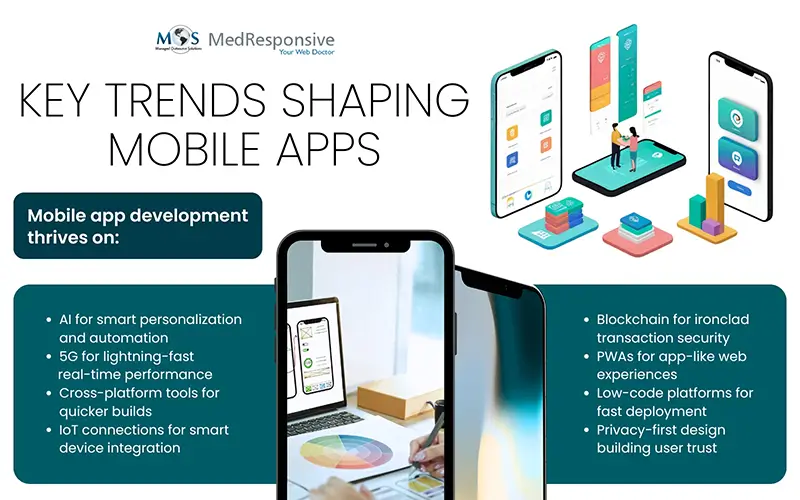
The Future of Mobile App Development
Mobile app ecosystems will continue to expand across devices, networks, and industries. Developers will move from coding functionality to engineering ecosystems that anticipate user needs.
Predicted directions include:
- Deeper AR-based commerce experiences
- Smarter IoT analytics for environmental management
- Integration with quantum-inspired computing for faster simulations
- Wider use of APIs creating universal app interoperability
The future of app development lies in adaptability. As technologies evolve, businesses will depend on predictive innovation. Staying ahead of emerging technologies in mobile apps helps organizations retain competitive advantage while ensuring user satisfaction and long-term growth.