
In enterprise environments where digital products influence customer acquisition, operational continuity, and competitive positioning, technology decisions rarely remain confined to engineering teams. They affect revenue models, service delivery, customer retention, and long-term scalability. As organizations expand digital capabilities across customer-facing and internal ecosystems, selecting the right mobile application development framework becomes a strategic business decision rather than a technical preference. Enterprises investing in customer experience and operational modernization increasingly engage custom mobile app development services to ensure technology choices align with integration requirements, security expectations, and long-term business priorities.
A platform that appears cost-efficient during implementation may still create escalating maintenance burdens, fragmented user experiences, and integration limitations as requirements evolve. Conversely, a well-aligned technology foundation supports scalability, shortens release cycles, improves customer interactions, and strengthens operational flexibility. Enterprise leaders who approach framework selection through a long-term business lens position themselves more effectively for sustainable growth.
Why Framework Selection Has Become an Executive-Level Decision
A decade ago, digital product decisions frequently sat within engineering departments, with limited executive involvement. That dynamic has shifted significantly. Today, enterprise leadership recognizes that technology ecosystems directly influence market responsiveness, customer satisfaction, workforce productivity, and operational resilience.
For many enterprises, digital platforms now function as revenue-generating assets rather than supplementary channels. Retail brands rely on customer engagement ecosystems to influence purchasing behavior. Financial institutions depend on secure digital experiences to maintain transaction confidence. Logistics companies use connected interfaces to coordinate fleets, optimize routes, and monitor delivery performance in real time.
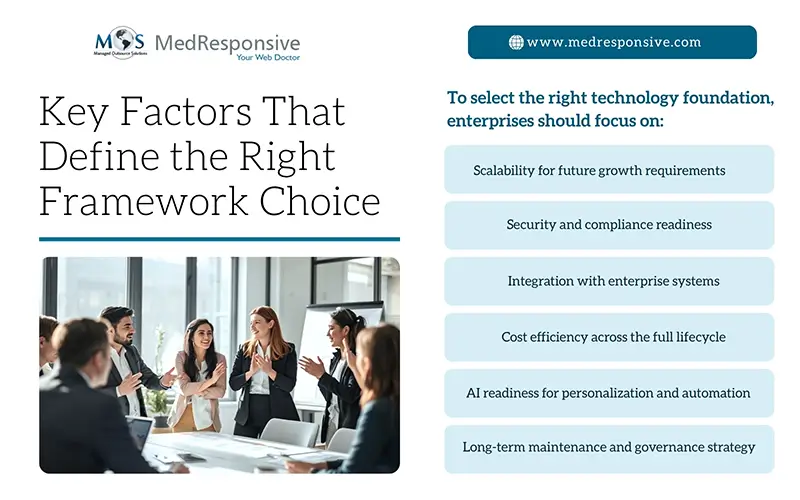
Leadership teams increasingly assess framework selection through business-critical questions:
- Can the platform support projected growth over the next five years?
- Will integration with existing enterprise systems create operational friction?
- How quickly can new capabilities be introduced without disrupting performance?
- Does the ecosystem support security and compliance obligations?
- Will maintenance complexity increase operational expenditure over time?
The Hidden Business Cost of Poor Framework Decisions
Many organizations underestimate the financial consequences of selecting the wrong technology foundation. Initial implementation budgets tend to dominate conversations, while long-term operational costs receive limited attention.
A framework selected primarily for rapid deployment may later introduce challenges such as:
- Increased maintenance complexity
- Performance degradation under higher traffic volumes
- Expensive redesign efforts
- Security retrofitting costs
Consider a financial services provider supporting high transaction volumes. Minor delays in authentication workflows or payment processing can affect customer trust and increase abandonment rates. In these environments, performance limitations create measurable business consequences.
Similarly, a healthcare organization managing appointment scheduling and patient communications must prioritize reliability and secure interoperability. Delays, synchronization failures, or inconsistent user experiences may disrupt service delivery and create compliance concerns.
Framework decisions therefore require a broader financial perspective.
Instead of evaluating implementation cost alone, enterprise leaders should assess:
- Total cost of ownership over multiple years
- Engineering resource availability
- Vendor ecosystem maturity
- Upgrade complexity
- Integration readiness
- Long-term operational scalability
This broader evaluation model produces stronger outcomes than short-term cost comparisons.
Mobile Application Development Framework Selection for Enterprise Growth
Choosing a mobile application development framework requires balancing speed, scalability, maintainability, and operational complexity. Enterprises that treat framework evaluation as a procurement exercise rather than a business strategy decision frequently underestimate future requirements.
Forward-looking organizations assess frameworks through a structured lens that connects technology decisions with measurable business outcomes.
Scalability Beyond Initial Growth Assumptions
Scalability remains one of the most misunderstood evaluation criteria.
Many digital ecosystems perform effectively during early adoption stages. Problems emerge later when customer activity increases, feature demands expand, and data processing requirements intensify.
Enterprise leaders should examine:
- Whether the framework can support increasing transaction volumes
- Performance stability during usage spikes
- Compatibility with expanding cloud infrastructure
- Efficiency when introducing new capabilities
- Resource demands as customer adoption grows
For example, a logistics organization supporting real-time shipment visibility may require continuous synchronization across multiple environments, including GPS systems, warehouse operations, customer notifications, and predictive analytics tools.
Scalability therefore should not be interpreted as a technical specification alone. It functions as a business continuity requirement.
Performance Expectations Based on Business Context
Performance expectations vary significantly across industries, making generalized framework recommendations ineffective.
For example:
- A media streaming platform prioritizes interface responsiveness and uninterrupted content delivery
- A field-service organization may prioritize offline functionality for technicians operating in low-connectivity environments
- A banking institution may prioritize transaction reliability and security validation over interface animations
This context matters because framework performance influences business outcomes differently depending on operational goals.
Google research has consistently demonstrated that slower digital experiences negatively influence engagement and conversion behavior, reinforcing the relationship between performance and customer retention.
Enterprises should therefore evaluate performance requirements according to operational realities rather than industry trends alone.
Native Versus Cross-Platform: Evaluating Tradeoffs Through a Business Lens
One of the most significant enterprise decisions involves choosing between native and cross-platform ecosystems. This choice influences engineering workflows, release timelines, operational costs, and long-term flexibility.
Many organizations approach this decision through a narrow technical lens. High-performing enterprises evaluate it through business consequences.
Native ecosystems generally suit organizations requiring platform-specific optimization, advanced hardware interactions, or highly responsive experiences. Financial trading platforms, high-performance streaming environments, and healthcare systems requiring seamless biometric integrations may benefit from this approach.
However, enterprise leaders must consider associated tradeoffs:
- Separate engineering workflows for different operating systems
- Longer implementation cycles
- Increased maintenance requirements
- Higher long-term engineering expenditure
While native ecosystems may strengthen performance precision, they can also increase operational complexity.
Cross-platform ecosystems, in comparison, support shared codebases across operating systems, reducing engineering duplication and accelerating rollout timelines.
For organizations prioritizing speed-to-market and cost predictability, this approach may provide stronger business alignment.
For example:
- Retail brands introducing loyalty ecosystems across regions may prioritize release consistency and rapid iteration
- Insurance firms modernizing customer self-service platforms may emphasize operational efficiency and maintenance simplicity
- Enterprise workforce systems may prioritize standardization across distributed teams
However, decision-makers should avoid assuming that shared code automatically translates into superior long-term outcomes.
The more complex the digital experience becomes, the more important it becomes to evaluate tradeoffs involving:
- Performance responsiveness
- Integration flexibility
- Security architecture
- Long-term maintainability
- Custom feature requirements
In some enterprise environments, short-term engineering efficiency may eventually conflict with advanced performance requirements.
This is why mature organizations evaluate frameworks according to business context rather than industry popularity.
Integration Complexity and Enterprise System Compatibility
Framework decisions rarely exist in isolation.
Most enterprises operate interconnected environments involving CRM systems, ERP platforms, customer support tools, analytics engines, payment systems, cloud infrastructure, and internal databases.
A framework that performs effectively in isolation may still create operational friction if integration requirements become difficult to manage.
Leadership teams should assess whether the selected ecosystem supports seamless interoperability with:
- Enterprise resource planning systems
- Customer relationship management platforms
- Payment gateways
- Identity and access management systems
Failure to evaluate integration complexity early can create fragmented operational workflows.
Logistics organizations managing real-time delivery tracking require uninterrupted synchronization between mapping tools, dispatch systems, and customer communications. Even small disruptions in data flow can affect service reliability.
This makes integration readiness a strategic priority rather than a technical afterthought.
Security and Compliance as Enterprise Requirements
Security considerations should influence framework selection from the earliest planning stages.
Enterprises operating in regulated industries face growing scrutiny surrounding data privacy, authentication standards, and system resilience. Security retrofitting after implementation frequently increases costs and delays release cycles.
Decision-makers should evaluate whether a framework supports:
- Secure authentication standards
- Data encryption capabilities
- Multi-factor authentication readiness
- Role-based access management
- Secure API interactions
The level of importance varies by industry.
For example:
- Healthcare providers may prioritize patient data protection and audit readiness
- Financial institutions may emphasize fraud prevention and transaction integrity
- Retail organizations may focus on payment security and customer identity management
The strongest enterprise ecosystems incorporate security architecture into framework evaluation rather than treating it as a secondary engineering task.
Organizations that overlook this requirement frequently encounter operational setbacks later, particularly when expansion introduces new regulatory expectations.
How AI Is Reshaping Digital Product Engineering
Artificial intelligence is changing how enterprises evaluate, build, optimize, and maintain digital ecosystems. The shift extends beyond automation into engineering efficiency, release quality, customer engagement, and operational intelligence.
As enterprise priorities evolve, technology leaders increasingly evaluate whether frameworks can support intelligent capabilities and future automation strategies.
AI-assisted Engineering and Faster Delivery Cycles
Engineering teams historically spent considerable time on repetitive workflows such as debugging, testing, and code refinement.
AI-assisted engineering systems are reducing friction across these activities by supporting:
- Intelligent code recommendations
- Automated defect identification
- Performance optimization suggestions
- Faster issue diagnosis
- Engineering productivity improvements
For enterprise organizations managing multiple product releases, these capabilities reduce engineering overhead while strengthening delivery speed.
GitHub research reports that developers using AI-supported engineering tools completed tasks faster while improving workflow efficiency and satisfaction levels.
For enterprise leaders, the implication extends beyond productivity. Faster delivery cycles influence competitiveness, operational responsiveness, and customer retention.
AI-driven Personalization and Behavioral Intelligence
Customer expectations continue to shift toward individualized digital experiences.
AI-driven systems analyze behavioral patterns, purchasing trends, service interactions, and engagement signals to improve personalization.
Organizations increasingly use these capabilities for:
- Recommendation engines
- Predictive customer support
- Personalized product experiences
- Intelligent communication workflows
- Behavioral segmentation strategies
For example, a retail company may personalize recommendations according to browsing behavior, while a financial institution may tailor customer guidance according to transaction history.
Framework selection increasingly depends on whether ecosystems can support advanced analytics, machine learning integrations, and scalable personalization strategies.
AI-enabled Testing and Operational Stability
Quality assurance historically depended on extensive manual testing cycles.
AI-enabled testing systems strengthen reliability through predictive issue detection and automated validation.
These capabilities improve:
- Defect identification speed
- Regression testing accuracy
- Pre-release risk assessment
- Stability across product updates
- Operational continuity
For enterprises managing high transaction volumes or service-critical environments, early issue detection reduces downtime risk and customer disruption.
Common Framework Selection Mistakes Enterprises Should Avoid
Even experienced organizations encounter preventable setbacks when framework decisions prioritize immediate requirements over long-term sustainability.
Common mistakes include:
- Prioritizing Speed Over Long-Term Scalability
- Ignoring Internal System Dependencies
- Underestimating Maintenance Requirements
- Evaluating Technology Based on Popularity
- Delaying Security Considerations
Rapid deployment may appear commercially attractive, but insufficient scalability planning frequently produces expensive rebuilding efforts.
Framework decisions that overlook enterprise integrations may create fragmented workflows and operational inefficiencies.
Some ecosystems require highly specialized expertise, increasing long-term engineering costs and vendor dependency.
Widely adopted frameworks do not automatically fit every business environment. Strategic alignment matters more than market attention.
Organizations that postpone security architecture discussions frequently face higher remediation costs and delayed rollout schedules.
High-performing enterprises reduce risk by evaluating frameworks through operational, financial, and strategic lenses simultaneously.
The Long-term Business Value of the Right Framework Decision
Technology decisions shape enterprise agility long after launch. Organizations that treat framework selection as a short-term implementation choice frequently underestimate how deeply these decisions influence scalability, customer experience, operational continuity, and maintenance economics.
As AI-assisted engineering, AI-driven personalization, and intelligent automation continue reshaping enterprise ecosystems, businesses require technology foundations capable of adapting to changing market conditions. Enterprises seeking sustainable digital growth increasingly rely on custom mobile app development services to align execution with business strategy, operational requirements, and future scalability goals. Selecting the right mobile application development framework strengthens performance, reduces technical debt, and supports resilient digital experiences aligned with long-term growth.
Build enterprise-ready digital experiences with expert custom mobile app development services tailored to your business goals!