Consumer expectations within the Apple ecosystem continue evolving as users demand faster performance, stronger privacy, seamless connectivity, and highly personalized digital experiences. Businesses building solutions for iPhone and iPad users must adapt to changing behaviors, emerging technologies, and platform-level innovations. Understanding the latest trends in iOS mobile app development has therefore become essential for organizations seeking stronger engagement and long-term competitiveness. Modern digital products are no longer evaluated solely on functionality. Users increasingly expect intelligent, secure, responsive, and deeply integrated experiences across devices. Organizations providing custom mobile app development services increasingly prioritize experiences that strengthen usability, responsiveness, and long-term engagement.
User Expectations Continue Reshaping Digital Experiences
According to Statista, Apple consistently maintains a strong premium smartphone market presence globally, reinforcing demand for high-quality digital experiences optimized for its ecosystem.
The Apple ecosystem has consistently influenced how users evaluate software experiences. Today’s users expect platforms that provide:
- Faster performance and responsiveness
- Personalized interactions
- Strong privacy protections
- Seamless synchronization across devices
- Intelligent recommendations and automation
A user may begin an activity on a smartphone, continue it on a tablet, and complete it on another Apple device without interruption. This growing expectation for continuity significantly influences software architecture and user experience design.
Why Businesses Continue Investing in Apple-Based Digital Experiences
For organizations investing in digital transformation, the challenge extends beyond launching functional software. They must create experiences aligned with changing user expectations, evolving platform standards, and increasing performance demands.
Organizations continue prioritizing Apple ecosystem investments because of user behavior, premium customer demographics, and strong engagement potential. While market share varies by geography, Apple users consistently demonstrate high digital engagement and stronger expectations around performance, usability, and privacy.
Several business factors continue driving investment:
Strong Customer Engagement
Apple users frequently engage with premium digital experiences, subscription services, and ecosystem-based functionality. Businesses targeting retention and recurring engagement increasingly prioritize software quality and seamless experiences.
Privacy and Trust Expectations
Privacy standards continue influencing platform decisions. Organizations operating in regulated industries such as healthcare, finance, and enterprise technology increasingly value ecosystems emphasizing secure user experiences.
Ecosystem Continuity
Cross-device continuity creates stronger engagement by enabling users to transition seamlessly across smartphones, tablets, smartwatches, and desktop environments.
High-performing organizations increasingly view Apple-based software engineering as a long-term strategic investment rather than a one-time technical initiative.
What Are the Latest Trends in iOS Mobile App Development?
Understanding the latest trends in iOS mobile app development requires looking beyond visual design changes. Emerging trends increasingly center on intelligence, privacy, personalization, and ecosystem integration.
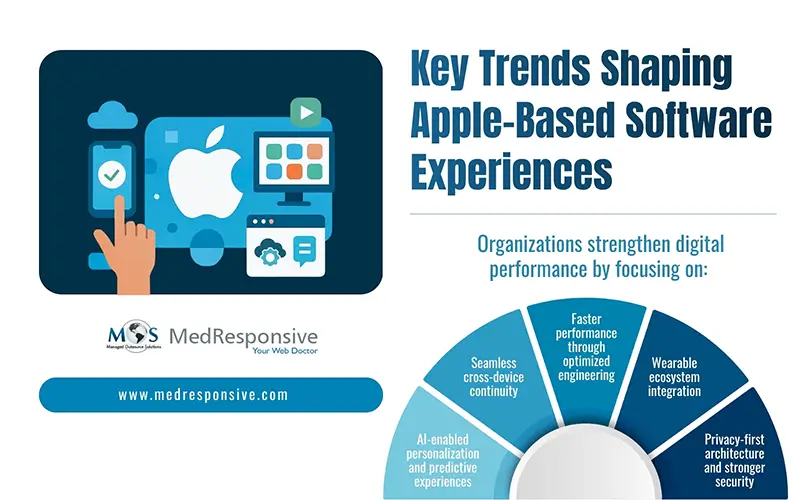
AI-Enabled Personalization
Users increasingly expect software experiences tailored to behavior, preferences, and usage patterns.
AI-enabled systems improve personalization through:
- Intelligent recommendations
- Adaptive content delivery
- Smart notifications
- Behavioral insights
Organizations investing in custom mobile app development services increasingly prioritize intelligent experiences that improve engagement and long-term retention.
On-Device Intelligence
Processing intelligence directly on devices continues gaining importance.
Benefits include:
- Faster responsiveness
- Reduced latency
- Better privacy protection
- Improved offline functionality
This approach reduces reliance on cloud processing while strengthening user trust.
Privacy-First Architecture
Privacy remains a defining characteristic of Apple’s ecosystem.
Organizations increasingly prioritize:
- Transparent permission management
- Secure authentication methods
- Privacy-focused tracking policies
- Encrypted communications
Businesses that ignore privacy expectations risk reduced trust and weaker adoption.
Wearable Ecosystem Integration
Connected experiences across Apple devices continue expanding.
Software increasingly integrates with:
- Smartwatches
- Health tracking systems
- Fitness ecosystems
- Connected home technologies
This creates stronger continuity and convenience for users.
Augmented Reality Experiences
Augmented reality capabilities continue expanding across industries.
Examples include:
- Virtual product visualization
- Healthcare education tools
- Real estate walkthroughs
- Retail try-on experiences
Immersive experiences increasingly influence user engagement.
Subscription-Based Digital Models
Recurring engagement strategies continue gaining momentum.
Organizations increasingly use subscriptions for:
- Premium services
- Personalized experiences
- Exclusive functionality
- Continuous updates
This supports stronger long-term customer retention.
Performance Optimization Through Swift
Performance expectations continue rising.
Modern software engineering increasingly prioritizes:
- Faster load speeds
- Reduced crashes
- Better energy efficiency
- Improved responsiveness
Swift continues supporting optimized performance and scalability.
Emerging Technologies Reshaping Future Digital Experiences
Beyond current trends, emerging technologies continue influencing how organizations approach software experiences within the Apple ecosystem.
Spatial Computing and Immersive Experiences
Spatial computing continues changing how users interact with digital environments. Organizations increasingly explore immersive experiences for healthcare, retail, education, and enterprise collaboration.
Voice-Based Interaction
Voice interfaces continue becoming more sophisticated. Intelligent voice assistance improves accessibility, convenience, and multitasking experiences.
Real-Time Cloud Synchronization
Cloud-connected experiences increasingly support instant updates across devices. Users expect seamless continuity regardless of where interactions begin or end.
Edge Computing for Faster Responsiveness
Processing closer to users improves speed and responsiveness. This reduces latency while strengthening performance for connected and intelligent experiences.
How AI Is Transforming Software Experiences
Artificial intelligence is reshaping how organizations design, optimize, and improve software experiences.
Traditional systems relied heavily on static functionality and manual optimization. Today, AI-assisted capabilities improve responsiveness and personalization.
Development Workflows
AI-assisted systems improve engineering efficiency by supporting:
- Code optimization
- Error detection
- Quality assurance
- Workflow acceleration
This improves delivery timelines and software reliability.
AI-Enabled Recommendations
AI-enabled experiences personalize user interactions based on behavioral patterns.
Examples include:
- Content suggestions
- Shopping recommendations
- Personalized notifications
- Intelligent assistance features
This strengthens engagement and user satisfaction.
Predictive Experiences
AI-driven systems increasingly anticipate user needs.
Examples include:
- Predictive search functionality
- Behavioral forecasting
- Smart reminders
- Personalized interactions
Predictive experiences improve convenience and responsiveness.
Intelligent Automation
AI-powered systems improve operational efficiency through automation.
Organizations increasingly use intelligent systems for:
- Customer support assistance
- Personalized workflows
- Recommendation engines
- Usage optimization
According to McKinsey, organizations report measurable business improvements through AI-enabled initiatives across customer-facing experiences and operational functions.
Common Mistakes and How to Avoid Them
Organizations investing in Apple-based software initiatives frequently encounter challenges when strategy lacks long-term planning.
Common mistakes include:
- Prioritizing visual design over performance
- Ignoring privacy expectations
- Underestimating ecosystem integration requirements
- Overlooking scalability planning
- Treating software launches as one-time initiatives
Sustainable success depends on continuous optimization and user-centered design.
High-performing organizations future-proof their software engineering strategy by viewing it as an evolving business capability rather than a technical expense. They may also opt to outsource the project to custom application development services. Reliable service providers prioritize:
- Privacy-first design principles
- AI-enabled functionality
- Cross-device continuity
- Scalable architecture
- Performance optimization
This helps organizations create stronger digital experiences aligned with future expectations.
Building Future-Ready Digital Experiences: Key Considerations
Organizations investing in Apple-based software should evaluate long-term priorities before implementation begins. Success depends on more than visual design or feature selection.
Key considerations include:
Prioritizing User Experience
Strong usability remains one of the most important differentiators. Navigation simplicity, responsiveness, and intuitive interactions directly influence retention.
Planning for Scalability
Organizations should anticipate increasing user activity, expanding features, and future integrations. Scalable architecture supports sustainable performance.
Strengthening Privacy and Security
Privacy expectations continue rising. Organizations should prioritize secure authentication, transparent permissions, and encrypted communication.
Preparing for Continuous Optimization
User expectations evolve rapidly. Organizations should treat digital products as continuously improving experiences rather than one-time launches.
Future-Ready Digital Experiences Will Define Success
As user expectations continue evolving, organizations must rethink how digital experiences are designed, optimized, and maintained. Consumers increasingly prioritize intelligent functionality, seamless continuity, privacy, and responsiveness across devices. These shifts reinforce the importance of understanding the latest trends in iOS mobile app development. Organizations that adapt strategically and invest in custom application development services can strengthen engagement, improve retention, and position themselves for long-term digital success.