
Business websites need to rank in search results to get found. To achieve that, you need to choose target keywords for your organic SEO campaign. Keywords connect what people search for to what you offer. When used correctly, they tell Google what your page covers so Google shows it when people need it. This process is the foundation of any marketing plan. Organic SEO service providers choose the right keywords to drive traffic, increase leads, and grow sales.
Keyword Research and Analysis
Keyword research and analysis is the process of finding, testing, and choosing the best words to target. It is the starting point of any digital marketing effort. It gets people from Google to your site. Do this right and you’ll get more qualified visitors that convert.
Research tells you what your customers want. It shows you their problems. Then you write content that fixes those problems. That’s how you attract the right people and turn them into customers.
Picking keywords is hard because Google regularly changes the way it ranks content. Search habits shift too. For any search engine optimization strategy to work properly, you need to find and use the right keywords. Before you start, know what you want. Ask yourself:
- How fast do you need results? (Some keywords take months, others weeks)
- Who do you want to reach? (Your local area, city or the whole country?)
- What’s your goal? (Brand awareness, visits, or sales?)
Different Types of Keywords
Before getting into keyword research, it is important to recognize different keyword categories. Keywords fall into three types:
- Short Keywords – One or two words with high search volumes. They are easy to identify but come with intense competition. Examples include “website design” or “Digital marketing” These keywords are hard to win.
- Medium Keywords – These run two or three words. They are more specific but less competitive than short keywords.
- Long Keywords – These keywords are longer, more detailed phrases with four or more words. For example, “How to find affordable SEO keywords for competitive markets” gets fewer searches but attracts more qualified visitors because they show exactly what someone wants.
The more specific your keyword, the better you rank. Local search now matters for most users, especially on mobile. Adding a geographic element to your keyword such as “digital marketing agency in New York” instead of just “digital marketing” helps you target people in that area.
Example:
- “Digital marketing” = 1,000,000 results
- “Digital marketing New York” = 10,000 results
- “Professional digital marketing agency in New York City” = 3,500 results
Remember, using specific keywords helps you rank higher and attract the right visitors. Using semantic keyword (related words) along with your main keyword gives full context to search engines. When you search phrases like “digital marketing New York,” Google will suggest related terms and auto-complete options. Tools like LSIGraph can help you find these semantic words.
Understand What People Want
Most people forget this: you need to know why someone searches, not just what they search.
Google identifies four types of searches:
Know – The user wants general information or facts. “What is digital marketing?” or “How do I start a business online?”
Website – The user wants a specific site. “Google Analytics” or “HubSpot login.”
Do – The user wants to take action. “Hire a marketing agency” or “Buy web hosting.”
Visit – The user wants to find or visit a place nearby. “Coffee shops open now” or “physicians near me.”
Match your content to what they want. If they search “how to improve website ranking,” give them educational content instead of a sales pitch. If they search “buy software,” show them options to buy.
This matters more than you think. Many businesses write content that doesn’t match what people are searching for. Someone searching “how to” wants steps and tips. Someone searching “buy” wants prices and details. Miss this and they bounce. Your ranking drops. Google notices this and lowers your ranking next time.
Voice Is the New Search
Recent data shows that half of all searches will be voice-based by the end of 2025. Voice-activated devices are everywhere now. People talk to Alexa and Google Home every day. This change matters for keywords.
People use longer, more natural phrases when they search with their voice. People don’t say “digital marketing tips.” They say “What are the best ways to improve my marketing in 2025?” or “Show me tips for small business marketing.”
Long keywords work well for voice. They sound natural when people speak. If you only target short keywords, you’ll miss voice search traffic. This means missing revenue opportunities.
Consider your own search behavior. When you type, you’re quick. “Marketing tips.” But when you talk, you use full sentences. “Show me the best marketing tips for my small business.” That’s why voice changes the game.
How to Find Your Keywords: 5 Steps
- Step 1: Start with What You Know
What would you search for to find your own business? Write down those words in a spreadsheet. Most tools let you save as Excel or CSV.
Think broad first. You can narrow down later. Write down 20-30 words you think matter. Don’t judge them yet. Just brainstorm.
- Step 2: Find Related Words
Use tools like LSIGraph to find connected words. These help Google understand your page better when you do keyword research and analysis.
Related words are gold. If someone searches your main keyword, Google will show them these related ones. If your content covers those too, you rank better. Google sees your page covers the whole topic.
- Step 3: Check Your Current Traffic
Look at Google Analytics and Google Search Console. See which words already bring people to you. Go to: Acquisition → All Traffic → Channels → Organic Search
You’ll find words you didn’t even think of that work. This is real data from real people. Pay attention. You’re probably already ranking for keywords you didn’t optimize for. Imagine what you could do if you focused on them.
- Step 4: See What Competitors Do
Tools like SEMrush or Ahrefs show you what competitors’ target. That sparks new ideas.
You don’t copy them. You just see where they put in effort. Maybe they’re strong in words you haven’t touched. Maybe you see gaps. Look for empty space where you can jump in and win. This competitive view saves you months of guessing.
- Step 5: Build Your Master List
- Search Volume – How many people search it per month
- Competition Level – How much other sites compete
- Does it fit your business? – Is it really relevant?
- Where you rank now – Are you already showing up?
- What stage is it? – Do people want to learn or buy?
Create a spreadsheet. For each keyword, track:
This spreadsheet becomes your roadmap. Update it every month. Some words will get easier to rank for. Others will get harder. Track it and adjust.
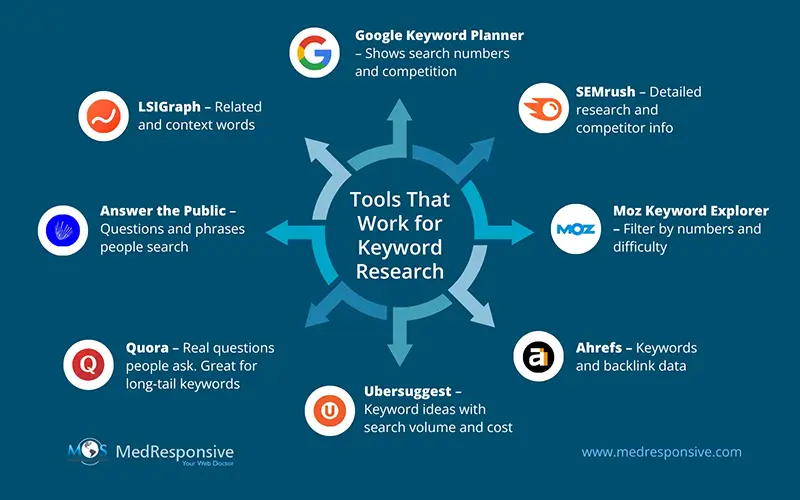
Start with Google Keyword Planner. It’s free and perfect for beginners. As you grow, add paid tools. They save time and show more data. But you can still win with free tools if you’re willing to work.
Put Keywords in the Right Places
Location matters once you have your list ready. Use them in:
- Page titles – Your main keyword here first
- Meta Descriptions – The 160 words under your title in search results
- Headings – H2 and H3 tags
- Your text – Naturally, don’t force it
- Internal Links – When you link to other pages
- Image labels – Google reads these too
- Web address – If it fits naturally
- Social posts – When you share use hashtags as well
But be mindful: don’t stuff keywords everywhere. Google dislikes that. Write for people first, keywords second. If a keyword doesn’t fit, skip it. Real readers can tell when content feels forced.
Short and Long Keywords Work Together
The best approach is a balance of both to bring steady growth. You make quick wins with long keywords while building long-term authority with short ones. That’s how you stay competitive.
Why This Matters for Your Business
Done right, choosing target keywords for your organic SEO campaign touches every part of your results:
- Shows your real market size
- Connects you with people looking for help
- Brings people ready to buy
- More clicks from search results
- Builds trust over time
Many companies use organic SEO services or hire SEO consulting services. These professionals pick, track, and adjust keywords whenever search engine optimization strategy changes.
When you add keywords in titles, content, links, and structure, you send Google a clear message. Your site deserves to rank. Over time, Google notices. You climb the rankings. Traffic grows and sales follow.
Common Mistakes to Avoid
Knowing what not to do is just as important as knowing what to do. Watch out for these:
- Picking Only Big Keywords – “Digital marketing” gets searched a million times a month. This seems attractive, but it’s a mistake. You’ll fight millions of sites. Pick some big ones, but focus on smaller ones too. Smaller keywords rank faster. They bring buyers. That’s where the money is early on.
- Ignoring What People Want – A popular word doesn’t help if it’s not right for you. Someone searching “how to” wants education. Someone searching “near me” wants a place. Match the search to your content or you lose them. They bounce. Google notices. Your rank falls.
- Stuffing Too Many Keywords – “Best digital marketing in New York for small businesses in NY that does marketing digitally near me.” That reads awkward. Users detest it and Google penalizes. Avoid at all cost. Use your keywords where they fit and skip them where they don’t.
- Never Updating Your Keywords – Search behavior changes just as your business changes. What ranked two years ago might be outdated now. Check quarterly. Try new words and drop old ones. Stay fresh or else you risk falling behind.
- Not Measuring Results – You pick keywords, write content, what next? Doing nothing is a mistake. Track everything. Which keywords bring traffic? Which ones bring sales? Do more of what works. Cut what doesn’t. Data beats guessing every time.
Turn Research Into Results
Pick the right keywords and watch your rankings improve. It’s not guesswork. It is research into what your audience wants, and appearing where they search.
Search keeps changing with voice, AI, and new updates from Google. But keyword strategy stays the key to winning.
Stick with your keyword plan. Keep testing and learning. The more you adjust, the better your results get. This approach builds your visibility, brings the right people, and grows your business. Start by picking one keyword to focus on. Write one piece of content. Measure the results. Then do it again. Before long, you’ll see real traffic and real sales. That’s the power of picking the right keywords.
Pick Better Keywords, Attract Better Customers.
Strengthen your search visibility, bring in qualified traffic, and focus on growing your business while we handle your keyword strategy and SEO optimization.
Contact Us Today.