
The healthcare domain has become highly competitive with more healthcare providers and innovative medical technologies making their appearance. Physicians, hospitals and health systems overall have recognized the growing significance of medical SEO. Building strong online visibility is important for the success of any medical practice as it helps attract potential patients and healthcare consumers. A well-planned physician review strategy is key to gaining credibility and standing out in local search results.
Nowadays, before choosing a healthcare practice or consulting a physician, it is quite common for individuals to go online to know more about the physician or his/her services. Online reviews, opinions, and feedback are among the most trusted and frequently consulted sources for patients. They play a vital role in digital marketing for healthcare by influencing how potential patients perceive a medical practice online. Online reviews help future patients to make an informed decision. While positive reviews are encouraging and will help attract more patients, negative reviews are a sign that there is more room for service improvement. It is important to acknowledge reviews and respond to them in the best way possible.
Importance of Online Reviews in Healthcare
Monitoring patient reviews is vital for online reputation management for doctors. These reviews act as trust signals and directly impact a practice’s visibility and growth.
- Positive reviews boost credibility and patient engagement.
- Negative reviews highlight areas for service improvement.
- Responding to reviews shows transparency and patient care.
However, getting positive patient feedback can be a challenge. Many patients hesitate to fill out surveys or respond to review requests due to inconvenience or privacy concerns. To overcome this, healthcare practices must use creative methods and patient-friendly communication strategies.
Here are some latest statistics on patient reviews from Repugen:
- 84% of patients visit online review sites to evaluate healthcare providers
- Reviews give valuable insights into healthcare quality and overall patient experience
- They help prospective patients make confident choices about their care.
- 73% of patients consider online reviews when selecting a healthcare provider
- Patients rely on reviews to make informed decisions.
- Positive feedback builds trust and confidence in the care they expect to receive.
- 81.96% of patients are familiar with Google Reviews
- Google remains a leading platform for patients to share and read reviews.
- This helps new patients assess providers and make informed healthcare decisions.
Reviews That Attract Patients
- 72% of patients only consider providers with an average rating of 4 stars or higher
- Healthcare organizations should prioritize patient satisfaction.
- Promptly addressing negative feedback helps strengthen reputation and attract new patients.
- 83.23% of patients require a minimum rating of 4 stars to even consider a provider
- Maintaining high ratings is crucial for gaining and retaining patient trust.
- 95.94% of patients require at least a 3.5-star rating
- This underscores the importance of consistent service quality and a strong online reputation.
Prospective patients place strong emphasis on positive ratings.
Effective healthcare review management requires a strategic and systematic approach. Many healthcare practices hesitate to ask for reviews because they fear it could strain patient relationships. Others who do ask often fail to get enough responses because they don’t use the right timing or methods.
Local Listings – The Foundation of Your Physician Review Strategy
Before collecting more patient reviews, physicians should ensure that their directory listings are accurate. Listings must include the correct practice name, address, contact details, and website. Start with Google My Business, one of the top review platforms. The information generated via this platform can easily be syndicated to other directories beyond Google. This can be done using listing management tools which can be found online with a simple Google search. However, make sure to read the fine print to understand the key features and limitations of the listing tool selected
Tips to optimize listings:
- Focus listings on the practice rather than individual physicians to avoid duplicate locations.
- Use tools to manage and sync listings across directories.
- Utilize physician-specific review platforms for individual doctor listings.
This foundational step strengthens your visibility and helps support your broader review and reputation plan.
It is highly recommended that business listings on review management platforms should be focused on the practice, not the physician. There are separate platforms just for physician reviews that can help you create and share those physician listings to the appropriate platforms. However, it is important to have a proper strategy to grow both the healthcare practice and physician reviews.
Why Review Marketing Is Important for Physicians
A patient review strategy helps improve the brand reputation, attract the interest of patients, increase revenue and create more buzz about the medical practice now and in the long run. In most cases, patient feedback can come in the form of reviews, private emails, star ratings and video testimonials. Patient feedback can be used to encourage prospects to visit your healthcare practice and avail your services. Patient reviews can also impact search engine optimization (SEO). A well-written review with the right keywords can make your healthcare practice appear in Google searches and increase your online footprint.
It is important to remember that there is no one-size-fits-all approach for increasing patient reviews. No matter, you get reviews from multiples sources or from a handful of sites like Google, Facebook, Yelp and Healthgrades. Every healthcare practice needs effective strategies to improve physician online reviews to strengthen their online presence.
Steps to Build a Strong Physician Reputation Management Plan
- Set up profiles on top review sites: One of the initial steps is to select third-party review sites that are relevant within the healthcare industry, attract users and show up results when your medical practice is searched online. For most healthcare practices, a combination of Yelp, Facebook, and Healthgrades is more than enough. Once the review sites are shortlisted, set up accounts.
- Ensure compliance: Some review sites, for instance, Yelp – disfavor healthcare providers asking patients for reviews. On the other hand, sites like Google are just the opposite, allowing marketers and providers to proactively ask for online reviews. When you try to reach out to patients to give reviews about your healthcare practice, make sure that your efforts are in compliance with each individual review site’s guidelines.
- Ask patients: Asking patients is one of the best ways to increase reviews for your healthcare practice. Patients know the relative importance of reviews to your healthcare practice and as long as you provide excellent service, they may be glad to do a review. When patients compliment your service via phone, email or personally, make sure to tell them to leave their feedback via a review on your website, or Yelp, or the review website of their choice.
- Selectively identify patients for reviews: One of the simplest strategies to increase reviews is to ask the patients in person about their experiences. If you know someone who had a positive experience, encourage them to share it for the benefit of other patients, as well as the growth of your practice. It is often best to ask them in person, with a follow-up email to remind them a day or two after their visit.
- Automate Email requests for reviews: Automating email requests is one of the top ways for medical practices to collect reviews and it is the best strategy that is likely to have the most impact on generating a large number of reviews. To attract the best possible response, send a review request email within a week of the appointment to take advantage of the positive feelings. Timing can make a significant difference between positive and negative reviews, so it is important to establish rules.
For instance, if you are a plastic surgeon performing a tummy tuck, never try to send out that request a few days after the surgery, but rather after a follow-up appointment. Ideally, this should be a completely hands-off process automated through your email system. One of the best ways to automate review collection via email is to use a customer relations management system to create a definite workflow that will send an email request to specific patients individually once they fulfill the conditions outlined.
- Make it convenient for patients to leave a review: Make it easy and convenient for patients to leave reviews as this will help attract more patient reviews.
- Consider taking reviews in your healthcare practice: Collecting reviews in your office before or after patient appointments is another important strategy. This can help attract reviews from the patients when your practice is top of mind.
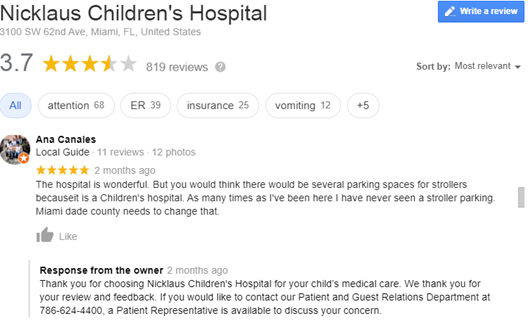
- Respond to existing reviews: When a patient leaves a review, he/she normally expects a response to their feedback. However, it is estimated that two-thirds of patients never get a response. Responding to patient reviews shows that you care for their opinion. Patients, at most times want to know whether their reviews are valuable and can contribute or effect the way a provider perceives patient care and experience. While responding to reviews, organizations need to be aware of the existing HIPAA guidelines to protect patient data. One way to avoid this issue is to create pre-drafted responses.
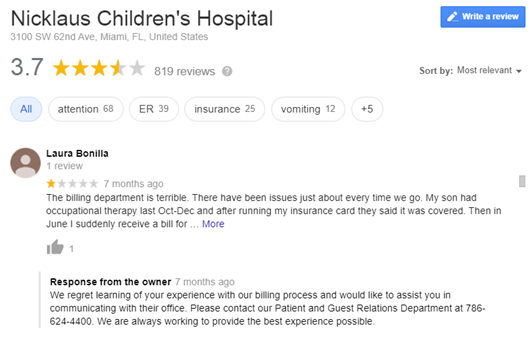
For instance, the marketing team at “Nicklaus Children’s Hospital, Miami FL, United States”, notifies the reviewer that the hospital is aware of their comments. They also encourage patients to take the conversation offline and provide more detailed feedback. With such carefully-worded responses, any healthcare organization can influence each review to improve the experience of patients and show them that their current and future feedback is important.

Image Source:
- Respond to negative reviews: Before responding to negative reviews, make sure to check your records to see whether the review posted is genuinely by one of your patients or customers. If not, it could well be a fake review. Whatever be the negativity conveyed in the review, make sure your responses are all positive. Address the complaint specifically. Your responses must address the following points –
- Thank the reviewer for their genuine opinion
- Point out your specific concern
- Apologize for the trouble caused and be honest about any mistakes made by your practice
- Acknowledge the reviewer’s concern as genuine, and if you feel it can’t be true, follow the next step
- Explain the possible reasons for the person to have felt wronged
- Provide a contact number to the concerned individual for the complaint to be fully redressed
- Publish reviews on your website: Publishing reviews on your healthcare website has several advantages. These include –
- Patients can read reviews, ask questions, and mark reviews as helpful or unhelpful.
- Other patients can see that people are happy with the services.
- Original, user-generated content is great for ranking and SEO.
If the reviews are generally positive, make sure to share them via social media channels and display them on your website.
- Incentivize (if appropriate): Consider incentivizing the patient review requests. However, it is important to do this carefully. No matter what specialty you are serving, you never want to let others know that you are paying patients to write positive reviews about your practice. For instance, healthcare practices can give offers to patients like anyone who writes a review in a specific month will be eligible for a free consultation.
Patient reviews are a powerful tool that every healthcare practice must utilize correctly to increase patient volume and strengthen online reputation. Obtaining positive reviews from patients and reducing the impact of negative reviews are the major considerations when it comes to digital marketing for healthcare. Healthcare providers must ensure that reviews regarding their services are regularly monitored and identify any concerns patients may have and address them appropriately.
By incorporating valuable reviews in the content strategy and using them as a channel to connect with patients, healthcare practices can establish an engaging brand. However, growing reviews doesn’t usually happen overnight and in most cases, patients may not take the time to write reviews. By carefully considering the above-mentioned strategies, healthcare practices can increase both the quantity and quality of the reviews they receive, and establish a brand that is engaging and trustworthy.
Enhance your online reputation
Start building your physician review strategy today!
Contact Us