Implementing a strong healthcare email marketing strategy is one of the most reliable ways to connect with patients, improve retention, and enhance overall practice growth. In fact, using a well-structured healthcare email marketing strategy helps healthcare providers educate, engage, and support patients while delivering timely and personalized communication. Many providers now rely on a professional healthcare SEO agency to implement email campaigns and ensure their message reaches the right audience in a compliant and effective manner.
Email continues to be one of the most powerful digital channels in healthcare. With an average industry open rate of 21.48% and a click-through rate of 2.69% (Source: Digitalis), email gives healthcare practices a direct path to patients who are seeking trustworthy information and dependable providers. When your emails are relevant, personalized, and compliant with regulations, you can build long-lasting patient relationships and improve your practice’s visibility.
This post how healthcare providers can use email to boost patient retention and engagement.
Why a Healthcare Email Marketing Strategy Matters
Email marketing plays a vital role in helping healthcare providers stay connected with their audience. Healthcare email campaigns support patient education, onboarding, retention, and long-term trust building. Below are some of the biggest reasons why email continues to matter for healthcare providers.
- Increasing Awareness Among Potential Patients
- A monthly health newsletter
- A medical guidance series
- Appointment reminders
- Special offers or introductory consultations
One of the biggest advantages of email marketing is its ability to increase visibility among prospective patients. Whether your practice offers specialized treatments, seasonal wellness packages, or first-time consultation discounts, email helps you spread the word effectively.
Before prospective patients call or book an appointment, they usually research online—looking at reviews, comparing services, and reading educational content. This creates an opportunity for you to invite them to subscribe to:
With an effective healthcare newsletter strategy, you offer potential patients a way to stay connected with your practice. Simple signup forms or pop-ups on your website help collect email addresses ethically and efficiently. When visitors share their concerns, request a guide, or subscribe to updates, your email list grows naturally. Over time, you can convert many of these subscribers into new patients by offering value-rich content and tailored promotions.
- Simplifying and Enhancing New-Patient Onboarding
- Pre-visit instructions
- Medication guidelines
- New-patient forms
- Payment links
- Insurance documentation requests
- Post-appointment care instructions
Onboarding new patients can be challenging due to varying demographics, chronic conditions, privacy requirements, and communication preferences. Email marketing dramatically simplifies this process.
With automated onboarding email workflows, healthcare practices can send:
Providing clear and timely guidance makes patients feel supported even before they step into your clinic. It also reduces administrative load, saves staff time, and ensures a smooth intake process.
- Strengthening Retention With Better Patient Engagement
- Annual checkup reminders
- Follow-up care notifications
- Prescription renewal reminders
- Messages for chronic condition management
- Post-treatment check-ins
Patient retention is just as important—if not more—than acquiring new patients. According to industry research, acquiring a new patient costs up to five times more than retaining an existing one. Even a small increase in retention (as little as 5%) can boost profits by 25%–95%. Even a small increase in patient loyalty can significantly improve profitability and this is where patient engagement emails become invaluable.
Email automation helps you nurture long-term relationships through:
These simple but meaningful touches help patients stay consistent with their care plans and build lasting trust in your practice.
- Humanizing and Strengthening Your Healthcare Brand
- Expert health tips
- Seasonal wellness advice
- Preventive-care reminders
- Educational videos
- Success stories or patient testimonials
- Updates about new technologies or services
More than 75% of potential patients search for hospital or clinic reviews before contacting a provider. Trust is everything in healthcare—and email marketing is one of the best tools to build it.
Consistently delivering patient-focused content helps position your practice as a reliable, knowledgeable, and approachable healthcare partner.
Your email newsletters can include:
By sharing relevant content regularly, you stay top-of-mind and show your patients that you care about their well-being, not just their appointments.
Email Marketing Strategies to Grow Your Healthcare Practice
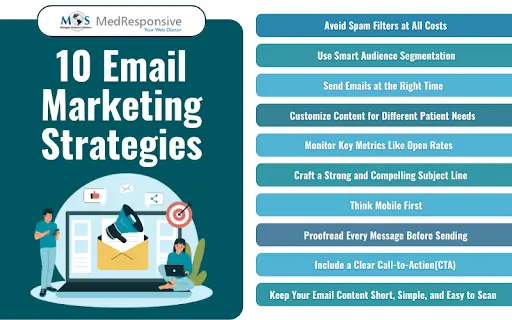
Creating a strong email strategy involves more than sending newsletters. It requires thoughtful planning, personalization, compliance, and continuous optimization. Here are nine essential best practices every healthcare provider should follow.
- Avoid Spam Filters at All Costs
- Avoid spam trigger phrases like “100% FREE,” “BEST DEAL,” or excessive exclamation marks.
- Build your email list organically—never buy or scrape lists.
- Use clean HTML, readable fonts, and a simple layout.
- Authenticate your emails using SPF, DKIM, and DMARC.
- Regularly remove inactive subscribers to keep engagement high.
- Allow patients to choose what types of emails they want to receive.
No email marketing effort can succeed if your messages land in spam folders. With nearly half of global email traffic marked as spam, it’s critical to ensure proper email delivery.
Tips to avoid spam filters:
Healthcare communication is sensitive; being transparent and compliant boosts trust and improves deliverability.
- Use Smart Audience Segmentation
Segmentation is the core of personalization. A single email rarely applies to everyone on your list, and sending irrelevant content decreases engagement quickly. Dividing your email list into meaningful groups—such as age, patient history, services used, or health conditions—helps you deliver the right message to the right person.
For example, diabetics may receive monthly lifestyle management tips, while cosmetic patients may get seasonal promotions. New patients may receive onboarding guides, while long-term patients get follow-up reminders.
Segmentation makes patients feel seen and understood. When your messages reflect their real needs, they’re far more likely to read, click, and trust your emails.
- Send Emails at the Right Time
- Best days to send: Tuesday and Friday
- Best times: 2 PM, 5 PM, and 8 PM
Even the most engaging email will underperform if sent at the wrong time. Timing greatly influences open rates, engagement, and conversions.
Industry research suggests:
However, each patient group behaves differently. This makes A/B testing essential. Try sending the same email to different segments at different times and compare results. You’ll quickly learn when your audience is most active.
- Customize Content for Different Patient Needs
- Educational content – tips on nutrition, skincare, seasonal health reminders
- Promotional content – treatment discounts or wellness packages
- Event invitations – webinars, health camps, vaccination drives
- Holiday greetings – festive and seasonal messages
- Monthly newsletters – roundups of helpful content
Patients vary in their interests, needs, and stages of care. Email marketing allows you to deliver diverse message types depending on the patient group. Patients engage more when they receive varied types of content, not just promotions
You can send:
Just ensure all email content remains HIPAA-compliant and respects patient privacy.
- Monitor Key Metrics Like Open Rates
Just because a patient receives your email doesn’t mean they’re actually reading it. Recent data from Constant Contact shows that health and wellness emails—whether from physicians, home care providers, dentists, or nutrition specialists—see an average open rate of 37.77% and a click rate of only 0.88%.
Tracking essential metrics such as open rates, click-through rates, and bounce rates helps you understand how well your emails are performing. Once you analyze these insights, you can refine your content, improve engagement, and send messages that resonate more effectively with your audience.
- Craft a Strong and Compelling Subject Line
- Keep it short—ideally under 50 characters
- Mention your practice name
- Avoid words like “Reminder”
- Be specific (e.g., “Your Annual Check-Up Is Due”)
- Use personalization where appropriate
Your subject line is the deciding factor in whether a patient opens your email. Healthcare inboxes are crowded, so your subject lines must be clear, engaging, and relevant.
Best practices:
A compelling subject line boosts open rates and drives patient action.
- Think Mobile first
A large share of patients read emails on their phones, making mobile optimization essential. Use responsive designs, short and clear text, and easily tappable buttons and links. This not only improves the user experience but also ensures your message is accessible across all devices.
- Proofread Every Message Before Sending
In healthcare, accuracy is non-negotiable. A single typo or unclear sentence can affect credibility and create confusion. Always review your email content carefully, but also have someone else look at it. Writers often miss their own mistakes, so a second set of eyes improves quality tremendously.
Clear, error-free communication reflects professionalism and care, qualities patients look for when choosing a healthcare provider.
- Include a Clear Call-to-Action (CTA)
- “Book an appointment”
- “Schedule your follow-up visit”
- “Download your nutritional guide”
- “Renew your prescription”
Every email should lead to one specific action. Patients should instantly understand what to do next.
Examples:
A clear CTA helps improve conversions and ensures your emails drive meaningful results.
- Keep Your Email Content Short, Simple, and Easy to Scan
Long emails tend to lose patient interest quickly, especially since 41% of people read emails on mobile devices. Patients appreciate concise messages that get straight to the point while still offering value.
Use short paragraphs, clear language, and relevant links. Your goal is to inform without overwhelming. When patients feel that your emails respect their time, they’re more likely to stay subscribed and engaged.
When properly executed, email marketing is one of the most impactful ways for healthcare providers to stay connected with patients. A thoughtful healthcare email marketing strategy can increase patient awareness, simplify onboarding, improve retention, strengthen your brand, and drive long-term patient loyalty. By following best practices, such as avoiding spam filters, sending messages at the right time, segmenting your audience, and crafting strong CTAs, you can create email campaigns that feel helpful, relevant, and trustworthy.
If you invest in a healthcare SEO agency, your practice will not only stay top of mind but also build lasting connections that support healthier, more engaged patients.