
Patients increasingly rely on digital channels to research symptoms, compare providers, evaluate treatment options, and build confidence before scheduling appointments. In this environment, trust and clarity influence decision-making as much as clinical expertise. This shift has made video content for healthcare marketing an important strategy for providers seeking stronger patient engagement and visibility.
Educational visuals, physician-led explanations, and treatment overviews help simplify complex medical information while improving credibility. Organizations increasingly integrating healthcare content marketing strategies into patient outreach strengthen confidence, improve engagement, and support more informed healthcare decisions.
For many providers, the challenge is no longer visibility alone but building trust before the first appointment. Patients want transparency, reassurance, and clear explanations from credible sources. Static website copy and text-heavy materials may not fully address patient concerns, particularly when procedures or treatment decisions feel unfamiliar. High-performing organizations increasingly use visual storytelling to improve patient understanding and strengthen digital communication strategies.
Why Visual Communication Matters in Patient Decision-making
Healthcare decisions involve uncertainty, urgency, and emotional complexity. Patients evaluating providers want information that feels understandable, credible, and accessible.
Visual communication strengthens patient confidence by helping organizations:
- Explain complex procedures clearly
- Humanize physicians and care teams
- Improve transparency around services
- Address common patient concerns
- Build familiarity before appointments
For example, a physician explaining a treatment process directly to patients may create stronger trust than written descriptions alone.
This matters because healthcare decisions rarely happen instantly. Patients may research symptoms, compare providers, review online content, and revisit websites multiple times before making contact.
According to a recent report from Pew Research Center, a large percentage of adults continue using online resources to seek health-related information before consulting a medical professional.
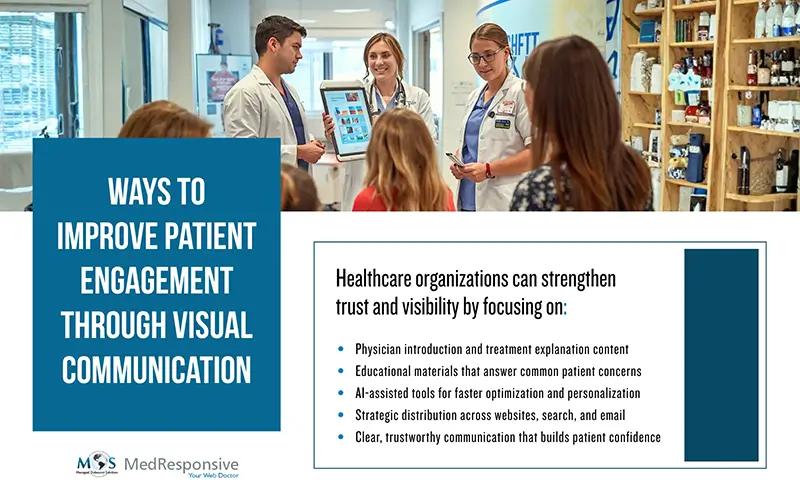
How to Use Video Content for Healthcare Marketing Effectively
Successfully using video content for healthcare marketing requires more than publishing short clips online. Organizations must align content strategy with patient intent, clinical goals, and digital behavior.
Effective visual communication should focus on education, trust, and patient confidence rather than promotion alone.
High-performing organizations generally create media assets that support different stages of the patient journey.
Physician Introduction Content
Patients want confidence in the provider they choose.
Short physician introductions can help patients:
- Understand medical expertise
- Learn about treatment philosophies
- Become familiar with providers before visits
- Reduce uncertainty around care decisions
This type of communication strengthens trust by creating familiarity.
Treatment Explanation Content
Medical terminology can feel overwhelming.
Educational explainers simplify:
- Procedures
- Recovery expectations
- Risks and benefits
- Treatment preparation
Clear explanations improve understanding and reduce patient anxiety.
Frequently Asked Questions
FAQ-based visual communication helps providers address recurring concerns efficiently.
Examples include:
- Appointment preparation
- Insurance questions
- Recovery expectations
- Treatment eligibility
- Common misconceptions
This improves clarity while reducing repetitive inquiries.
Facility Walkthroughs
Patients unfamiliar with a clinic or hospital may experience uncertainty.
Facility walkthroughs help:
- Improve comfort levels
- Showcase cleanliness and professionalism
- Familiarize patients with the care environment
- Reduce anxiety before visits
This becomes particularly valuable for specialty care providers and surgical centers.
Patient Education Materials
Preventive care and condition awareness remain important opportunities for patient engagement.
Educational campaigns may focus on:
- Chronic disease management
- Preventive screenings
- Wellness recommendations
- Lifestyle guidance
Organizations using healthcare content marketing strategies increasingly integrate educational media to strengthen patient trust and improve long-term engagement.
Distribution Strategy Matters as Much as Content Quality
Creating strong visual communication is only part of the process. Distribution strategy significantly affects reach and engagement.
Organizations should prioritize channels based on patient behavior and search intent.
- Website Integration
Provider websites should act as central hubs for educational content.
Placement matters.
Organizations may integrate media into:
- Treatment pages
- Physician profiles
- FAQ sections
- Patient resource centers
This improves time on site and patient understanding.
- YouTube and Search Visibility
Search platforms increasingly surface multimedia results for health-related searches.
Educational content hosted on video-sharing platforms may improve:
- Brand visibility
- Search presence
- Educational reach
- Patient engagement
When properly optimized, multimedia assets strengthen broader SEO performance.
- Email Communication
Patient email campaigns may benefit from educational media.
Examples include:
- Post-appointment education
- Procedure preparation guidance
- Preventive health reminders
- Seasonal awareness campaigns
This strengthens continuity of care communication.
- Social Media with Purpose
Organizations should avoid creating superficial social posts solely for visibility.
Instead, content should prioritize:
- Patient education
- Clinical transparency
- Provider credibility
- Community trust
The strongest engagement typically comes from content that answers real patient questions.
Compliance and Ethical Considerations
Healthcare organizations must balance engagement goals with regulatory obligations.
Visual communication should maintain:
- Accuracy in medical claims
- Patient privacy protections
- Consent for testimonials
- Ethical representation of outcomes
Exaggerated claims or misleading messaging can damage credibility and create compliance concerns.
Educational value should remain the primary objective.
How AI Is Transforming Healthcare Communication
Artificial intelligence is reshaping how providers plan, optimize, and evaluate multimedia communication strategies.
Traditional content development relied heavily on manual editing, audience assumptions, and delayed performance analysis. Today, AI-assisted tools improve efficiency and personalization.
AI-assisted Editing
AI-assisted platforms help teams edit educational materials faster.
This improves:
- Caption generation
- Audio enhancement
- Editing efficiency
- Accessibility improvements
Faster production supports greater consistency.
AI-enabled Personalization
AI-enabled systems analyze patient behavior to personalize content recommendations.
For example:
- A patient researching orthopedic care may receive educational content relevant to treatment preparation
- Preventive care messaging may vary based on patient demographics and interests
This strengthens engagement through relevance.
AI-driven Audience Insights
AI-driven analytics help organizations evaluate performance more effectively.
These systems identify:
- Audience drop-off points
- High-performing topics
- Patient engagement trends
- Search behavior patterns
This helps organizations refine communication strategies.
AI-powered Optimization
AI-powered systems improve discoverability through:
- Search optimization recommendations
- Content performance analysis
- Metadata suggestions
- Engagement forecasting
According to McKinsey, organizations adopting AI in customer-facing functions continue reporting measurable improvements in engagement and operational efficiency.
Common Mistakes Organizations Should Avoid
Even well-intentioned efforts may underperform when organizations focus on visibility rather than patient value.
Common mistakes include:
- Producing overly promotional content
- Using complex medical terminology without explanation
- Ignoring patient intent
- Publishing inconsistent content schedules
- Failing to optimize for search visibility
Patients value credibility and clarity more than promotional messaging.
How High-Performing Providers Measure Success
Success should not be evaluated solely through views or impressions.
Leading organizations assess:
- Appointment inquiries influenced by content
- Engagement on treatment pages
- Patient education outcomes
- Search visibility improvements
- Audience retention rates
This provides stronger insight into how communication influences patient behavior.
Why Trust-driven Communication Creates Long-Term Value
Patient trust begins long before the first appointment. Organizations that communicate clearly, explain treatments effectively, and provide accessible educational materials strengthen credibility throughout the decision-making journey. Providers relying solely on static content may struggle to build meaningful engagement in increasingly digital environments. In contrast, organizations using video content for healthcare marketing create stronger patient connections, improve understanding, and support long-term growth through more informed and confident healthcare decisions. For providers seeking stronger visibility and patient engagement, partnering with experts offering healthcare digital marketing services can further strengthen communication strategies and digital performance.
Frequently Asked Questions
1. Why is visual communication important in patient engagement?
Visual communication helps simplify medical information and improve patient understanding before appointments. It also strengthens trust by helping patients become familiar with providers, procedures, and care environments.
2. What type of content works best for healthcare organizations?
Educational explainers, physician introductions, FAQs, treatment overviews, and facility walkthroughs generally perform well. The most effective content answers real patient concerns while improving transparency and confidence.
3. How is AI improving healthcare communication strategies?
AI-assisted tools improve editing, personalization, audience analysis, and content optimization. AI-driven insights also help organizations identify which topics improve engagement and patient education.
4. Do healthcare organizations need expensive production equipment?
Not necessarily. Clear messaging, credibility, and educational value matter more than high-end production quality. Professionally planned content with accurate information typically performs better than overly promotional materials.
5. How should organizations measure success?
Success should be measured through patient engagement, appointment inquiries, audience retention, and search visibility rather than views alone. Metrics tied to patient trust and conversion provide stronger performance insight.
Looking to improve patient engagement through smarter digital communication?
Discover how strategic content can strengthen visibility and trust.