
Local search optimization has become a cornerstone of digital marketing, especially for businesses focused on attracting customers within a specific geographic area. With local search traffic driving more footfall, calls, and conversions than ever before, understanding local SEO mistakes is critical. Many small to medium businesses invest time and money in local search strategies only to find they aren’t getting the results they expect. By identifying and avoiding the common mistakes when optimizing for a particular geographic area, local search optimization services increase your chances of ranking higher in local searches.
In this guide, we will walk through the major pitfalls that many businesses fall into, why they happen, and actionable ways to fix them—so your local SEO efforts yield real results.
How Local SEO Errors Impact Rankings and Conversions
Common mistakes in local search optimization may confuse search engines and potential customers. This leads to lower rankings, reduced traffic, and missed conversion opportunities.
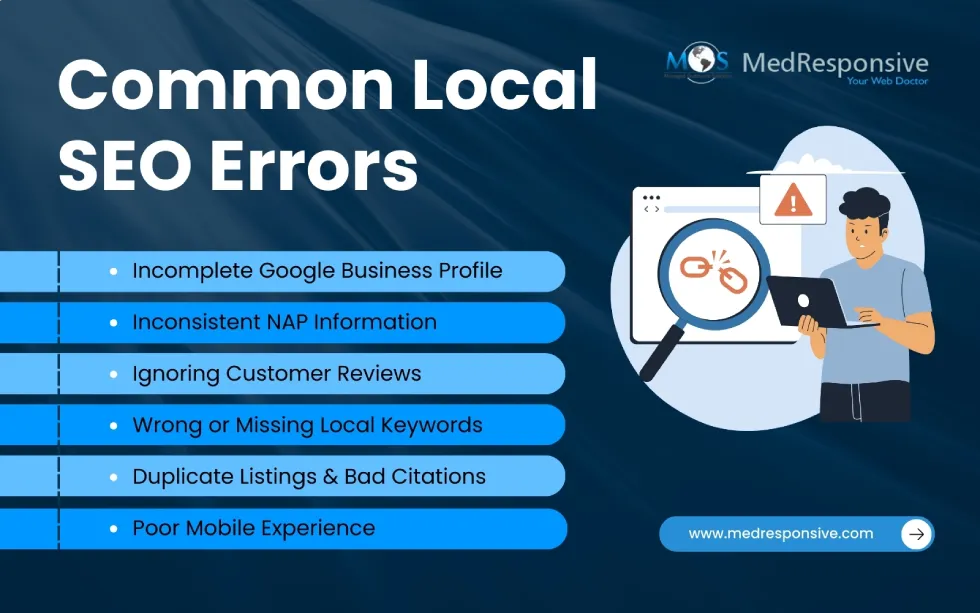
- Incomplete or Unoptimized Google Business Profile: One of the most fundamental local SEO errors is failing to fully optimize your Google Business Profile (GBP). A complete GBP profile should include your exact business name, address, phone number (NAP), business hours, service categories, and photos. Businesses that leave these fields incomplete miss out on valuable ranking opportunities because search engines lack the necessary data to match you with local queries. A thorough GBP also makes it easier for potential customers to find critical information at a glance—boosting both visibility and conversions. Therefore, claim and verify your GBP, fill out every available field, choose precise service categories, and upload high-quality images regularly.
- Inconsistent NAP Details across Platforms: Consistency matters in local SEO. One of the most common mistakes is having inconsistent Name, Address, and Phone information across your website, directories, and social profiles. Search engines use this data to validate your business’s legitimacy, and mismatched listings create confusion—leading to lower rankings. This inconsistency also weakens local citations, which are important signals for credibility. In order to fix this issue, audit all online listings and directories to ensure your NAP data is identical everywhere it appears. Use tools like Moz Local or Yext to automate this process.
- Ignoring Customer Reviews: Customer reviews are a powerful local ranking signal. Yet, many businesses either fail to collect reviews or ignore the ones they receive—both positive and negative. Not responding to reviews signals to search engines and users that you aren’t engaged with your audience. Positive reviews build trust and can improve click-through rates from search results, while thoughtful responses to negative reviews show a commitment to customer service. Encourage happy customers to leave reviews and respond to all feedback professionally and promptly.
- Failing to Use Relevant Local Keywords: A key goal of local SEO is to align your content with the terms people in your area are using to search. Targeting broad, generic keywords like “dentist” won’t help you show up for local searches such as “dentist near me in NYC.” Ignoring location-specific and geo-targeted keywords in your content, Meta tags, and service pages is one of the biggest reasons your optimization efforts don’t produce results. Conduct keyword research focused on local intent and include these terms naturally within your website content, title tags, and GBP description. Local search optimization services can help you with effective strategies.
- Duplicate Listings and Inaccurate Citations: Another frequent local SEO mistake is having multiple directory listings for the same business. Duplicate entries dilute your authority and can create conflicting information about your business. These should be identified and consolidated to strengthen your online presence and improve search visibility. Use citation management tools or manual audits to find and remove duplicates—ensuring only accurate, authoritative listings remain.
- Neglecting Mobile Optimization: With a growing number of local searches happening on mobile devices, having a website that isn’t mobile-friendly is a serious oversight. Search engines prioritize websites that load quickly and display correctly on phones and tablets. If your site is slow or difficult to navigate on mobile, users are more likely to abandon it—hurting your metrics and rankings. Adopt a responsive design, reduce page load times, and make key actions (like calling or getting directions) prominent and easy to execute.
- Lacking Location-specific Pages: For businesses serving multiple areas, having a single generic page limits visibility. Each service area needs its own content with tailored local keywords and information. Create dedicated landing pages for each city or neighborhood you serve, optimized with unique content and relevant local terms.
- Over-optimization and Keyword Stuffing: On the opposite end of the spectrum, some businesses try to game the system by stuffing too many keywords into their content. This is a classic local SEO error that can make content look spammy and reduce readability. Search engines today are sophisticated enough to penalize this unnatural practice. Use relevant local keywords in a way that reads naturally and adds value for users, rather than forcing them into every sentence.
- Ignoring On-page SEO Elements: Beyond keywords, local search optimization requires attention to on-page elements like title tags, Meta descriptions, headers, and structured data. Missing these is often overlooked but critically impacts how search engines interpret and rank your pages. Optimize every page with localized titles, Meta descriptions, and schema markup where appropriate.
- Lack of a Holistic Local SEO Strategy: One of the biggest long-term mistakes is treating local SEO as a one-time task rather than an ongoing effort. A strong strategy should include regular updates to your GBP, new content, review management, and performance tracking. Without consistent monitoring and refinement, your rankings can plateau or even decline. Set up regular audits, track performance metrics with tools like Google Analytics and Google Search Console, and adjust your approach based on trends and data.
- Not Monitoring Performance: Failing to monitor your local SEO performance means you won’t know what’s working and what isn’t. Regular tracking lets you identify trends, competitive shifts, and areas that need improvement. Tools such as rank trackers and analytics platforms help you measure your visibility and impact over time. Schedule routine checks of your local search rankings, traffic sources, and conversion rates.
Avoid These Local SEO Pitfalls
Local SEO is one of the most valuable investment areas for businesses that rely on nearby customers. However, local SEO mistakes—from incomplete business profiles to poor keyword use—can significantly hinder your visibility and results. By recognizing and addressing these common mistakes in local search optimization, you’ll be better positioned to improve rankings, attract more local customers, and boost your overall online presence. Whether you are working with professional local search optimization services or handling SEO in-house, building a consistent, comprehensive local strategy will help ensure why local SEO is not working for you becomes a thing of the past—replaced instead with growth and measurable success.