Did you know that users decide whether to stay on a webpage or leave within the first 10 seconds (even less sometimes), with headings playing a major role in that decision?
Yes, users form a first impression based on factors like visuals, clarity, and relevance in a matter of milliseconds (as fast as 50 ms). However, the way your website content is structured—especially your H2, H3, and H4 headings—can make or break both user engagement and search engine visibility.
We live in an SEO landscape, where writing content is only half the job. How that content is organized determines whether search engines can understand it, whether users can read it easily, and whether your page actually ranks for the right keywords. A well-planned H2–H4 hierarchy does far more than “break text into sections”; it acts as a roadmap for readers and crawlers alike.
In this post, we shall explore in depth why heading hierarchy matters, how an effective SEO heading structure directly impacts SEO performance, common mistakes to avoid, and best practices you can apply immediately.
Understanding Heading Hierarchy: H2, H3, H4 Explained
Before learning about the SEO benefits, let us first gain an understanding of H2–H4 heading hierarchy.
What Is Heading Hierarchy?
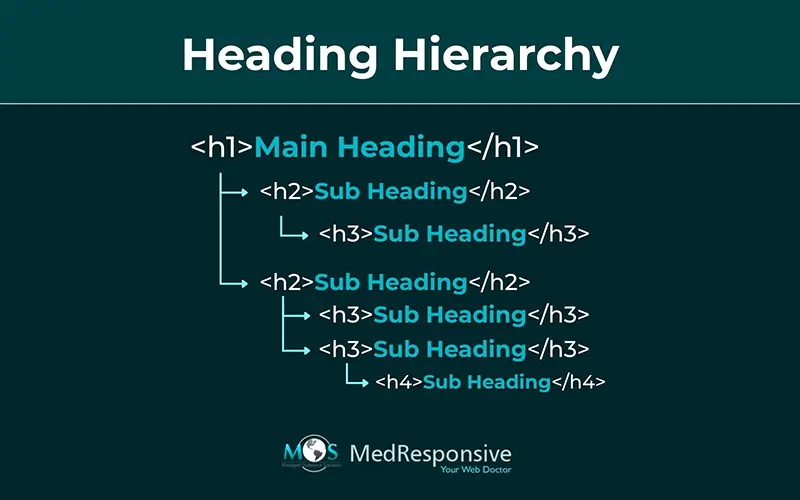
Heading hierarchy is nothing but the logical structure by which the content in a website is organized. It is done using HTML heading tags:
- H1: The main topic of the page (used once)
- H2: Major sections supporting the main topic
- H3: Subsections within an H2
- H4: Supporting points under an H3
Think of it like a book, where:
- H1 = Book title
- H2 = Chapter titles
- H3 = Subsections
- H4 = Key points within subsections
When this structure is logical, both users and search engines can instantly grasp how information flows.
Why H2–H4 Matter More Than You Think
While H1 usually gets the most attention, H2–H4 headings hold a significant role in content clarity. They provide context, clarify relationships between ideas, and help search engines interpret content depth and relevance—a critical aspect of heading hierarchy SEO.
How Search Engines Read and Interpret Headings
Search engines don’t “read” websites like we do. They scan, categorize and analyze the content structure.
Headings Help Search Engines Understand Context
Google uses headings to:
- Identify main topics and subtopics
- Understand semantic relationships
- Determine keyword relevance
- Generate featured snippets and sitelinks
A clear H2–H4 hierarchy acts like signposts, clearly conveying search engines what each section is about without letting the engine do the guesswork.
Semantic SEO and Topical Authority
Modern SEO isn’t just about keywords, but also about topics and intent. Well-structured headings allow you to naturally cover a topic in depth, signaling topical authority.
For example:
- H2: Benefits of Structured Headings
- H3: Improved Crawlability
- H3: Better User Engagement
- H4: Lower Bounce Rates
- H4: Longer Session Duration
This layered structure tells Google that you’re comprehensively addressing the subject.
SEO Benefits of a Proper H2–H4 Heading Structure
Let’s break down exactly how a strong heading hierarchy improves SEO performance.
- Improved Crawlability and Indexation: Search engine bots crawl pages faster and more efficiently when headings are properly structured. Clear sections reduce ambiguity and help crawlers prioritize important content.
- Faster indexing
- Better understanding of page focus
- Reduced risk of misinterpretation
SEO impact:
- Better Keyword Distribution (without Stuffing): Headings are prime real estate for keywords—but only when used naturally.
- Target primary keywords in H2s
- Use variations and long-tail keywords in H3s and H4s
- Avoid unnatural repetition
A good hierarchy allows you to:
This supports keyword relevance without triggering over-optimization penalties.
- Higher Chances of Featured Snippets: Many featured snippets are pulled from well-structured content.
- Question-based H2s
- Clear H3 answers
- Concise explanations under each heading
When your page has:
All this makes the job of extracting snippet-worthy content easy for Google.
- Improved User Experience (UX): It is important to understand that SEO and UX are deeply connected. Therefore, structured headings have benefits like:
- Making content scannable
- Minimizing cognitive load
- Helping users find answers quickly
When users stay longer and interact more, behavioral signals like dwell time and scroll depth improve, indirectly supporting rankings and imparting an SEO-friendly user experience.
- Stronger Internal Linking Opportunities
- Link from one relevant subsection to another
- Anchor internal links naturally using heading-related phrases
- Improve page-to-page topical flow
Clear sections make it easier to:
This strengthens site architecture and distributes link equity more effectively.
Common Heading Hierarchy Mistakes That Hurt SEO
Even well-written content can underperform in search results, if the heading structure is flawed.
- Skipping Heading Levels
Jumping from H2 straight to H4 confuses search engines.
Incorrect:
H2 → H4
Correct:
H2 → H3 → H4
Always ensure that you maintain logical progression so that search engines can make sense of your content.
- Using Headings for Styling, Not Structure
Headings should never be used just to make text bold or larger. This misleads crawlers and weakens semantic clarity.
If it’s not a new section or sub-point, it shouldn’t be a heading.
- Overloading Headings with Keywords
The days of keyword stuffing are long gone. Packing headings with keywords makes content unreadable and feel spammy.
Instead of:
Best SEO Heading Structure Tips SEO Guide
Use:
Best Practices for SEO-Friendly Heading Structure
- Inconsistent or Redundant Headings
Repeated or vague headings like “Conclusion,” “More Information,” or “Details” offer little SEO value.
Each heading should clearly describe what follows.
Best Practices for Creating an SEO-Friendly H2–H4 Hierarchy
Here’s how to get it right every single time.
- Plan Headings before Writing Content
- Logical content flow
- No missing subtopics
- Balanced depth across sections
Outline your headings first. This ensures:
- Make Headings Descriptive and User-centric
- Reflect real user questions
- Set clear expectations
- Encourage scrolling
Your headings should:
Good headings feel helpful, not robotic.
- Use Variations and Semantic Keywords
- Synonyms
- Related terms
- Contextual variations
Instead of repeating the same phrase, use:
This supports semantic SEO without sacrificing readability.
- Keep Headings Concise but Informative
Aim for clarity over cleverness. A reader should understand the section’s purpose instantly.
- Align Headings With Search Intent
- Informational → Question-based H2s
- Commercial → Comparison-focused H3s
- Transactional → Benefit- or action-oriented headings
Different intents require different structures:
The Role of Heading Hierarchy in Long-form Content
Long-form blogs (1000+ words) require strong structure, without which:
- Readers feel overwhelmed and lost
- Bounce rates increase
- Key insights get buried
However, with a clean H2–H4 hierarchy:
- Content feels lighter and easier to consume
- Readers scroll deeper and spend time
- Search engines reward clarity and depth
This is one reason why well-structured long-form content consistently outperforms shorter, poorly organized pages.
Why Collaborate with MedResponsive for SEO Success
At MedResponsive, SEO isn’t treated as a checklist to meet but is approached as a strategic growth engine.
Here’s what sets us apart:
- Content-first SEO strategies that balance structure, intent, and engagement
- Expert-led heading optimization designed for both users and search engines
- Healthcare and industry-specific SEO experience, not generic templates
- Data-driven insights that ensure every heading supports visibility and conversions
Why Heading Structure Is Key to SEO Success
A well-structured H2–H4 heading hierarchy isn’t just good formatting, but a critical SEO signal as well. It improves crawlability, strengthens topical authority, enhances user experience, and supports higher rankings in an increasingly competitive search environment.
If your content isn’t structured strategically, it’s leaving visibility (and traffic) on the table.
And with the right SEO agency, you don’t have to figure it out alone.
Stop Letting Poor Heading Structure Affect Your Rankings
It’s time to turn your content structure into SEO advantage with MedResponsive
Contact Us