Pay-per-click campaigns in healthcare can deliver strong results—but only when done right. A single healthcare PPC mistake can quickly drain your ad budget while bringing in very few qualified patients. With healthcare PPC conversion rates typically ranging from 2.4% to 11% depending on the specialty, every detail in your campaign strategy matters. From targeting the wrong keywords to poorly designed landing pages, even small errors can significantly affect how many potential patients actually convert.
The good news is that these mistakes are avoidable with the right strategy and optimization. For example, Google Ads leads can convert 34% better when remarketing is used, and lead form ads can reduce the cost per appointment by around 22%, making campaigns more efficient and patient-focused. Associating with an experienced healthcare SEO agency can help healthcare organizations identify common PPC pitfalls, refine their ad strategies, maximize returns from their healthcare PPC advertising and improve overall healthcare digital advertising efforts.
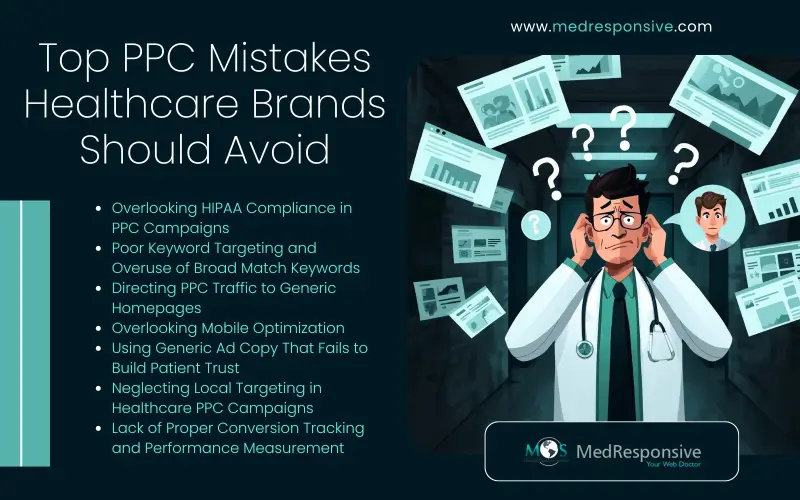
7 Common Healthcare PPC Mistakes
The following are the common PPC mistakes in healthcare marketing
- Overlooking HIPAA Compliance in PPC Campaigns
One of the most critical mistakes healthcare marketers make is overlooking HIPAA regulations when running medical PPC campaigns. Any advertisement that collects patient information must comply with healthcare privacy laws, and this responsibility extends beyond the ad itself to the landing pages where users submit their data. If patient information is collected through unsecured forms or handled improperly, it can lead to serious legal and financial consequences.
To avoid this, healthcare organizations should always use HIPAA-compliant forms on landing pages, avoid referencing specific patient information or medical conditions in ad copy, and ensure that all personal health data collected through PPC funnels is encrypted and securely stored. Addressing compliance from the beginning protects patient privacy and prevents costly penalties.
- Poor Keyword Targeting and Overuse of Broad Match Keywords
Using broad match keywords too aggressively is another common healthcare PPC error. While broad keywords can help reach a larger audience, they often trigger ads for irrelevant searches that have little connection to the services offered. This results in wasted ad spend, lower conversion rates, and a higher cost per lead. For example, bidding on a broad keyword such as “doctor” may bring in searches related to different medical specialties, job opportunities, or even television shows. To improve targeting, healthcare marketers should use phrase match and exact match keywords, regularly update their negative keyword lists, and monitor search term reports weekly to identify irrelevant queries. Tightening keyword targeting helps ensure that ads reach people who are genuinely searching for the medical services provided.
- Directing PPC Traffic to Generic Homepages
Directing PPC traffic to a homepage is a frequent mistake that can significantly reduce campaign performance. Homepages are typically designed to provide general information about a healthcare organization rather than guide visitors toward a specific action. As a result, potential patients may struggle to find what they need and leave the site without converting. Instead, PPC ads should direct users to dedicated landing pages that match their search intent. For example, someone searching for “urgent care near me” should be taken to a page focused specifically on urgent care services. High-performing healthcare landing pages typically include a strong headline that aligns with the ad copy, easy access to contact forms or phone numbers, trust signals such as testimonials and certifications, and a mobile-friendly design with fast loading speeds. Optimized landing pages can greatly improve patient conversion rates.
- Overlooking Mobile Optimization
As more people rely on mobile devices to search for healthcare services, failing to optimize your PPC campaigns for mobile can result in missed opportunities. Healthcare businesses that don’t adapt their ads, landing pages, or websites for mobile users’ risk distancing a large segment of their audience. Ensure that your PPC ads and landing pages are mobile-friendly. Test how your landing pages look and function across different devices to make sure the experience is smooth for users on smartphones and tablets. Mobile optimization for PPC campaigns can boost your conversion rates and provide a better user experience for potential patients.
- Using Generic Ad Copy That Fails to Build Patient Trust
Healthcare is a trust-driven industry, yet many PPC ads use generic promotional language that fails to connect with patient concerns. Patients are not simply purchasing a product—they are choosing a provider who will impact their health and well-being. Generic ad copy often sounds like a standard sales message rather than addressing patient needs. To build credibility and improve click-through rates, healthcare ads should highlight patient benefits and outcomes, include trust signals such as “Board Certified,” “20+ Years of Experience,” or “Trusted by 10,000+ Patients,” and speak directly to common patient concerns. For instance, instead of using a basic call-to-action like “Book Now for Fast Service,” a more reassuring message would be “Same-Day Appointments with Certified Physicians—Your Health Comes First.” Patient-focused messaging strengthens trust and encourages more users to take action.
- Neglecting Local Targeting in Healthcare PPC Campaigns
Since most healthcare services are location-specific, failing to use precise local targeting can significantly reduce the effectiveness of PPC campaigns. For example, someone searching for a “dentist” in California is unlikely to be interested in a provider located in New York. However, many healthcare campaigns are still launched without proper geo-targeting, which results in ads being shown to irrelevant audiences, and incurring wasted advertising spend.
To improve campaign performance, healthcare marketers should focus on strong local targeting strategies. These include using radius targeting around the practice location, excluding regions or cities that are outside the service area, and customizing ad copy with specific city names or neighborhood references. Hyper-localized PPC campaigns typically deliver higher click-through rates and better conversion performance compared to broad national campaigns.
- Lack of Proper Conversion Tracking and Performance Measurement
Another major healthcare PPC mistake is running campaigns without proper conversion tracking. Without accurate tracking, it becomes difficult to determine which keywords, ads, or devices are actually generating patient inquiries or appointments. Many marketers rely only on click metrics, but clicks alone do not provide a clear picture of campaign effectiveness. By implementing advanced conversion tracking through tools like Google Tag Manager or CRM integrations, healthcare organizations can monitor important actions such as form submissions, phone calls, appointment bookings, and live chat interactions. Having access to this data enables marketers to make informed decisions, optimize campaigns, allocate budgets more effectively, and scale strategies that are proven to drive results.
Healthcare organizations that want to maximize their advertising budgets and attract the right patients must avoiding common PPC mistakes. By refining targeting, improving ad messaging, ensuring compliance, and continuously optimizing campaigns, providers can significantly improve their results. Implementing effective PPC strategies for healthcare providers not only boosts visibility but also increases patient engagement and appointment bookings. A reliable healthcare SEO agency can further strengthen your digital marketing efforts by combining SEO and PPC insights to deliver sustainable growth and better long-term outcomes.