
AI in healthcare marketing is rapidly reshaping how healthcare providers reach patients, deliver meaningful content, and drive long-term engagement. Gone are the days when healthcare marketing relied solely on traditional outreach. Today, artificial intelligence in healthcare has taken center stage, empowering marketers with tools to improve precision, efficiency, and personalization like never before.
Healthcare organizations that embrace advanced technologies typically experience tangible gains in patient acquisition, stronger retention rates, and improved brand reputation. From streamlined automated campaign workflows to smart patient engagement tools like AI-powered chat support, innovation is reshaping how providers connect with their audiences. These advancements are far more than industry buzzwords — they are redefining digital marketing for healthcare, elevating the effectiveness of healthcare digital marketing services, and establishing a new benchmark for personalized, patient-focused communication. In this post, we will take a closer look at how AI is transforming healthcare marketing, explore the key advantages driving this shift, examine real-world applications, and discuss what the future of AI in healthcare marketing trends could mean for providers heading into 2026 and beyond.
Key Benefits of Using AI in Healthcare Marketing
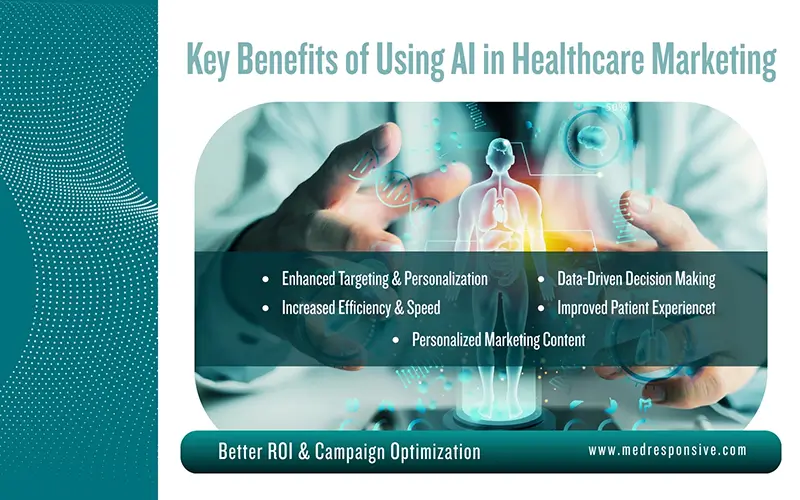
Using AI in healthcare marketing has many advantages, including improved efficiency and personalization. Below discussed are some key benefits of AI in healthcare digital marketing:
- Enhanced Targeting and Personalization: AI algorithms analyze large volumes of data to segment audiences and identify optimal messaging strategies, leading to higher engagement and reduced wasted spend.
- Increased Efficiency and Speed: AI processes complex tasks quickly — from campaign management to analytics reporting — freeing teams to focus on strategic storytelling and creative direction.
- Data-driven Decision Making: AI provides real-time insights into campaign performance, patient behaviors, and predictive trends, allowing marketers to make quick, informed decisions that improve campaign outcomes.
- Improved Patient Experience: Tools like AI Chatbot for healthcare websites enhance accessibility and streamline patient journeys, creating frictionless interactions and reinforcing trust in healthcare brands.
- Personalization of Marketing Content: AI empowers healthcare organizations to craft marketing content that feels individualized for each recipient. By analyzing data points such as age, location, search behavior, appointment history, and social media engagement, AI tools can dynamically create personalized content. This could be in the form of email newsletters (tailored to a patient’s past services), digital ads or website banners that change based on browsing habits. Such level of personalization strengthens patient trust, and fosters a more patient-centered brand identity.
The Role of AI in Healthcare Marketing
At its core, AI — especially machine learning, natural language processing, and predictive analytics — gives healthcare marketers the ability to harness powerful insights from complex data sets. With millions of patient interactions happening online every day, AI tools can analyze patterns and behaviors, helping marketers create targeted, meaningful campaigns that resonate with the people they serve. From enhancing ad targeting to automating routine campaign tasks, AI enables healthcare teams to operate with unmatched speed and accuracy. Below are some impactful applications that demonstrate how AI is reshaping healthcare marketing in 2026 and beyond.
- AI-powered Chatbots and Virtual Assistants: One of the most visible applications of artificial intelligence in healthcare marketing is the use of AI-powered chatbots and virtual assistants on healthcare websites and digital platforms. These intelligent systems can interact with visitors in real time — answering frequently asked questions, scheduling appointments, guiding users through forms, and providing information about services without human intervention. As these AI chatbots operate 24/7, they enhance user engagement and drastically improve response times, leading to higher patient satisfaction. Ready access to information reduces calls to support staff and ensures that inquiries are handled consistently and efficiently. Over time, chatbot interactions can also feed valuable patient behavior data back into marketing systems for improved targeting and personalization.
- Personalized Content Creation: AI tools can analyze individual patient behaviors, demographics, search histories, and interaction patterns to generate highly personalized content — from email newsletters and blog posts to targeted social media ads. Instead of generic messaging, AI enables marketers to deliver content that resonates with specific audience segments. For example, a patient frequently researching pediatric care might receive tailored updates on children’s health services, while a senior citizen might get information about chronic condition management. This level of personalization improves engagement and strengthens patient loyalty.
- Predictive Analytics for Targeted Campaigns: By processing historical data through machine learning models, AI can forecast future trends — such as who might need flu shots, which patients are likely to respond to specific outreach, or which services will be in high demand. With these insights, healthcare marketers can launch precision-targeted campaigns that reach the right people at the right time. This not only increases effectiveness and conversion rates but also reduces wasted marketing spend.
- Automation of Marketing Operations: AI significantly automates routine marketing operations — freeing up teams to focus on strategy and creative work. Tasks such as campaign scheduling, lead prioritization, performance tracking, and even real-time adjustments can now be handled by AI platforms. For example, an AI system can automatically adjust campaign settings based on early engagement results, reallocating budgets or reshaping messaging to boost performance — all without manual oversight.
- Voice Search Optimization: Voice search is becoming an essential part of digital engagement, especially as more people use voice assistants like Siri, Google Assistant, or Alexa to find health information. Optimizing for voice search involves using more natural, conversational phrases in content that mirror how people speak. By fine-tuning content to match these search patterns, healthcare brands can improve visibility and accessibility in voice search results.
- Social Media Monitoring and Sentiment Analysis: AI-powered sentiment analysis tools crawl social media, review platforms, and online forums to detect tones, trends, and public reactions to services or messages. This capability enables healthcare marketers to respond proactively if negative sentiment arises or to amplify positive feedback and leverage it in promotional efforts. Real-time sentiment insights help organizations stay connected with their audience, build trust, and maintain a patient-centric brand image.
Practical Tips for Using AI in Healthcare Marketing
Integrating artificial intelligence in healthcare marketing can dramatically improve efficiency, personalization, and performance — but it should be done thoughtfully to ensure compliance, trust, and positive patient experience. Below are actionable tips to help your organization get the most out of AI tools while safeguarding patient data and maintaining credibility.
- Protect Patient Information: Healthcare marketers work with sensitive data, especially protected health information (PHI). When using AI systems that may process or store patient data, it’s essential to ensure they comply with relevant data privacy regulations, such as HIPAA in the U.S. or GDPR in Europe. Before adopting any AI tool:
- Review its privacy policy.
- Confirm security certifications and data handling protocols.
- Understand how the tool manages, stores, or shares sensitive information.
- Fact-check AI-generated Content: AI tools can create content quickly — from email campaigns and social posts to blog copy — but they are not perfect. In healthcare marketing, where information accuracy is critical, AI-generated content must be reviewed and verified before publication. Best practices include:
- Having qualified humans edit and approve all AI-generated medical content.
- Ensuring clinical or subject matter experts validate any health-related messaging.
- Avoiding reliance on AI alone for statements concerning treatments, conditions, or health outcomes.
- Personalize Outreach with Caution: AI excels at audience segmentation and personalized messaging based on behavioral data. However, there’s a fine line between helpful personalization and overly intrusive messaging. Avoid referencing specific medical conditions or implying intimate knowledge of individual health situations. Tailor content based on broader inferred interests or general behavioral insights rather than deeply personal or sensitive data points. Always respect patient privacy and expectations when designing AI-powered personalization. This fosters trust while still delivering relevant and engaging content.
- Use AI for Routine and Time-consuming Tasks: One of the biggest advantages of AI in healthcare marketing is its ability to automate repetitive tasks that would otherwise take up valuable staff time. Examples include:
- Scheduling social media content.
- Generating routine performance reports.
- Analyzing engagement metrics across channels.
- Automating email sends or segmentation workflows.
- Combine Human and AI Insights: AI tools are powerful at analyzing large datasets and spotting patterns, but they lack the emotional intelligence that human teams bring. The most effective healthcare marketing strategies combine both. To get the best results:
- Use AI to gather insights and identify opportunities.
- Allow human experts to interpret these insights, make decisions, and tailor messaging.
- Maintain human oversight in areas where empathy, judgment, and ethical considerations are essential.
This approach ensures that AI supports — rather than replaces — human creativity and judgment in healthcare marketing.
- Test, Monitor, and Refine Continuously: Start small, by testing tools on specific campaigns or channels, and measure performance against clear metrics like engagement, conversions, or ROI. Good testing practices include:
- Running pilot campaigns with AI tools before full rollout.
- Setting KPIs to evaluate performance.
- Monitoring results regularly and adjusting strategies as needed.
- Iterating based on feedback and outcomes.
- Greater Personalization at Scale: AI will make it possible to deliver one-to-one patient experiences across every digital channel — from email to mobile apps — with messaging tailored to individual preferences and health histories.
- Predictive Outreach and Real-time Automation: AI systems will not only respond to current patient behavior but predict future needs — enabling proactive outreach and more meaningful patient relationships.
- Integration with Voice Search and Conversational Interfaces: With more patients using voice assistants and conversational search, healthcare content will be optimized for natural language queries, improving accessibility and reach.
- Ethical and Privacy-first Marketing: As data collection grows more advanced, AI tools will be built with strict privacy controls to ensure compliance with evolving healthcare regulations and patient expectations.
Neglecting data protection can lead to breaches, legal penalties, and loss of patient trust — risks that outweigh the benefits of automation.
This reduces the risk of misinformation and ensures your messaging remains safe, trustworthy, and compliant.
By delegating these routine tasks to AI, your team can focus more on high-value activities such as strategic planning, creative content, and campaign optimization.
AI systems evolve over time, and what performs well today may need refinement tomorrow — ongoing oversight ensures sustained success and alignment with your goals.
Future of AI in Healthcare Marketing Trends
Looking ahead, innovation in AI will continue to accelerate, transforming the way healthcare marketers approach strategy and execution. Here’s what to expect:
The future of AI in healthcare marketing trends points toward smarter, more responsive, and highly patient-centric strategies that deliver value at every touch point — from first search interaction to long-term care engagement.
The growing adoption of AI in healthcare marketing is far more than a temporary shift. It represents a fundamental change in how providers engage with patients, streamline marketing operations, and deliver highly personalized experiences. From healthcare digital marketing enhanced by predictive analytics to responsive support systems like AI chatbots for healthcare websites, the advantages are undeniable. Together, these innovations are reshaping digital marketing for healthcare, making it smarter, faster, and more patient-centric than ever before.
Discover how smart, data-driven digital marketing for healthcare can elevate patient engagement and accelerate growth.