
Keywords act as a signboard that directs people to your website. Every piece of online content—whether a website page, blog, article, or social post—relies on keywords to help search engines understand what the content is about. Among the different types of keywords used in SEO, one of the most valuable yet often overlooked are the semantically related keywords, also known as LSI (Latent Semantic Indexing) keywords.
These are words and phrases that are conceptually connected to your primary keyword. For example, for the keyword “house,” semantic keywords could include “home,” “residence,” “property,” “real estate,” and so on. When strategically integrated, these keywords help search engines understand the full context of your content and match it more accurately with user queries. An experienced healthcare SEO agency uses LSI keywords to enhance relevance and ranking on search engine results pages (SERPs).
This post explores the importance of semantic keywords, where to place them, and how you can use them to create high-ranking, user-focused content.
Birth of Semantic Keywords (Semantically Related Keywords)
A decade ago, search engines like Google and Yahoo primarily relied on keyword frequency. The more times a keyword appeared, the more relevant the content seemed. As a result, content writers often stuffed keywords unnaturally just to rank higher.
In 2013, Google launched its revolutionary Hummingbird algorithm, which shifted SEO away from keyword repetition toward context and user intent. Instead of matching exact keywords, Google began to understand meaning, variations, and relationships between words. This made semantic keywords crucial for modern SEO.
Writers now have to produce content rich in meaning, not just in keywords. Semantically related phrases became essential because they help search engines evaluate the overall topic, not just the presence of specific keywords. This shift contributed heavily to semantic SEO, reinforcing the importance of deeper content understanding.
What Are Semantic Keywords?
Semantic keywords are conceptually connected phrases that help search engines understand the context of your content. They are not merely synonyms—they can include:
- Related subtopics
- Variations of a phrase
- Industry-specific terms
- Words commonly associated with your primary keyword
For example, if your main keyword is “sunset,” semantic keywords could be “twilight,” “golden hour,” “evening sky,” “sunset photography,” etc.
These keywords help Google grasp what your content truly means rather than simply matching exact words. With Google’s increased focus on semantic search, using these keywords significantly enhances your visibility and relevance.
How Semantic Keywords Improve Search Engine Rankings
Including semantic keywords makes your writing:
- More natural: Repeating a primary keyword too many times makes content monotonous. Semantic keywords help maintain variety without losing relevance.
- More relevant to user intent: Semantic variations help you answer the full scope of what users are searching for.
- More search-engine friendly: Google places well-written, semantically rich content among top-quality results because it understands the deeper context.
- Unique compared to competitors: Semantic keywords act as differentiators in your content, making it stand out among others targeting the same main keyword.
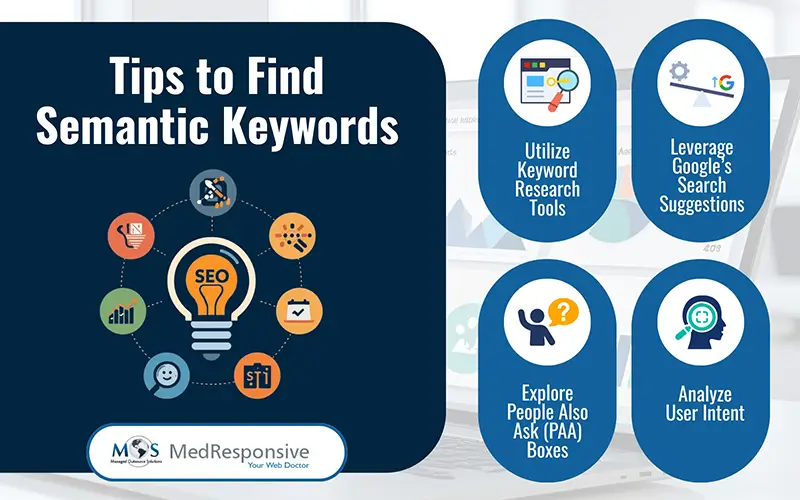
How to Find Semantic Keywords
- Utilizing Keyword Research Tools: Keyword research tools are invaluable for discovering contextually related and high-search-volume terms connected to your primary keywords. These platforms analyze large amounts of online content to reveal semantic patterns, related keyword phrases, and keyword variations that support topical relevance. When you are unsure which keywords to focus on, sorting them by metrics like volume and competitiveness can improve your strategy. Using these tools helps uncover semantically related keywords that strengthen optimization, enhance content depth, and increase your likelihood of ranking higher in search results.
- Google keyword planner
- Serpstat
- KWfinder
- Keyword Tool
- Wordtracker
- Key Collector
- Wordstream
- Keys4up
- LSI Graph
- Semantic link
There are several tools available today for conducting effective semantic keyword research. These include:
- Leveraging Google’s Search Suggestions: Google’s autocomplete feature is a simple yet powerful way to identify semantic keywords that reflect real user search behavior. Typing your target keyword into the Google search bar reveals additional phrases commonly used by searchers. Incorporating these terms into your content improves relevance, ensures stronger alignment with user intent, and boosts SEO performance. Google’s suggestions help you better meet audience expectations and increase your chances of appearing in more prominent search positions.
- Exploring People Also Ask (PAA) Boxes: People Also Ask (PAA) boxes showcase frequently asked questions related to user queries and provide valuable insight into search behavior. These questions help identify what users truly want to know, allowing you to build content that directly answers their concerns. By addressing PAA questions effectively, you enhance content authority, increase topical relevance, and improve the chances of ranking in featured snippets or other high-visibility placements.
- Analyzing User Intent: Understanding user intent, informational, navigational, or transactional, is essential for effective keyword usage. Knowing what currently ranks for your target keywords helps clarify user expectations. Aligning your content with this intent helps boost engagement, and improves SEO outcomes. This also helps refine contextual keyword usage for maximum relevance.
Best Places to Include Semantic Keywords for SEO
If you are a writer with many years of experience, you might know that stuffing keywords would give you negative results. The same is applicable to semantic keywords as well. If you use semantic words of the primary keyword, it would increase the potentiality for improving the ranking of your website.
You can include semantic keywords in various places in your content. Let’s discuss them in detail.
- Webpage Title
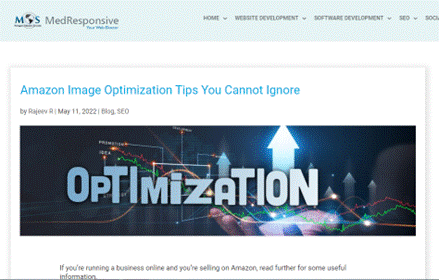
Starting from the head of your website, the title of your webpage is the perfect place to include semantically related keywords. Since it would appear among the search engine results, it is a good strategy to have the title explain what is inside your webpage.
- Website URL
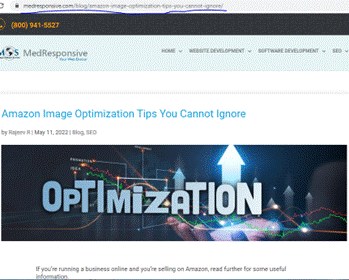
URL is the address of a webpage. After the web page title, the URL is an optimal place to include the main as well as semantically related keywords.
- Meta Description
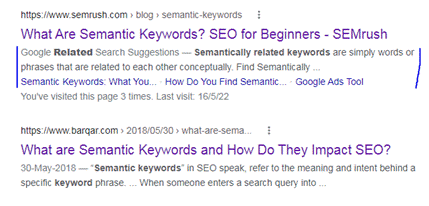
Meta description is what appears in the SERP (Search Engine Result Page). It assists Google in determining the content on the webpage. Thus, it is an effective place to add keywords, especially semantic keywords.
- Header
Head tags provide clues to Google regarding what the webpage is all about. Thus, it carries a lot of potential for SEO. So, it is also a suitable place for adding semantic keywords along with relevant keywords.
- Anchor Text
Anchor texts are the visible characters or words where a hyperlink is attached, that links to another document or webpage of your website. Adding or using semantically related keywords helps search engines as well as users to comprehend the content of that page.
- First and Last Paragraphs
As semantic keywords are attributed to the context of the blog or article, it is important to add them in the first as well as the last paragraphs. This will help the search engine bots to start their crawl in the first paragraph and finish it in the last paragraph.
Semantic keywords are an essential part of modern SEO. With search engines now focusing on context, topic depth, and user intent, semantically related keywords help search engines understand your content more accurately. They improve relevance, enhance readability, boost rankings, and keep your audience engaged.
By researching the right semantic keywords and placing them strategically, across headings, paragraphs, meta descriptions, alt text, FAQs, and anchor text, you create content that aligns with user intent and stands out in competitive search results.
Ready to elevate your SEO game?
Let’s begin.
Contact Us