
Digital marketing for healthcare has become a critical strategy for clinics, hospitals, and individual practitioners aiming to differentiate themselves in a highly competitive market. Today’s patients rely less on referrals or directories and more on online searches to evaluate and choose healthcare providers. Visibility and credibility across digital platforms significantly influence patient decisions. Paid advertising in healthcare digital marketing plays a key role in boosting online presence, reaching the right audience, and generating measurable patient engagement.
What Is Digital Marketing for Healthcare?
Healthcare digital marketing refers to all online strategies that healthcare organizations use to attract, engage, and retain patients. This includes search engine optimization (SEO), content marketing, email campaigns, social media engagement, and — importantly — paid advertising. Unlike traditional marketing that often lacks precise targeting or immediate feedback, digital marketing provides analytics, adaptability, and unmatched reach. Paid advertising enables healthcare providers to connect with patients at the exact moment they are searching for services.
Understanding the Role of Paid Ads in Healthcare Digital Marketing
Paid ads are advertisements that healthcare organizations pay to display on search engines and social media platforms. Rather than waiting for organic SEO results, paid campaigns such as Google Ads, Meta Ads (Facebook and Instagram), and YouTube ads allow providers to appear at the top of search results or in users’ social feeds instantly.
How Do Paid Ads Work?
Paid advertising is commonly delivered via pay-per-click (PPC) campaigns where healthcare providers pay each time a prospective patient clicks on an ad. These ads can be tailored to target specific demographics (e.g., age, location, interests) and display personalized messages to potential patients. These are highly effective for services that depend on local or specialized visibility.
The role of paid ads in healthcare digital marketing is multifaceted — from capturing high-intent search traffic to reinforcing brand presence across digital channels. With paid campaigns, you can ensure your practice appears for specific searches such as “urgent care near me,” “physiotherapy services,” or “best pediatric clinic in [City],” which increases the chances of new patient acquisition.
Boost patient reach with targeted healthcare ads
Benefits of Paid Advertising for Healthcare Providers
The benefits of paid advertising for healthcare providers go far beyond visibility — they extend into measurable results, optimized spend, and strategic brand building.
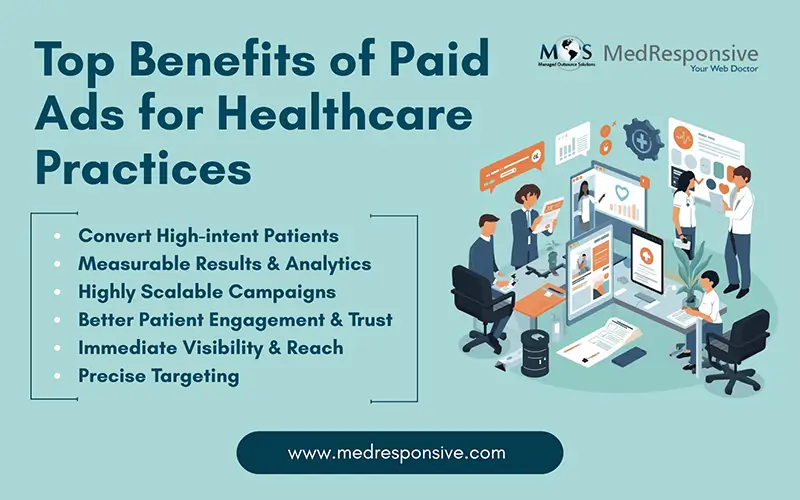
- Convert High-intent Patients: Paid ads help practices capture high-intent users — those actively searching for care. For instance, someone searching for “urgent care center near me” often has immediate healthcare needs. Placing your service at the top of those search results increases the likelihood of converting that search into an appointment.
- Measurable Results and Analytics: Unlike many traditional advertising methods, paid digital campaigns give healthcare marketers data on impressions, clicks, conversions, and cost per acquisition. This enables campaign optimization in real time — adjusting budgets, bids, and messaging for maximum efficiency.
- Highly Scalable: Paid advertising campaigns can be scaled to fit any budget. Whether you are a small clinic or a large hospital network, campaigns can be adjusted to broaden reach or target specific niches. This makes paid advertising in healthcare a versatile tool for both short-term campaigns and long-term growth.
- Better Patient Engagement and Trust: When executed well with patient-focused messaging and clear calls-to-action (like “Book an Appointment” or “Consult with a Specialist Today”), paid ads can improve engagement and establish trust with the audience even before they walk through your door.
- Immediate Visibility and Patient Reach: One major benefit of paid advertising in healthcare is instant visibility. Unlike SEO, which takes time to show results, paid campaigns can place healthcare providers at the top of search results as soon as they launch. This is especially useful for new clinics, time-sensitive services, or seasonal healthcare needs.
- Precise Targeting for Better Patient Engagement: Healthcare providers can customize campaigns based on location, demographics, search intent, and user interests across digital platforms. This targeted approach helps practices connect with patients actively seeking specific services. Paid ads are especially effective for local providers looking to drive appointment-ready leads.
Paid Ads Complement Organic Marketing
While paid ads are essential, they are most effective when integrated with organic strategies such as SEO and content marketing. Paid campaigns deliver quick wins, while search optimization and content efforts build long-term visibility and authority. When these channels work together, the strategy becomes more robust — fuel immediate patient acquisition while building trust and organic reach over time. For example, a new clinic might use paid advertising for rapid visibility in local searches while investing in high-quality SEO content that will generate organic traffic as its reputation grows. This blended approach ensures that your practice is seen both now and in the future.
Best Practices for Paid Advertising in Healthcare Digital Marketing
- Focus on High-intent Keywords: Choosing the right keywords is essential for successful paid advertising in healthcare. Target search terms that reflect immediate patient needs, such as treatment-specific or location-based queries. High-intent keywords help attract users actively looking for care, increasing the likelihood of conversions. Avoid overly broad terms that may drive traffic but not appointments. Continuous keyword refinement improves campaign efficiency over time.
- Optimize Landing Pages for Conversions: A paid ad is only as effective as the landing page it leads to. Healthcare landing pages should be clear, relevant, and focused on a single goal—such as booking an appointment or requesting a consultation. Include concise messaging, trust signals (certifications, reviews), and easy-to-use contact forms. A fast-loading, mobile-friendly page significantly improves patient engagement and conversion rates.
- Use Geo-targeting and Audience Segmentation: Geo-targeting allows healthcare providers to reach patients within a specific service area, making campaigns more cost-effective. Audience segmentation based on age, gender, interests, or search behavior further improves relevance. This ensures your ads are shown to people most likely to need your services.
- Track Performance and Optimize Regularly: Monitor key metrics such as click-through rates, cost per conversion, and appointment bookings. Use this data to refine ad copy, bidding strategies, and targeting parameters. Ongoing optimization ensures campaigns remain effective and aligned with patient behavior.
- Maintain Compliance and Patient Trust: Healthcare advertising must adhere to privacy regulations and platform-specific policies. Avoid misleading claims, protect patient data, and use compliant language in ad copy. Transparency and accuracy help build trust with potential patients. A compliant approach not only prevents penalties but also strengthens your brand credibility in the long run.
Maximizing Impact with Paid Advertising in Healthcare
Paid advertising increases immediate visibility and drives targeted traffic, enables precise audience engagement, and delivers measurable outcomes that help healthcare providers grow sustainably. When integrated with organic strategies like SEO and content marketing, paid ads become a powerful tool that ensures both short-term conversions and long-term patient relationships. For providers aiming to stay ahead in a competitive digital landscape, investing in paid advertising in healthcare isn’t just an option — it is a strategic imperative for sustainable growth and impactful patient acquisition.