
Healthcare apps are reshaping the patient experience—making care more accessible, efficient, and outcome-driven. Developing an application that meets the requirements of the intended user is a monumental undertaking. A solid understanding of best practices in medical application development is critical to ensuring compliance, usability, and high-quality patient care. The application must be secure, easy to use, and meet regulatory guidelines (such as HIPAA) for the healthcare industry. Developing a secure and compliant healthcare app is critical to success in this highly regulated field. A successfully implemented healthcare app drives patient engagement, lowers operational costs, and builds trust between users and healthcare providers.
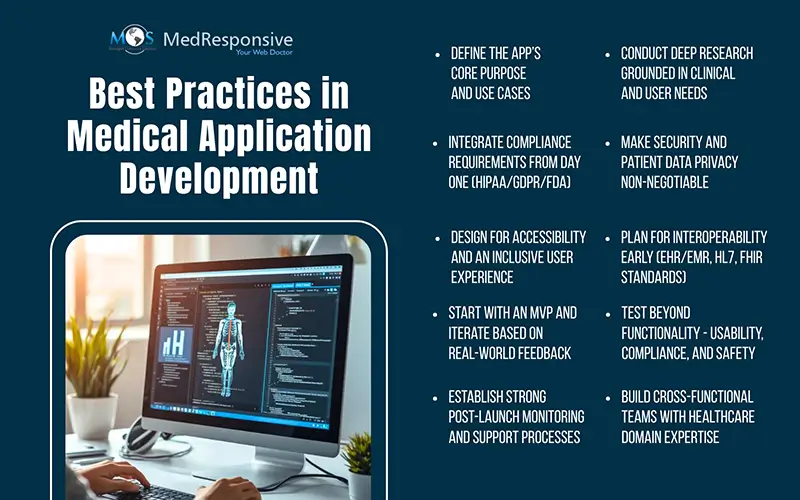
Best Practices in Medical Application Development
Medical application development is by no means an easy task. The development is a journey and the work doesn’t stop once it is launched. When you follow these best practices, your app won’t just perform well but adapt and grow as healthcare changes:
- Define the core focus area of the app
Determine the type of medical app you are going to develop and who its intended users are–whether it is patients or doctors or administrative staff or the combination of all three. Once you figure this out, your medical app development process is likely to proceed smoothly. This will ensure your application has the required features to meet the operational goal such as faster diagnosis or improved scheduling.
Identify a single use case to limit the scope of problem you are attempting to solve such as telehealth, chronic care management or integration with a hospital’s electronic health record system. Create basic user personas, for example, a senior citizen, a busy physician, front desk staff, to ensure that the processes you are developing mirror how real people behave rather than the way you presume people to behave.
- Research to ground the application
Prior to initiating the coding process, understand the daily experiences of the target group. Involve your product and UX teams to conduct questionnaires and one-on-one conversations with all the mentioned groups (patients, doctors, nurses and admin staff) to not only spot the shortcomings in existing products but also to learn about the communication and decision-making styles of the healthcare workers.
Carry out a study of the existing software to uncover the most preferred functionalities and the areas where the competitors are lacking particularly in terms of user-friendliness and trustworthiness. The research will give you an idea of what not to develop in an application that may appear ideal on paper, but does not fit into clinical workflow and/ or patients’ demands
- Ensure compliance is part of the plan
In medicine, regulations can be one of the factors that limit the design of applications. Nevertheless, you should still find out which regulatory frameworks are applicable in your market (like HIPAA in the US, GDPR and MDR in the EU) and then incorporate those regulations into your system architecture design to create a secure and compliant healthcare app.
Invite legal and compliance experts to help you right at the beginning of medical application development process in order to avoid major changes or costly rework during the development cycle.
- Consider security and privacy to be non-negotiable
Healthcare apps for patients and providers handle some of the most sensitive types of data that prevails today. Therefore, implementing security measures is a best practice to implement from day one. It is important to use strong encryption techniques for both data transmission via the internet and local storage.
It is also necessary to use a secure and reliable cloud infrastructure and have a well-defined policy which indicates the people who can access or view particular information. You can apply role-based access controls and multi-factor authentication to the most sensitive user groups. Besides, you need to implement automatic session timeouts to prevent accidental and unauthorized access. Having such organized and well-defined security protocols will enhance the trust level among medical professionals, patients, and procurement decision-makers.
- Design for accessibility and an inclusive user experience
Healthcare applications will be used by seniors, some of who may not be knowledgeable about the use of technology. Hence, it is very important to keep things simple to facilitate a better user experience. Accessibility standards, such as the Web Content Accessibility Guidelines (WCAG), should be followed and methods like large, legible text, colors with high contrast, and compatible layouts with screen readers and other assistive devices should be applied.
The app should make everyday tasks—like booking appointments, sending reports, or checking vital signs—quick and easy with minimal clicks. Buttons must be large, and the language simple, so even users with limited dexterity or health literacy can use the app confidently on their own.
- Develop Interoperability Plans Early
Usually, healthcare applications do not function as independent units and need to be integrated with hospitals, clinics, laboratories, insurance companies, and other systems in a smooth way. It’s essential to build safe APIs so your app can safely read and write data to electronic health record or electronic medical record systems, connect with wearable gadgets, and share scheduling and billing information with the hospital information system.
You should adopt standardized data formats (for example HL7, FHIR) so that integrating with new partners is not always a custom development task. In medical application development, standardized interoperability will enhance the appeal of your product to those providers that are in search of integration-friendly tools working alongside their existing workflows
- Begin with an MVP and iterate
Rather than rolling out a feature-rich application, create an MVP that satisfies one or two main objectives exceptionally well. The telehealth MVP, for instance, which would include secure video visits and simple scheduling. A chronic care MVP might focus on symptom logging and medication reminders.
Begin by introducing the version to a limited number of actual users, and collect analytics and information from interviews to find out their difficulties and which features they do not use or require. It is advisable that you work in short development cycles so that you can swiftly improve the product based on facts.
- Test Beyond Basic Functionality
Since even minor flaws have serious implications in medical contexts, testing must be broad and systematic. It is not enough just to perform unit and functional tests–run tests for usability, performance under load, security, and data integrity on all kinds of devices and operating systems.
Experiment with real-world scenarios, like those found in a shared group of devices in clinics, slower networks, and older hardware. This will help ensure that clinicians and patients experience a stable and predictable application whether they are working in a large hospital or a rural setting.
- Establish procedures for post-launch support
A medical application’s real trial comes when it is introduced to actual patients, physicians, and healthcare systems. Carry out the monitoring of crashes, errors, and performance of the application and also record usage patterns to find out which features are valuable and where users are leaving.
Assign a team of professionals for support requests, supplying fixes, and dealing with new regulatory requirements or platform updates. Consider the post-launch feedback as a source for permanent input to your roadmap.
- Assemble cross-functional teams with healthcare awareness
Medical app development should be handled by experienced teams that blend deep technical expertise with solid clinical and regulatory knowledge. From the very beginning, make sure that those who work in compliance, UX, and engineers think on the lines of safety, usability, and regulation. For instance, having a clinical advisor review the user interface can help prevent confusion that might lead to medical errors.
The support of constant teamwork between product, engineering, design, legal, clinical, and other departments can be really beneficial. When all departments have common goals and metrics, the result will be safer and more practical applications that fit real-world care delivery.
Common Mistakes to Avoid
Learning from the mistakes made by others can help you avoid pitfalls. Here are some common mistakes you need to avoid:
- Ignoring Users: Do not assume you know what your users want. Ask them and pay attention to what they say.
- Adding Too Much To Your Application: Avoid the mistake of adding too many features to your new application. Users are less likely to familiarize themselves with complex functions and adopt the application.
- Ignoring Security: Do not view security as optional. It is mandatory.
- Lack of Documentation: Keep a proper record of your decisions and processes as it will be helpful in later stages of maintenance and compliance.
- Launching Too Quickly: Don’t be in a hurry to launch your application. Give yourself enough time to test your application first. Launching too quickly can cause problems that may be difficult to resolve.
Key Takeaways
To develop healthcare apps for patients and providers, careful planning and execution are necessary. Concentrate on addressing an actual problem faced by your users. Security and compliance should be the first considerations in all decisions. Conduct extensive testing before the launch. Pay attention to user feedback and keep on improving. You can keep an eye on metrics such as user engagement, error rate, and patient satisfaction. It will give you a clear picture as to how your app is performing in real-time.
It is a fact that successful medical app development means the same as patient safety first, privacy rights and building trust. If the users are convinced that the app is working perfectly and their data is secure, the app will be successful.
Bringing Your Medical App Vision to Life
From idea to launch is a thorough process which demands commitment to best practices. Medical application development is not the same as the development of regular software. Following best practices will result in an app that really helps both medical professionals and patients. Your MVP should be the smallest possible version. Perform tests on everything. Be in constant communication with the users. Always prioritize security and regulatory compliance, and continue to monitor how your app evolves, scales, and delivers meaningful value to patients and providers.
Building such a medical app can be a daunting task but you don’t have to do it alone. Reach out to a specialized mobile app development company that has the technical expertise and knowledge of healthcare regulations to develop an app that is secure, compliant, and easy to use for both patients and healthcare providers.
Need help developing your medical app?
Our experts specialize in secure, compliant medical app development.
Contact Us