
The global behavioral health burden continues to intensify, placing pressure on traditional care systems that already operate under constrained clinical capacity. In response, digital tools such as AI chatbots have gained prominence, particularly conversational systems that simulate structured dialogue for screening, guidance, and early intervention. As adoption expands, organizations investing in healthcare app development services are embedding these systems into digital care ecosystems to improve accessibility, streamline triage, and support continuous interaction in structured treatment pathways.
This post explores how AI chatbots are transforming mental healthcare with support that extends beyond conventional appointment-based care.
Mental Healthcare Landscape and the Need for Scalable Digital Intervention
Psychiatric conditions represent a significant portion of global disease burden, yet access to care remains uneven across regions and populations. According to the World Health Organization, close to 1 billion people live with a mental disorder, highlighting the scale of unmet clinical need.
Healthcare systems face structural limitations that include clinician shortages, long waiting periods, and uneven distribution of psychiatric services. These constraints have led organizations to explore technology-supported care models that complement traditional therapy rather than replace it.
Key systemic pressures include:
- Limited availability of licensed mental health professionals in many regions
- Delayed diagnosis due to low screening penetration
- High cost of continuous therapy for long-term conditions
- Stigma that prevents individuals from seeking early intervention
Digital engagement models have emerged as an operational response to these barriers. Within this environment, conversational systems powered by artificial intelligence provide structured, scalable interaction points that support early-stage psychological assessment and guidance.
Looking to develop an AI-powered mental health solution?
Our experts build secure, scalable platforms tailored to modern behavioral care needs.
Expanding Role of AI Chatbots in Mental Healthcare
The emergence of AI chatbots transforming mental healthcare reflects a broader restructuring of how early mental health support is delivered. These systems function as AI-enabled conversational interfaces designed to simulate therapeutic dialogue, provide coping frameworks, and assist in symptom tracking.
Unlike static mental health applications, modern systems integrate natural language processing and contextual reasoning to interpret user input in real time. This enables adaptive responses that align with emotional tone, intent, and risk indicators.
Core functional characteristics include:
- Real-time conversational engagement using natural language models
- Structured mental health screening based on validated frameworks
- Continuous interaction outside clinical appointments
- Risk flagging mechanisms for escalation to human professionals
These systems do not replace clinical diagnosis but serve as an initial engagement layer that supports triage and early detection.
A further dimension shaping adoption is the measurable shift in intervention timing. In conventional mental health systems, escalation typically depends on self-reporting during scheduled consultations. AI-enabled conversational systems introduce continuous monitoring loops that capture incremental behavioral changes across interactions rather than relying on isolated clinical snapshots.
These systems identify subtle linguistic drift patterns, such as declining emotional variability, reduced response elaboration, and increased use of absolutist phrasing. When aggregated over multiple sessions, these signals contribute to a dynamic risk index that supports earlier clinical prioritization. This mechanism is particularly relevant in high-volume support environments where clinicians must triage cases based on urgency rather than conduct exhaustive assessments for every individual.
Another operational advantage lies in adaptive engagement sequencing. Instead of using static questionnaires, AI-driven systems modify follow-up questions based on prior responses, creating a branching interaction model that improves diagnostic resolution. This approach reduces informational gaps that typically arise when users disengage mid-assessment or provide incomplete responses.
From a governance standpoint, explainability has become a core requirement. Organizations are increasingly required to document why specific conversational patterns triggered escalation logic, ensuring transparency in clinical decision support environments.
Research published by Our World in Data highlights that mental health disorders contribute significantly to years lived with disability globally.
AI Architecture underlying Conversational Mental Health Systems
The effectiveness of AI-enabled mental health systems depends on layered architecture rather than a single model. Most enterprise deployments separate ingestion, inference, safety evaluation, and response generation into distinct functional layers.
At the ingestion stage, conversational inputs are normalized and anonymized to separate personally identifiable information from analytical processing streams. This design supports compliance requirements in regulated healthcare environments.
The inference layer typically uses transformer-based language models fine-tuned on domain-specific datasets. These datasets may include clinically annotated conversational patterns, diagnostic symptom clusters aligned with psychiatric frameworks, and anonymized therapeutic interaction transcripts. Fine-tuning improves contextual sensitivity when interpreting emotionally complex language.
A critical subsystem is the safety classification layer. This component evaluates outputs for crisis indicators, self-harm risk signals, and ambiguous emotional states that require human review. Unlike general sentiment analysis, it prioritizes escalation thresholds over classification precision alone.
Latency management also plays a role in production environments. Low-risk queries are handled through optimized inference pathways, while more complex or sensitive inputs trigger deeper model evaluation. This balance maintains conversational continuity without compromising safety.
Auditability completes the architecture. Every decision path is logged in structured formats that support clinical review and regulatory compliance. This ensures transparency in how responses are generated and escalated.
Model calibration is another key technical requirement. Domain-specific fine-tuning reduces misinterpretation of emotionally nuanced language, while controlled memory systems prevent over-reliance on outdated conversational context. Confidence scoring layers further determine whether outputs require secondary validation before user delivery.
System resilience is reinforced through failover pathways that maintain service continuity during infrastructure disruptions, ensuring stability in high-stakes care environments.
Applications of Conversational Systems in Behavioral Healthcare Delivery
AI-based conversational systems are being deployed across multiple care scenarios where scalable engagement is required.
Common applications include:
- Early-stage screening for anxiety and depressive symptoms
- Behavioral tracking through structured check-ins
- Cognitive behavioral therapy reinforcement exercises
- Crisis detection and escalation routing
- Psychoeducation and mental health literacy support
In corporate environments, these systems support workforce wellness programs by providing confidential interaction channels. In education settings, they assist in identifying early stress indicators among students.
Organizations frequently integrate these systems through healthcare app development services, ensuring secure architecture, regulatory alignment, and scalable deployment across user bases.
Role of AI in Reshaping Mental Health Interaction Models
AI introduces a shift from episodic care models to continuous behavioral monitoring frameworks. Instead of relying solely on scheduled clinical sessions, systems maintain ongoing interaction loops that track emotional variation over time.
This transformation is defined by:
- Movement from reactive intervention to proactive monitoring
- Use of behavioral signals for risk estimation
- Dynamic conversational adjustment based on user history
- Predictive modeling for early intervention triggers
In enterprise implementations, collaboration with teams specializing in medical app development ensures that systems meet compliance standards, interoperability requirements, and clinical validation protocols.
Integration with Digital Healthcare Ecosystems
Modern mental health platforms operate within interconnected healthcare ecosystems that include electronic health records, telehealth systems, and analytics platforms.
Key integration outcomes include:
- Unified patient data across digital and clinical systems
- Streamlined referral pathways to mental health professionals
- Centralized reporting dashboards for care providers
- Reduced fragmentation in patient history tracking
This interoperability ensures conversational systems contribute directly to clinical workflows rather than functioning as isolated tools.
Challenges and Limitations in Deployment
Despite technological progress, deployment introduces persistent constraints.
Key challenges include:
- Privacy risks associated with sensitive mental health data
- Misinterpretation of nuanced emotional language
- Dependence on high-quality training datasets
- Regulatory variation across jurisdictions
- Limited capability in acute psychiatric emergencies
Ethical governance and clinical oversight remain essential to maintaining system reliability and safety.
Future Direction of AI-enabled Mental Health Systems
The next phase of development focuses on multimodal and predictive systems that integrate text, voice, and behavioral data.
Emerging directions include:
- Multimodal emotional analysis combining speech and text signals
- Personalized mental health pathways based on longitudinal data
- Integration with wearable devices for physiological tracking
- Expansion of preventive mental health frameworks in workplaces
These advancements point toward proactive mental health ecosystems that prioritize early detection over reactive treatment.
Strategic Outlook on AI-Enabled Mental Health Transformation
The evolution of conversational systems signals a structural shift in how mental health services are delivered and scaled. The growing role of AI chatbots in transforming mental healthcare reflects this transition toward hybrid care models, where automation and clinical expertise work in tandem.
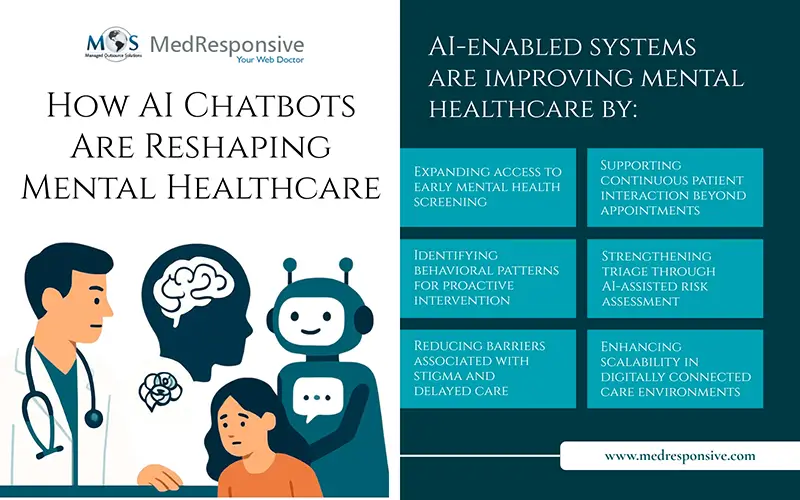
These systems improve accessibility, strengthen early detection, and support continuous engagement across diverse populations. Their long-term effectiveness depends on responsible deployment, clinical validation, and integration into broader healthcare ecosystems.
The future of mental healthcare will depend on how effectively organizations combine AI-enabled systems with human expertise, supported by advancements in medical app development, to deliver structured, scalable, and clinically reliable care pathways.