
Voice search is transforming the way patients find healthcare information online. With the growing use of voice assistants such as Siri, Alexa, and Google Assistant, people increasingly rely on spoken queries to search for nearby clinics, medical advice, and healthcare services. As a result, voice search optimization for healthcare has become an essential part of modern digital marketing strategies for medical practices, hospitals, and healthcare organizations.
However, optimizing healthcare content for voice search requires a different approach than traditional SEO. Many healthcare organizations make mistakes when attempting to adapt their content for voice-based queries. Understanding these healthcare voice search SEO mistakes can help providers improve their visibility, connect with patients more effectively, and enhance their online presence. An experienced healthcare SEO agency can help healthcare organizations implement advanced voice search strategies, improve search rankings, and create patient-focused content that aligns with modern search behaviors.
Why Voice Search Optimization Matters for Healthcare Marketing
Want to stay competitive in the digital space? Then, you must understand why voice search optimization matters for healthcare marketing. Voice search is rapidly becoming a preferred method for finding information online, particularly among mobile users. Patients increasingly rely on voice assistants to locate nearby healthcare providers, research symptoms, and schedule appointments. Effective healthcare voice search optimization enables medical practices to connect with patients at the exact moment they are searching for healthcare services.
Ranking for voice queries can dramatically increase exposure and patient inquiries. Voice search tends to prioritize local results, making it especially valuable for healthcare providers who depend on local patients.
Another reason why voice search optimization matters for healthcare marketing is its impact on the patient experience. Voice search delivers fast and convenient access to information, so that users can find answers without typing. Healthcare websites that provide clear, concise, and well-structured content are more likely to be selected as trusted sources.
Common Errors in Healthcare Voice Search Optimization
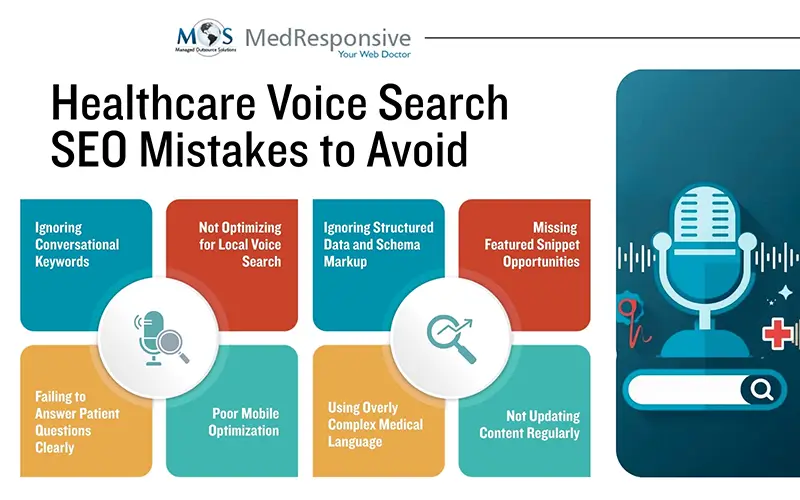
Here are some of the common mistakes in healthcare voice search optimization and how to avoid them:
- Ignoring Conversational Keywords and Natural Language: One of the most common mistakes is failing to adapt content to the conversational style of voice queries. Unlike traditional searches where users type short phrases such as “dentist near me,” voice search queries tend to be longer and more natural. For instance, a patient might ask, “Who is the best dentist near me for teeth whitening?” instead of typing a short keyword. If healthcare websites only focus on short keywords, they may miss opportunities to rank for these conversational queries. To avoid this mistake, providers should create content that answers common patient questions using natural language. Incorporating long-tail keywords and question-based phrases can significantly improve voice search performance.
- Failing to Optimize for Local Voice Search: When it comes to healthcare, many voice searches are location-based. Patients frequently use voice assistants to find nearby doctors, urgent care canters, pharmacies, or specialists. If a healthcare website does not prioritize local SEO, it may struggle to appear in voice search results. Healthcare organizations should ensure their business information—such as name, address, phone number, and operating hours—is accurate and consistent across all platforms. Optimizing for local search queries like “near me” or “closest clinic” is also essential. Partnering with professional agencies can help healthcare providers implement effective local SEO strategies that support both traditional and voice search visibility.
- Not Answering Patient Questions Clearly: Voice search results often prioritize content that directly answers users’ questions. Healthcare websites that provide vague, overly complex, or poorly structured information may struggle to appear in voice search results. Publishing content that does not directly address patient concerns is another common mistake. Instead of writing general articles, healthcare websites should create clear answers to frequently asked medical questions. Providing concise and informative answers increases the chances of voice assistants selecting the content as a featured snippet or spoken response.
- Overlooking Mobile Optimization: People perform searches most commonly on smartphones and mobile devices. If a healthcare website is not mobile-friendly, it can negatively affect voice search rankings. Slow-loading pages, difficult navigation, and poorly formatted mobile content frustrate users and reduce search visibility. Healthcare organizations must ensure that their websites load quickly, display properly on all screen sizes, and offer a seamless mobile experience.
- Ignoring Structured Data and Schema Markup: Structured data helps search engines better understand website content. Unfortunately, many healthcare websites overlook schema markup, which is a key element of healthcare voice search optimization. Using healthcare-related schema help search engines identify important information such as medical services offered, physician profiles, clinic locations, appointment availability and patient reviews. Adding structured data improves the chances of appearing in rich search results, which are often used for voice assistant responses.
- Creating Content That Is Too Complex: Healthcare content involves technical terminology, but overly complex language can reduce the effectiveness of voice search optimization. Voice assistants prioritize content that is easy to understand and clearly structured. Healthcare websites should aim to simplify their content without compromising accuracy. Using plain language, short paragraphs, and easy-to-understand explanations helps ensure that patients can quickly find the information they need.
- Neglecting Featured Snippet Opportunities: Featured snippets are the short answers that appear at the top of search results. Voice assistants may pull information directly from these snippets when responding to voice queries. Failing to structure content in a way that makes it eligible for featured snippets is another common error. Healthcare providers can increase their chances of capturing these positions by:
- Using question-based headings
- Providing concise answers under each question
- Organizing content with bullet points or lists
- Writing clear definitions or explanations
- Not Updating Content Regularly: Healthcare information changes frequently as new research, treatments, and medical guidelines emerge. Outdated content can harm credibility and reduce search engine rankings. Voice assistants prioritize fresh, reliable information when providing answers to users. Healthcare organizations should regularly review and update their website content to ensure accuracy and relevance.
Voice search is rapidly changing how patients search for medical information and healthcare providers online. As voice-enabled devices become more common, healthcare organizations must refine their digital strategies to match evolving search behaviors. By avoiding common healthcare voice search SEO mistakes – such as ignoring conversational queries, overlooking local optimization, or failing to create clear and structured content – providers can significantly improve their online visibility. Partnering with an experienced healthcare SEO agency can help organizations build a strong voice search strategy, improve search rankings, and stay competitive in the rapidly evolving digital healthcare landscape.
Avoid costly healthcare voice search SEO mistakes.