
In today’s digital-first healthcare environment, patients no longer rely solely on referrals or proximity when choosing providers. They search online for symptoms, treatments, appointment processes, insurance coverage, and post-care instructions. Healthcare organizations that anticipate and answer these questions gain a powerful advantage in search visibility. Patient FAQs for healthcare SEO play a critical role in enhancing your online visibility. Well-crafted FAQ content does more than answer common patient concerns—it strengthens your website’s relevance, authority, and usability. When implemented as part of a comprehensive healthcare SEO strategy, patient FAQs can significantly improve rankings, attract high-intent traffic, and enhance patient satisfaction. Healthcare practices can collaborate with a reliable healthcare SEO agency to develop and optimize patient-focused FAQ sections. This post explores the key role of FAQs in improving healthcare SEO and patient satisfaction, and how healthcare providers can leverage them as a long-term SEO asset.
Understanding Patient FAQs in Healthcare SEO
Patient FAQs are structured content sections designed to address the most common questions patients ask before, during, and after care. These questions may relate to symptoms, treatment options, costs, insurance acceptance, appointment scheduling, recovery timelines, or telehealth availability.
From an SEO perspective, healthcare SEO FAQs help search engines understand your content better. Google prioritizes pages that clearly answer user intent, especially in healthcare, where accuracy, clarity, and trust are essential. FAQs should align perfectly with how patients search—often in question-based queries such as “How long does recovery take?” or “Is this procedure covered by insurance?” By aligning FAQ content with patient search behavior, healthcare providers improve both discoverability and credibility. Below discussed are some key points on how FAQ content bridges the gap between search optimization and patient-centric communication:
- Capture High-intent Search Queries: Patients searching healthcare-related information usually have a strong intent—either to learn, compare, or book an appointment. FAQs allow websites to target long-tail, question-based keywords that are easier to rank for and often closer to conversion. Using Patient FAQs enables providers to appear in search results for highly specific queries, driving qualified traffic rather than generic visitors.
- Builds Trust through Transparency: Patients want clarity. FAQs that explain procedures, risks, timelines, and expectations reduce anxiety and position your practice as transparent and trustworthy.
- Reducing Friction in the Patient Journey: Clear answers to administrative questions—such as appointment booking, billing, or insurance—minimize confusion and reduce unnecessary calls. This not only improves patient satisfaction but also operational efficiency.
- Supporting E-E-A-T Signals: Google emphasizes Experience, Expertise, Authoritativeness, and Trustworthiness (E-E-A-T) in healthcare content. Well-written FAQs demonstrate subject expertise and reinforce your organization’s authority in its specialty.
- Improved Chances of Featured Snippets and Rich Results: FAQ-based content is ideal for featured snippets and “People Also Ask” results. When optimized correctly, FAQs can appear prominently at the top of search results, increasing visibility and click-through rates. Implementing FAQ schema markup further supports this goal, allowing Google to display expanded results that build trust before users even click.
- Improved On-page SEO and Content Relevance: Search engines assess relevance by analyzing how well content answers a user’s question. FAQs expand your page depth, semantic relevance, and keyword coverage without appearing forced or repetitive. This section enhances content comprehensiveness, keyword context and variation, page authority and topical relevance. This in turn helps websites rank higher for both primary and related search terms.
Best FAQ Content Strategy for Healthcare Websites
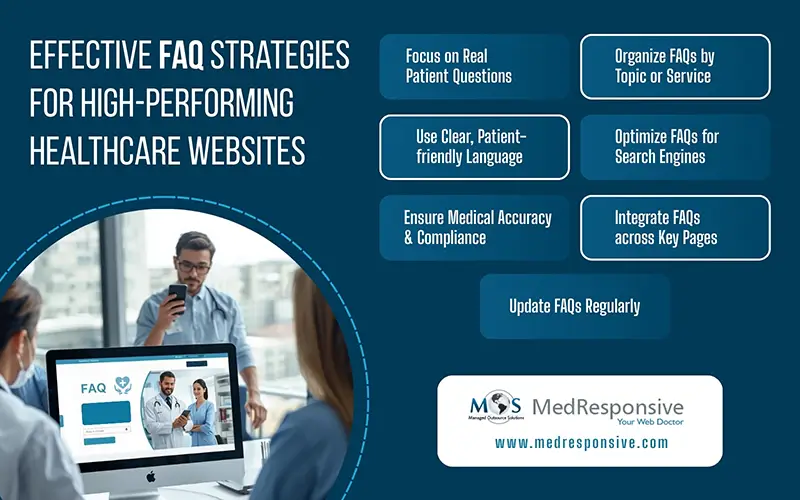
- Focus on Real Patient Questions: An effective FAQ strategy begins with understanding what patients actually want to know. These questions often come from appointment calls, online searches, reviews, and patient forms. Addressing real concerns improves content relevance and aligns with patient search intent. This approach helps healthcare websites rank for long-tail, high-intent queries. It also increases trust by showing patients their needs are understood.
- Organize FAQs by Topic or Service: Structuring FAQs by medical condition, treatment type, or service category makes content easier to navigate. Patients can quickly find answers without scrolling through unrelated questions. From an SEO perspective, organized FAQs improve internal linking and topical relevance. Search engines better understand page context, leading to better rankings. This structure also supports future content expansion.
- Use Clear, Patient-friendly Language: Healthcare FAQs should simplify complex medical information without sacrificing accuracy. Avoiding jargon ensures patients of all backgrounds can understand the answers. Clear language improves engagement, reduces bounce rates, and encourages patients to stay longer on the page. It also aligns well with voice search queries, which are often conversational. Patient-friendly content enhances overall satisfaction.
- Optimize FAQs for Search Engines: Each FAQ should be written in a question-and-answer format that mirrors how patients search online. Including relevant keywords naturally helps improve visibility without keyword stuffing. Proper use of headings, internal links, and schema markup enhances SEO performance. Optimized FAQs are more likely to appear in featured snippets and “People Also Ask” sections. This increases click-through rates and authority.
- Ensure Medical Accuracy and Compliance: Accuracy is critical in FAQ content, as misinformation can damage trust and credibility. All answers should be reviewed or approved by qualified professionals when possible. Compliant content aligns with healthcare regulations and Google’s E-E-A-T guidelines. This protects both patients and the healthcare organization. Reliable information strengthens long-term SEO performance.
- Integrate FAQs across Key Website Pages: FAQs should not be limited to a single page; they work best when embedded within service and treatment pages. Contextual FAQs support the main content without overwhelming users. This improves page depth, relevance, and engagement metrics. Search engines view such pages as more comprehensive and helpful. Integration also guides patients toward conversions.
- Update FAQs Regularly: Healthcare information, policies, and patient expectations change over time. Regularly updating FAQs ensures the content remains accurate and trustworthy. Fresh content signals relevance to search engines and improves rankings. Updates also help address new patient concerns and emerging treatments. A dynamic FAQ strategy supports sustainable SEO growth.
Leverage patient FAQs for healthcare SEO to strengthen your online visibility.
Patient FAQs are no longer optional—they are a strategic necessity in modern healthcare marketing. When executed correctly, patient FAQs for healthcare SEO enhance search visibility, improve user experience and patient trust.
By understanding the role of FAQs in improving healthcare SEO and patient satisfaction, providers can transform simple questions into powerful SEO assets. When combined with a well-defined healthcare SEO strategy, FAQs help providers rank higher, communicate better, and convert more patients. Adopting the best FAQ content strategy for healthcare websites ensures your content remains relevant, compliant, and valuable—both for search engines and the patients who rely on you for accurate information and care.