
Businesses increasingly rely on digital experiences to engage customers, improve operational efficiency, and create new revenue opportunities. As consumer expectations continue evolving, organizations across industries are investing in digital products that deliver convenience, accessibility, personalization, and performance.
Within this rapidly changing environment, mobile app development has become a strategic business initiative rather than a purely technical undertaking. From planning and interface design to deployment and long-term optimization, creating a successful digital product requires structured execution, informed decision-making, and strong alignment between business objectives and user expectations.
Organizations that invest in scalable, user-focused applications strengthen customer engagement, improve retention, and position themselves for long-term digital growth.
Why Mobile Applications Matter for Modern Businesses
Smartphones have fundamentally changed how people access services, communicate, shop, manage finances, and interact with businesses.
Organizations now view digital products as essential customer engagement channels and operational tools.
According to Statista, global mobile app revenue continues to grow significantly, reflecting sustained consumer reliance on mobile ecosystems and digital services.
Several factors continue driving the growth of digital products:
- Increased smartphone penetration across global markets
- Rising demand for personalized user experiences
- Expansion of mobile commerce and digital services
- Consumer preference for on-demand accessibility
- Greater dependence on digital communication platforms
Businesses that invest in high-performing digital experiences improve brand visibility, strengthen customer loyalty, and create scalable engagement opportunities.
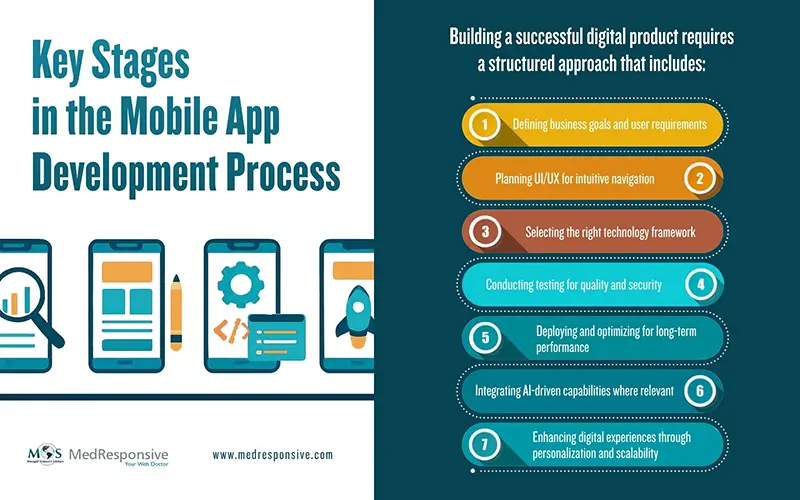
Understanding the Mobile App Development Process
Successful mobile app development depends on structured execution rather than isolated technical activities.
The process generally involves:
- Requirement gathering and business analysis
- Market research and competitive evaluation
- User experience planning
- Technical architecture selection
- Frontend and backend engineering
- Testing and quality assurance
- Deployment and ongoing optimization
Each stage directly influences product functionality, scalability, usability, and long-term performance.
Organizations that approach development systematically reduce cost overruns, improve delivery timelines, and strengthen market readiness.
Planning and Requirement Analysis
Every successful digital solution begins with strategic planning.
Organizations that skip this stage frequently encounter usability issues, scope confusion, budget expansion, and workflow inefficiencies later in the process.
Planning starts with several critical questions:
- What problem will the application solve?
- Who represents the target audience?
- Which features align with business goals?
- What technical requirements exist?
- Which monetization or engagement strategy applies?
Requirement analysis also involves documenting workflows, integrations, user journeys, technical dependencies, and expected business outcomes.
Competitive research plays an equally important role because it helps organizations identify market gaps, understand user expectations, and avoid ineffective design choices.
Clear planning reduces ambiguity during development while improving collaboration between stakeholders, designers, and engineering teams.
Choosing the Right Development Approach
Technology selection significantly affects scalability, performance, maintenance requirements, and long-term cost.
Organizations typically choose between two primary approaches.
Native Development
Native applications are built specifically for a single operating system such as iOS or Android.
Advantages include:
- Stronger platform optimization
- Better performance capabilities
- Improved hardware integration
- Enhanced user experience consistency
- Greater responsiveness and stability
However, maintaining separate codebases often increases development cost and long-term maintenance complexity.
Cross-Platform Development
Cross-platform frameworks support deployment across multiple operating systems using a shared codebase.
Benefits include:
- Faster development timelines
- Reduced engineering effort
- Lower maintenance requirements
- Broader audience reach
- Improved cost efficiency
The ideal approach depends on business priorities, budget considerations, scalability requirements, and performance expectations.
UI/UX Design and User-centered Experiences
User Experience (UX) Design: Creating Intuitive and Engaging Mobile Experiences
User experience design directly affects retention, engagement, and customer satisfaction.
Even technically advanced applications struggle when navigation feels confusing, inconsistent, or inefficient.
Effective interface planning focuses on:
- Simple and intuitive navigation
- Consistent visual hierarchy
- Fast interaction speed
- Accessibility across user groups
- Reduced cognitive friction
- Responsive interface behavior
Design teams typically create wireframes and interactive prototypes before engineering begins. This stage helps identify usability challenges early and improves stakeholder alignment.
Modern businesses increasingly recognize the importance of performance and intuitive design in shaping customer loyalty and long-term user retention.
According to Matrix Media, users quickly abandon digital experiences that fail to meet usability expectations, emphasizing the importance of performance and intuitive design.
Organizations that prioritize usability reduce churn and strengthen long-term engagement.
Development and Technical Architecture
Once planning and interface validation are complete, engineering teams begin implementation.
Development generally involves two core technical layers.
Frontend Engineering
Frontend systems represent everything users directly interact with, including:
- Navigation interfaces
- User dashboards
- Interactive forms and components
- Visual content presentation
- Real-time interactions
Performance optimization remains essential because delays negatively affect engagement, conversion rates, and retention.
Backend Engineering
Backend systems manage:
- Databases and storage
- Authentication and access control
- APIs and integrations
- Cloud infrastructure
- Security frameworks
- Data processing workflows
Scalable backend architecture supports business growth without compromising performance or reliability.
Engineering teams also determine hosting models, security protocols, and data management strategies during this stage.
The Role of AI in Transforming Mobile App Development
Artificial intelligence is reshaping how organizations design, build, optimize, and maintain digital products.
Instead of functioning solely as a post-launch enhancement, AI increasingly supports the development lifecycle itself.
AI-driven Coding Support
Modern engineering environments use AI-assisted tools to improve development efficiency through:
- Intelligent code suggestions
- Automated debugging support
- Error detection during development
- Faster documentation generation
- Workflow automation
These capabilities reduce repetitive engineering effort while accelerating delivery timelines.
AI-enabled User Personalization
Organizations increasingly implement AI-driven personalization engines that analyze behavior patterns and tailor experiences accordingly.
Examples include:
- Personalized recommendations
- Adaptive interfaces
- Behavioral segmentation
- Predictive notifications
- Dynamic content delivery
AI-assisted Testing and Optimization
Testing environments now incorporate automated validation systems capable of identifying defects before release.
Benefits include:
- Faster issue detection
- Improved regression testing
- Reduced manual workload
- Higher release confidence
- Predictive quality monitoring
AI integration is steadily shifting the process toward proactive quality management rather than reactive issue resolution.
Testing and Quality Assurance
Testing determines whether an application performs reliably under real-world conditions.
Strong quality assurance strategies generally include:
Functional Testing
Ensures features behave as expected.
Performance Testing
Measures stability under varying traffic and usage conditions.
Security Testing
Identifies vulnerabilities that could compromise sensitive user information.
Compatibility Testing
Verifies performance across devices, operating systems, and screen sizes.
Organizations that underinvest in testing often face performance failures, security concerns, poor reviews, and reduced customer trust.
Testing should continue throughout the development lifecycle rather than occurring only before launch.
Deployment and Post-launch Optimization
Launching a product does not represent the end of the process.
Continuous optimization determines long-term business success.
Post-launch priorities typically include:
- Monitoring performance metrics
- Tracking user engagement behavior
- Resolving technical issues
- Introducing feature updates
- Improving speed and responsiveness
- Strengthening security protections
Analytics platforms help businesses understand how users interact with digital experiences while identifying friction points and engagement barriers.
Frequent optimization strengthens retention and supports evolving business objectives.
Industry Applications Across Business Sectors
Digital products support organizations across multiple industries, each with unique operational requirements.
Retail
Businesses improve customer engagement through digital commerce experiences, loyalty platforms, and personalized purchasing journeys.
Finance
Financial organizations implement secure digital experiences for payments, account management, and financial monitoring.
Logistics
Companies improve inventory visibility, shipment tracking, and operational coordination.
Healthcare
Healthcare organizations increasingly invest in patient engagement platforms, telehealth experiences, and remote care solutions.
Teams specializing in medical app development support organizations building secure, regulation-aware digital health platforms.
Similarly, providers offering healthcare app development services help institutions improve accessibility, patient communication, operational efficiency, and care coordination.
Common Challenges in Development Projects
Despite rapid technological advancement, organizations continue facing several recurring implementation challenges.
Common obstacles include:
- Unclear project scope
- Budget overruns
- Feature creep
- Weak usability planning
- Security vulnerabilities
- Insufficient testing
- Poor scalability preparation
Organizations reduce these risks through disciplined planning, cross-functional collaboration, and phased execution strategies.
Strong governance improves predictability while minimizing avoidable setbacks.
Future Trends Shaping Digital Product Creation
Technology evolution continues redefining expectations surrounding digital experiences.
Emerging trends include:
- Greater AI integration across engineering workflows
- Increased personalization through behavioral analytics
- Expansion of low-code and no-code platforms
- Wider adoption of cloud-native architecture
- Enhanced cybersecurity frameworks
- More intelligent automation systems
Businesses increasingly prioritize flexibility, scalability, automation, and adaptive user experiences when investing in digital products.
These developments indicate a broader shift toward faster delivery cycles and increasingly intelligent digital ecosystems.
Strategic Outlook on Mobile App Development
The process of creating digital experiences continues evolving alongside changing business priorities and technological advancement.
The phrase mobile app development represents far more than engineering activity alone. It reflects a coordinated process involving planning, design, architecture, testing, deployment, optimization, and continuous innovation.
Organizations that invest in thoughtful execution strengthen customer engagement, improve operational efficiency, and position themselves for sustainable digital growth.
As AI-enabled technologies continue reshaping engineering workflows, businesses that combine strategic planning with technical excellence will remain better positioned to compete in increasingly digital markets.