
In the ever-evolving world of digital marketing, businesses are constantly searching for faster and more effective ways to rank on search engines. One such strategy that has gained attention is parasite SEO, a technique that leverages the authority of high-ranking websites to boost content visibility. Instead of building domain authority from scratch, marketers publish content on established platforms to tap into their existing credibility and search engine trust.
While this approach can generate quicker visibility, many businesses still rely on professional organic SEO services providers to build long-term, sustainable rankings through strategic content creation, technical optimization, and authoritative link building. Understanding how parasite SEO works and how it compares to services offered by an SEO services provider, can help you determine the right strategy for your digital growth goals.
What Is Parasite SEO in Digital Marketing?
In simple terms, it is the practice of publishing your content — such as blogs or articles — on high-authority websites that already rank well on search engines. Instead of building your own website’s authority from scratch, you leverage the credibility of established platforms to help your content rank faster on Google. It is also known as Barnacle SEO or Piggyback SEO. This approach is often associated with high authority websites SEO, where marketers strategically publish content on trusted domains to gain quicker visibility.
As the name suggests, this strategy relies on the strength of an existing “host” domain. Your content benefits from the platform’s domain authority, backlink profile, and search engine trust, making it easier to appear on the Google SERP (Search Engine Results Page). In this way, your content draws ranking power from the host website’s established reputation through effective domain authority leverage, allowing you to capitalize on the credibility the platform has already built.
For businesses that are just beginning their SEO journey, this technique can be one of the quickest and most effective ways to gain visibility, especially when targeting medium to low-competition keywords. Many reputable platforms allow user-generated or branded content, giving global businesses access to powerful publishing opportunities. When executed properly, the results can be both fast and impressive.
When Should You Use Parasite SEO?
Parasite SEO is particularly effective in the following situations:
- Highly Competitive Niches
- When Speed Is a Priority
- Limited Budget
- Market Testing
If you operate in a competitive industry where ranking on your own domain feels difficult, publishing on high-authority websites can help you gain visibility more quickly.
If your goal is to generate traffic, leads or sales quickly, Parasite SEO can help establish an online presence in a shorter time frame compared to traditional SEO methods.
For startups and small businesses with limited marketing budgets, Parasite SEO can be a cost-effective alternative to long-term SEO campaigns that require sustained investment.
This strategy is also useful for testing new keywords, products, services, or offers before committing significant time and resources to building authority on your own website.
Always focus on delivering genuine value when publishing on high-authority platforms. Quality, relevance, and user-focused content are essential to maximize the benefits of Barnacle SEO and maintain credibility.
How Parasite SEO Works Step by Step
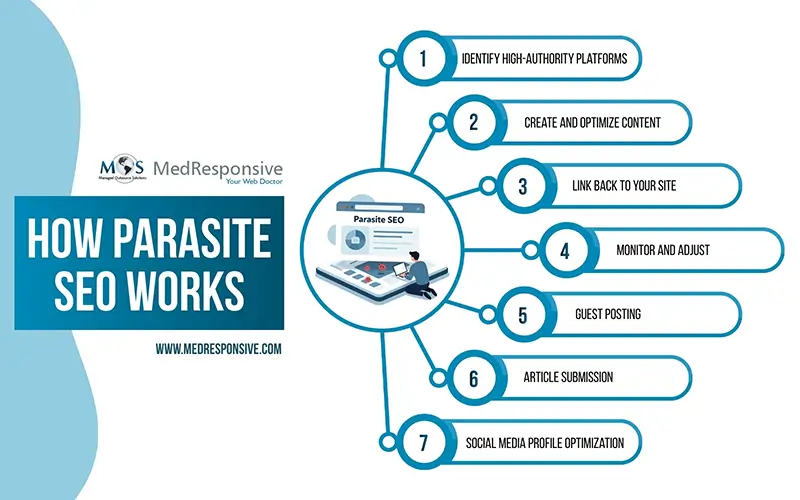
Here’s how parasite SEO typically works:
- Identify high-authority platforms: Barnacle SEO involves finding platforms that already rank well in search engines, such as social media sites, video sharing platforms, forums, or high-traffic blogs. Platforms such as Medium, Quora, LinkedIn or Reddit carry significant weight in search engine algorithms due to their established domain authority and user engagement. Once identified, the next step is crafting compelling content tailored to these platforms.
- Create and optimize content: Content creation involves thorough keyword research to target relevant topics or queries related to your business niche. By aligning your content with popular search queries, you increase the likelihood of visibility and engagement. Optimizing content involves strategically incorporating target keywords, meta descriptions, and other SEO elements within your content. By adhering to best practices in on-page optimization, you enhance the visibility and discoverability of your content in pages.
- Link back to your site: Within the content you publish on these platforms, strategically include links pointing back to relevant pages on your website. These backlinks serve as valuable signals to search engines, indicating the relevance and authority of your website in relation to the content topic. A well-planned backlink authority strategy ensures that these links are placed contextually, use relevant anchor text, and support your broader SEO goals rather than appearing promotional or spammy.
- Monitor and adjust: Monitor the performance of your content on these platforms and adjust your strategy as needed to maximize its impact on your website’s SEO. By regularly tracking the performance metrics of your content on these platforms, such as search engine rankings, traffic, and user engagement, you can identify areas for improvement and refine your strategy accordingly. This approach allows you to adapt to changes in search algorithms, user behavior, and competitor activities, maximizing the impact of your piggyback SEO efforts on your website’s overall SEO performance.
- Guest posting: Guest posting is where individuals or businesses contribute content to external websites or blogs in exchange for a byline or author bio that includes a link back to their own website. By guest posting on high-authority websites relevant to their niche or industry, content creators can leverage the existing domain authority and audience of these platforms to enhance their own website’s SEO. Additionally, it also allows for the dissemination of valuable content to a broader audience, increasing brand visibility and credibility.
- Article submission: Article submission involves creating and distributing articles on high-authority platforms to improve search engine visibility and drive traffic to your own website. By leveraging established platforms such as Medium, Quora, or LinkedIn Pulse, you can tap into their existing domain authority and user base to increase the reach of your content. Article submission allows you to target specific keywords or topics relevant to your business or industry, optimizing your content for search engines while providing valuable information or insights to readers. Additionally, including links back to your website within these articles can generate referral traffic and enhance your site’s backlink profile, which is crucial for improving search engine rankings.
- Social media profile optimization: In barnacle SEO, optimizing social media profiles plays a crucial role in leveraging the authority and visibility of established platforms to enhance one’s own online presence. By precisely crafting social media profiles with relevant keywords, compelling descriptions, and high-quality imagery, individuals and businesses can effectively attract organic traffic and improve search engine rankings.
Parasite SEO Example
Some of the platforms for this SEO method include:
- Quora
Quora is a question-and-answer platform with a high domain authority and often ranks well in search engines. - YouTube
YouTube is the largest video-sharing platform globally and is owned by Google. Videos on YouTube often rank well in Google’s search results, making it an effective platform for parasite SEO, especially for video content. - Medium
Medium is a popular blogging platform where users can publish articles on a wide range of topics. It has a high domain authority and often ranks well in online results. - Reddit
Reddit is a social news aggregation, web content rating, and discussion website. It consists of various communities (subreddits) where users can share content and engage with others. Posts on Reddit can rank well, particularly within niche subreddits. - LinkedIn
LinkedIn is a professional networking platform where users can connect with colleagues, share content, and engage with industry discussions. Articles published here often have good visibility in results, making it suitable for parasite SEO targeting professional topics. - WordPress
WordPress.com is a hosted version of the popular WordPress blogging platform. Users can create blogs and publish content here, which can rank well in search engine results due to WordPress’s strong reputation and SEO capabilities.
Challenges with Barnacle SEO
While parasite SEO offers several benefits, it also comes with its own set of challenges. One primary challenge is the risk of dependence on third-party platforms, as algorithm changes or policy updates can suddenly impact the visibility or accessibility of content. Additionally, maintaining consistency and relevance across multiple platforms can be time-consuming and resource-intensive, requiring ongoing monitoring and optimization efforts.
Also, competition on popular platforms may be severe, making it difficult to stand out amidst a sea of content creators vying for attention. Another challenge lies in balancing the need for optimization with providing valuable and engaging content to users, as overly promotional or spammy tactics can backfire and lead to penalties or removal of content. A provider of organic SEO services can help businesses with effective parasite SEO strategies and help them achieve better rankings.
Boost your rankings faster with expert Parasite SEO strategies.
Partner with our SEO Services today.
Contact Us