Nearly 90% of Americans search online for health information before seeing a doctor. They want to understand symptoms, find local doctors, or read reviews. This shift matters a lot for your practice. If you are a cardiologist and patients search “best cardiologist near me,” your website either shows up or it doesn’t. If it doesn’t, competitors, potential patients will call your competitors. Google changes constantly by making many tweaks a year. Sometimes it releases big updates that reshape rankings. The latest Google algorithm updates changed everything for healthcare providers. It released three major updates in 2025: March, June, and December. More changes keep coming. You need to understand what shifted and adapt.
Old SEO tricks stopped working years ago, and what brought traffic five years back then may now hurt rankings. Today, patient numbers depend on where you rank in search results. This guide explains the major updates to Google algorithms and how you can protect your online presence.
Understanding Google’s Algorithm Changes
Google wants to show people the most useful results. Every update serves that goal. For healthcare, this matters more because information affects real health choices.
The Helpful Content Update (HCU)
Google now prioritizes content written for people, not search engines. Pages built around keywords instead of patient needs drop in rankings fast. Many health websites got hit hard. They had pages like “best plastic surgeon in New York” with no real patient info. Google wants pages that explain symptoms, diagnoses, treatments, and risks. Thin copy designed just to get clicks doesn’t work anymore.
AI-Generated Content Scrutiny
In the last few years, ChatGPT and similar tools flooded the web with copy-paste content. Google dislikes low-quality, generic AI content that shows no expertise. It doesn’t hate AI: it hates repeat content already available everywhere.
Healthcare content matters more because medical info falls under the “Your Money or Your Life” (YMYL) category. Google demands high accuracy, good sources, and medically reviewed content. AI content that’s personalized, reviewed, and sourced works fine; generic AI content dropped into a blog doesn’t.
EEAT Moves to Center Stage
EEAT means Experience, Expertise, Authoritativeness, and Trustworthiness. Google now uses this to judge health pages heavily. Google wants:
- Content written by people with real medical training
- Author bios showing credentials
- Links to trusted medical sources
- Current treatment info
A diabetes blog should be written or checked by an endocrinologist or diabetes educator groups like the American Diabetes Association. Without these signals, even good content struggles to rank.
How Medical SEO Changed Through Major Google Updates
Each big algorithm update pushed health websites toward quality and understanding the past helps explain today’s rules.
- Panda (2011)
Panda targeted poor-quality and copied content. As a consequence, thin, spammy sites dropped. Health organizations had to write real, in-depth content. Patient reviews, FAQs, and condition guides became important.
- Penguin (2012–2016)
Penguin targeted link manipulation: buying links and creating fake networks. Some health sites got caught and paid penalties. Penguin 4.0 came out in 2016 as a real-time signal. Sites that cleaned up bad links recovered in weeks instead of months.
Even though Penguin 4.0 affected less than 1% of searches, that meant billions of queries globally. Clinics and hospitals using bad link tactics and refusing to fix them saw rankings drop long-term.
- Hummingbird and RankBrain (2013–2015)
Hummingbird helped Google understand spoken language and intent. RankBrain added machine learning to understand unusual searches. Instead of matching exact keywords, Google started grasping questions like “doctor for chronic knee pain after running.”
Medical SEO couldn’t rely on short phrases anymore. Practices using natural, patient-friendly language and answering real questions outranked those stuck on rigid keyword phrases.
- Pigeon and Possum (2014–2016)
Pigeon tightened local search rules. Possum refined location and business listings. For health providers, this meant local SEO became critical. Accurate business details, closeness, and local authority now heavily affect “near me” searches.
- Mobile-First and Page Speed (2015–2018)
Google shifted to mobile-first indexing. Page speed became a ranking factor. Most health searches now happen on phones. Slow websites drop in rankings. Clean code, small images, and mobile design are now basic needs.
Why Healthcare SEO Differs From Other Industries
Healthcare SEO differs from retail or general blog SEO. The stakes are higher and rules are stricter. When someone searches for a symptom, what they read affects their health choices. Healthcare content gets judged harder on accuracy, safety, and trust. It falls under YMYL and has stricter EEAT standards. Generic SEO tricks work poorly for medical practices and create legal risks. This is why many medical practices hire professional SEO services. Experts balance medical accuracy, rules, and leverage best practices, working far better than DIY solutions.
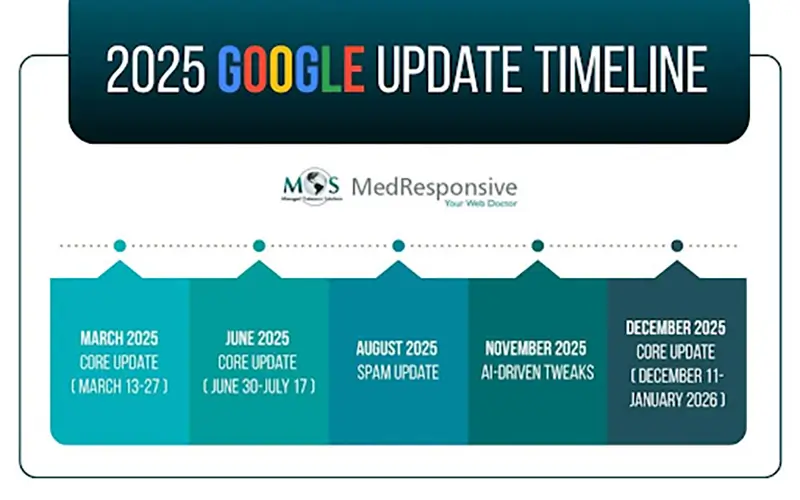
The 2025 Update Timeline: What Changed and When
Knowing when updates rolled out helps you track ranking drops. Here’s the 2025 timeline:
- March 2025 Core Update (March 13–27)
Google’s first update of 2025 took 14 days. During this period, health, beauty, and fitness sites saw bigger ranking swings. This update pushed topical authority hard. Medical SEO now demands it. Sites showing deep knowledge across related topics beat isolated pages.
- June 2025 Core Update (June 30–July 17)
The second major update focused on topical authority and AI overviews. This rollout took 16 days. Google wanted cluster-based expertise. Writing about “heart disease” wasn’t enough. You needed pages on cholesterol, high blood pressure, and cardiac rehab, all linked together showing real expertise.
- August 2025 Spam Update
Google released another filter targeting AI spam and unoriginal content. The update aimed to cut that by 45%.
- November 2025 AI-Driven Tweaks
Around November 7, Google made continuous AI-based ranking adjustments. Unlike announced updates, these caused real ranking shifts. Google now uses AI to constantly refine rankings based on content quality, user behavior, and search intent rather than waiting for big announced changes.
- December 2025 Core Update (December 11–January 2026)
Google’s third major update started December 11. It aims to “surface relevant, satisfying content for searchers from all types of sites.” This reinforces topical authority, AI readiness, and user experience as key factors.
Topical Authority: The New Ranking Powerhouse
Topical authority became critical in 2025. It’s different from old keyword SEO. It means Google judges how deeply and broadly your site covers a topic.
If your practice does orthopedic surgery, having separate pages on knee, shoulder, and hip surgery is recommended. But it’s linking those pages to rehab, pain control, physical therapy, and return-to-sport pages that creates real authority. Google highlights genuine expertise.
To build topical authority:
- Create a main pillar page on your specialty
- Create 8-12 cluster pages on specific subtopics
- Link pages showing how they connect
- Answer real patient questions on each page
- Update all pages together when treatment guidelines change
Health practices with strong topical authority weather updates better, as their authority rests on real depth, not quick tricks.
AI Overviews: The New Visibility Landscape
2025 brought major changes. Google AI Overviews are reshaping healthcare search.
What are AI Overviews? Google shows AI-created summaries at the top of some results. Instead of clicking your site, patients see a quick answer from multiple sources right in search results.
The numbers matter: 67% of health searches now show AI Overviews. Practices featured in these summaries get 340% more clicks. When patients see your practice cited, it signals trust and authority.
But here’s the catch: being in an AI Overview differs from ranking #1. To appear, your content must:
- Use clear question-based headers
- Have short, easy paragraphs (40-50 words)
- Use medical schema markup
- Come from verified medical pros
- Cite trustworthy sources
If you’re only optimizing for keywords, you are missing 67% of health searches that show AI Overviews instead of regular links.
Beyond Google: GEO, AEO, and AI Search Engines
Google leads, but the search world is growing. Patients now use AI assistants such as ChatGPT, Perplexity, Gemini, and Bing Copilot a lot more than before. So, you need to optimize beyond Google.
Generative Engine Optimization (GEO) means making your content understandable to AI models like ChatGPT. Here’s the surprise: 90% of ChatGPT quotes come from pages outside Google’s top 20. Your practice can appear in AI chatbot answers even if you don’t rank top on Google, as long as content is well-made and trusted.
Answer Engine Optimization (AEO) means writing clear, short answers to patient questions. Create content that AI systems want to quote and cite.
This is where professional SEO services matter. Teams knowing both traditional SEO and AI optimization position your practice for visibility across all search types, not just Google.
Practical Steps to Strengthen Healthcare Website SEO in 2025
Understanding updates helps but taking action is what grows your visibility. Here are some practical steps:
- Audit Your Content for EEAT and Topical Authority
- Add author names, roles, and medical credentials
- Include medical review sections with reviewer names and credentials
- Cite peer-reviewed journals, medical groups, and major health groups
- Update old posts with new research and treatments
- Map content to find gaps in topic coverage
Review blogs, service pages, and landing pages with EEAT in mind:
SEO consulting services make a big difference here. Experts can audit your site and identify what to fix first.
- Refresh and Expand Existing Content
- Expand “types of knee surgery” to include recovery time, risks, rehab tips, and FAQs
- Update old hypertension posts with new treatment guidelines
- Add links from old posts to newer related content
Google often rewards updated, popular content. Instead of constantly writing new short posts, deepen your best articles. For example:
This shows Google your information reflects current medical care.
- How to Optimize Your Healthcare Website for Better Visibility
- Load in under 2-3 seconds on desktop and mobile
- Work on phones and tablets
- Have clean URLs and XML sitemaps
- Avoid pop-ups that interrupt reading
- Use schema markup for doctors, services, and FAQs
- “How long does recovery take after ACL reconstruction?”
- “What are stroke warning signs?”
- “When should I see a dermatologist for a mole?”
Start with technical basics. Your site should:
Then build content around real patient questions, not broad topics. Write posts like:
These targeted pieces attract people actively seeking care.
Show your doctors on the site. Include bios with education, board certifications, specialties, languages, and interests. This builds both EEAT and patient trust.
- Structure Content for AI Overviews
- Use H1, H2, H3 headers that clearly show topic and subtopic
- Create FAQ sections with explicit questions and answers
- Write short paragraphs (40-50 words) answering specific questions
- Use bullet points and tables
- Add FAQ schema and other structured data
Format content so AI systems understand and cite it:
This doesn’t change how you write for readers. It makes info easier for patients and AI to use.
- Strengthen Local SEO
- Claim and verify your Google Business Profile
- Use consistent name, address, phone across all directories
- Pick the right business categories
- Ask patients for honest reviews and respond to them
Local visibility drives patient volume for most clinics. Focus on:
Local algorithms look at relevance, distance, and reputation. Accurate info, good reviews, and local citations help you appear in maps and local packs.
- Build Topical Authority Through Content Clusters
- Pick a core topic your practice specializes in
- Create one main pillar page covering the entire topic
- Create 8-12 cluster pages on specific subtopics
- Link pages showing how they connect
- Update all pages together when guidelines change
Instead of random blog posts, create topic clusters:
This signals to Google that your site completely covers your specialty, not just some blog posts.
- Prepare for Voice Search and Conversational Queries
More patients use voice assistants: “Can I drink coffee before my blood test?” or “What happens at my dermatology visit?” Voice searches are longer and more conversational.
Answer questions directly. Use natural language. Write as you speak. This helps both voice and traditional search see your content as helpful.
- Implement Strong Medical Schema Markup
- MedicalOrganization or Physician schema for your practice
- AggregateRating and Review schema for patient testimonials
- FAQPage schema for Q&A content
- LocalBusiness schema for clinic info
Use structured data to help Google and AI systems understand your content:
Schema doesn’t guarantee better rankings, but it boosts your chances of rich results, which improves clicks.
Professional SEO Services vs. DIY Approaches
Many providers try to handle SEO themselves, but it’s become too complex. Professional SEO services combine technical skill, content planning, medical knowledge, and algorithm monitoring.
Working with SEO consulting services for healthcare brings real benefits:
- Understanding HIPAA rules for online content and forms
- Knowledge of medical terms and patient communication
- Experience recovering from penalties
- Ability to track analytics that connect SEO to patient leads
- Skills to optimize for both traditional search and AI
DIY efforts often miss technical issues like slow pages, crawl errors, duplicate content, and missing schema. So, staying current with three major updates and continuous AI tweaks demands dedicated expertise.
Real-World Case: Recovering After an Algorithm Hit
A mid-sized dental practice lost first-page rankings after June 2025’s update. Traffic dropped. Appointment requests slowed. What went wrong:
- Blog posts were thin with no author credentials
- Mobile pages loaded slowly due to large images
- Business info differed across directories
- Topics were broad but lacked depth and connections
The fix took two months:
- Added dentist bios with qualifications
- Updated content with better sources
- Organized content into topic clusters
- Compressed images
- Fixed local listings
After a structured cleanup, patient calls jumped 40%. The site now matched what Google and patients expect.
This shows recovery works when you treat updates as feedback. Fastest recoveries happen when practices quickly understand topical authority and restructure content into connected clusters.
The Future: Continuous Updates Instead of Big Shocks
Google made a big change in 2025. It moved from announced updates to constant AI tweaks. Small updates now happen regularly without notice. This means ranking changes are becoming normal. Instead of waiting for the next big update, focus on consistently publishing high-quality, topically strong, EEAT-rich content. Build internal links showing how content relates. Keep medical info current. Watch what content users prefer.
Shallow, quick-fix content faces constant pressure. Deep, authoritative content survives these changes.
What to Focus on Going Forward
Google will continue to roll out new and refined updates. The pattern is clear: it rewards helpful, accurate, fast, trustworthy sites. Healthcare providers should focus on:
- Write for patients first, search engines second
- Show expertise with credentials, bios, and medical review
- Keep treatment info and stats current
- Maintain a fast mobile site under 2-3 seconds
- Build real local reputation with reviews
- Organize content into topic clusters showing expertise
- Optimize for AI Overviews and AI search features
- Plan for continuous updates rather than big announced ones
You can work with professional SEO services or focus on buildng in-house expertise. Either way, the goal is the same: appear when patients search for your care. Algorithm updates aren’t threats. Handled right, they push you ahead of competitors who ignore them.
Your next patient is searching right now. With the right strategy for the latest Google algorithm updates, you make it easy for them to find you, trust you, and book an appointment.
Boost rankings, enhance visibility, and attract more patients with professional healthcare SEO outsourcing.