
The deep-learning boom started in 2018, triggering the evolution of modern generative AI systems. Google’s AI Overviews, Bing’s Copilot, Perplexity, and ChatGPT are changing how users discover information. It has led to the development of a new discipline of search engine optimization (SEO) known as Generative Engine Optimization (GEO). While traditional search engines display links in a ranked list format, generative search engines create a single, synthesized response directly from the content of various websites. This major paradigm shift has significantly altered how businesses are approaching online visibility.
SEO and GEO are not competing disciplines–they are complementary. According to Google’s Danny Sullivan, “good SEO is good GEO”. The basic tenets that drive effective search engine optimization — clear content, authority and a user-centric focus — still apply to how businesses achieve visibility in AI-created responses. However, learning how to optimize for search results created by AI requires applying these core principles to the needs of large language models and generative search systems.
What is Generative Engine Optimization (GEO)?
Generative Engine Optimization refers to the strategies that increase brand AI search visibility in search results created by artificial intelligence. Instead of attempting to improve search rankings, GEO strategies aim to have your brand quoted or referenced in the synthesized responses generated by AI search engines. This is a shift from focusing on acquiring clicks to establishing influence through citations.
This distinction matters as generative search engines operate in a fundamentally different way from traditional search algorithms. Generative search engines analyze content from multiple sources, identify relevant data, and create comprehensive synthesized responses. Research shows that utilizing GEO strategies can improve brand visibility in generative search engine responses by up to 40%. Businesses and content creators recognize that this offers additional visibility opportunities outside of traditional search results into previously unexplored channels.
Subcategories of Artificial Intelligence Search Engine Optimization (AI SEO)
There are different subcategories of AI SEO:
- Answer Engine Optimization (AEO): AEO is focused on gaining featured snippet and brand visibility in AI-generated responses in platforms such as Google’s AI Overviews and Perplexity.
- Large Language Model Optimization (LLMO): LLMO is focused on structuring content in ways that allow large language model platforms such as ChatGPT, Gemini and Claude to correctly retrieve and reference your content.
Ultimately, both approaches ensure your content gets discovered across all search platforms.
Does Traditional SEO Still Matter in the GEO Era?
Regardless of the platform or algorithm used to access search results, content that excels in traditional search engines also succeeds in generative search results due to the fact that both reward the same qualities: clarity, authority and relevance. This alignment allows businesses to maintain existing SEO practices and simply adapt those practices to accommodate AI-driven discovery.
Write for People, Not for Machines
Generative search systems prioritize content written for humans, not algorithms. Google’s Helpful Content System already penalizes low-quality, thin content filled with irrelevant keywords and rewards comprehensive, logical content. High-quality content trains AI models to favor the same characteristics.
Content that simplifies complex ideas in plain language and organizes information logically stands a better chance of getting cited in AI-generated responses. For example, consider these two sentences: “Best laptops for people who need laptops for work are work laptops.” vs. “Professionals working remotely benefit from laptops with at least 16GB RAM, SSD storage and 10+ hour battery life.” Both sentences convey similar meaning. But, the second sentence is more informative to humans and relevant to machines and is therefore more likely to be cited in AI-generated responses.
Create Unique, Authoritative Content
Large language models and generative search engines prefer content that contains unique and authoritative information. Research conducted by Semrush found that domains whose pages appear in AI Overviews typically have higher Domain Authority scores and are linked to by other websites at a higher rate than the average result. Google encourages brands to focus on producing “non-commodity, unique content that visitors will find useful and enjoyable.” Unique content consists of proprietary research, case studies demonstrating measurable results and expert interviews.
Technical Quality Matters
Page experience still affects visibility in AI search. Google relies on certain technical parameters to evaluate the quality of content. A website’s ranking can be negatively impacted if it demonstrates poor user experience such as pop-ups, slow loading pages and poor mobile user experience. Additionally, Core Web Vitals, mobile-friendliness and HTTPS are essential. If users cannot effectively interact with your website, your site sends negative quality signals to AI models and potentially prevents them from accessing your content.
Use Entity Identification
Generative search relies heavily on entity identification — understanding not just keywords, but people, places, concepts and relationships that are represented by those keywords. For example, when a piece of content refers to “Apple,” entity markup clarifies that Apple refers to the technology company versus the fruit. By providing AI systems with the ability to understand the entities referenced in your material, you help ensure that they can properly retrieve your information when users enter related search phrases.
From Traditional SEO to GEO
Although AI search may feel like a revolution in search technology, it is actually the next stage in Google’s pursuit of rewarding people-first content. This people-first philosophy began with PageRank, where Google relied upon links from reputable sources as a proxy for trust and value. Over the years, Google has continually reinforced the importance of quality through numerous updates to its algorithm. For example, the Panda update in 2011 targeted thin content, the Hummingbird update in 2013 transitioned away from the reliance on exact keyword matches to semantic search optimization and the 2022 Helpful Content Update codified the philosophy: “content should be created primarily for people, not search engines.” In 2025, AI Overviews represent the most recent iteration in the evolution of this philosophy. While the ranking criteria has remained the same — only the way results are presented has changed.
Decoupling: Impression-Based and Click-Based Searches
One of the biggest shifts taking place in the way we measure search success is decoupling impression-based searches and click-based searches. With AI search, AI search visibility and traffic are no longer tied together; impressions are growing while clicks are decreasing. Therefore, businesses must consider a new way to measure SEO success.
At recent SEO conferences, attendees reported that, since the launch of AI Overviews, click-through rates had decreased on their sites, despite increases in impressions. AI Overviews are contributing to this trend because they provide synthesized answers that make it unnecessary for users to click through to source pages. For SEO professionals and publishers, this creates a measurement problem. Historically, traffic has served as the primary Key Performance Indicator (KPI), but visibility is becoming increasingly important than visits.
How Businesses are Adapting to the New Reality
Here’s how your business can adapt to the new reality:
- Focusing on optimizing for visibility-first SEO: Even if your content doesn’t generate clicks, appearing in answer boxes and AI Overviews will establish brand awareness and authority.
- Considering impression-based influence: If your content consistently appears in AI-generated summaries of high-value searches, you’re building brand recognition and topical authority.
- Applying advanced attribution modeling: Content that introduces prospects through AI Overviews won’t receive credit for conversions that occur weeks or months later through direct visits.
- Measuring Share of Voice in AI Search: Measure how often your brand gets cited in comparison to your competitors.
Optimizing Content for AI-Generated Search Results
Understanding how to optimize content for AI-generated search results is essential for businesses looking to maximize their visibility.
Structuring Content for AI Thought Processes
Large language models break down and score pages on relevance. Creating separate segments in your content and designing each segment to exist independently of one another will increase the likelihood of being referenced in AI-generated responses. Segment each section of your content to be between 100-300 words, and add descriptive subheadings to your content. Use language that is descriptive and contextually relevant to how users query content.
Increasing Entity Signals
Entity signals refer to identifying the specific people, companies, products and concepts referred to in your content. Since AI systems rely on contextual understanding rather than exact keyword matching, semantic search optimization is an essential component of identifying entities and their corresponding attributes. The broader the semantic coverage of your content, the greater your authority, and thus the greater the probability that your content will be referenced by AI systems.
Creating Content Ready to be Answered by AI Systems
Since AI models are designed to produce answers, they naturally favor content that has been pre-formatted for ease of comprehension. Make your material easy to scan by using clear subheadings, define terms and format content with bullet points and short paragraphs. Add direct answer to the main question right at the beginning of the first few paragraphs. Definition sections perform exceptionally well in AI Overviews.
Considering Citations the New Form of Backlinks
As large language models such as ChatGPT and Perplexity reference your work as a source, it establishes your brand as an authority on a topic, regardless of the volume of traffic your content receives. Users may not visit your site immediately, but they associate your brand with expertise. Research suggests that users who click on your content via large language models are approximately 4.4 times more likely to convert than users who arrive via traditional search.
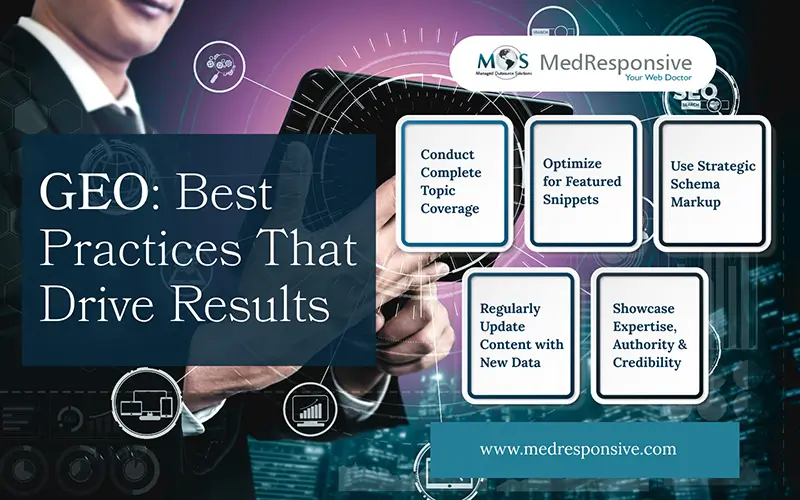
Best Practices for Developing a Generative Engine Optimization (GEO) Strategy
Implementing best practices for generative engine optimization strategy requires expanding your current SEO strategy to accommodate the requirements of AI-driven discovery.
- Conduct Complete Topic Coverage
First, develop a pillar page which provides comprehensive overview of the topic. Next, create content clusters around the pillar page focusing on a single, related topic. You can also add detailed articles that address the specific facets of the topic. For example, a search engine optimization company that develops content on GEO would develop a pillar page that describes GEO, supplemented with articles on entity optimization, structured data implementation and measurement techniques.
- Optimize for Featured Snippets
Pages in featured snippets are more likely to appear in AI Overviews. Format your content to resemble the typical formats of featured snippets. Provide brief definitions, use bullet points for guides, present data in tables, and utilize question-based headings that are followed by direct answers.
- Use Strategic Schema Markup
Structured data serves as a bridge between your content and the understanding of AI systems. Depending on the type of your business, use schema markup for Article, FAQ, HowTo, Product, Organization, and LocalBusiness. Ensure that the structured data matches with what visitors actually see.
- Regularly Update Content with New Data
Outdated content needs to be revised with new data, new statistics and new examples. Add new insights or views to update the subject.
- Showcase Expertise, Authority & Credibility
Before publishing, it is important to check your facts carefully, show your author’s expertise, review the material and include author profiles.
Role of Professional Search Engine Optimization (SEO) Companies
With increasing complexity of the GEO environment, many companies hire an agency with both basic understanding of traditional SEO and ability to handle new AI-based optimization requirements. The professional SEO agencies keep track of both traditional and AI algorithms updates and platform changes. The professionals do an exhaustive keyword research to identify the classic search terms and also the semantic terms used by the AI systems.
A professional search engine optimization company creates an optimized SEO strategy based on the client’s particular goals. Unlike the generic SEO packages available today, these agencies analyze the client’s brand, target audience dynamics, competitor landscape before creating the customized SEO strategy. Furthermore, the agencies provide transparent reports on the clients’ performance across both traditional and generative search channels.
Evaluating the Performance of Your Company within the GEO Environment
While some traditional SEO metrics are important, they are no longer enough to measure all aspects of success. It is essential to track additional metrics which measure visibility, authority, and relevance across both traditional and generative search.
Tracking impressions to see how often your pages are appearing in search and generative results; Tracking share of voice to determine how frequently your brand appears compared to other brands in the AI Overview; Tracking entities to see if the AI consistently links your brand to key topics; Tracking how often your content is referenced in AI citations.
Same Principle but Different Platform
Regardless of whether it is traditional search or AI Overviews, the underlying principle for achieving visibility remains the same: Provide your users with easy-to-read and relevant information and create a positive user experience. However, what has changed is the platform.
The number of searches in AI Overviews is expected to exceed the number of organic search queries in the coming years. This signals an urgent need to include optimization in SEO strategies for generative search engines. Brands that focus on depth, clarity and usefulness will continue to get visibility from both organic search and AI citations.
GEO: The Evolution of SEO
GEO is the next step in SEO evolution. You need to combine traditional SEO with strategies designed for AI powered discovery for enhanced visibility. Leveraging the expertise of a professional search engine optimization company is an ideal option to ensure your content addresses both traditional and AI-generative search requirements.
Take the next step in search optimization and connect with our team for expert GEO guidance.