
Patients want clear answers to their questions and easy access to healthcare. They search on their phones, ask questions, read reviews, and compare options before choosing a provider. Hospitals, clinics, and solo practices can no longer rely solely on word of mouth. Strong digital marketing is essential for attracting new patients, building trust, and driving long-term growth.
Search engines, AI tools, social media, and review sites directly shape patients’ decision-making. SEO connects these channels and helps patients find the right information. An effective SEO strategy involves more than ranking for a few keywords. It is about answering patient questions, providing clear information, and proving that the organization is safe and trustworthy.
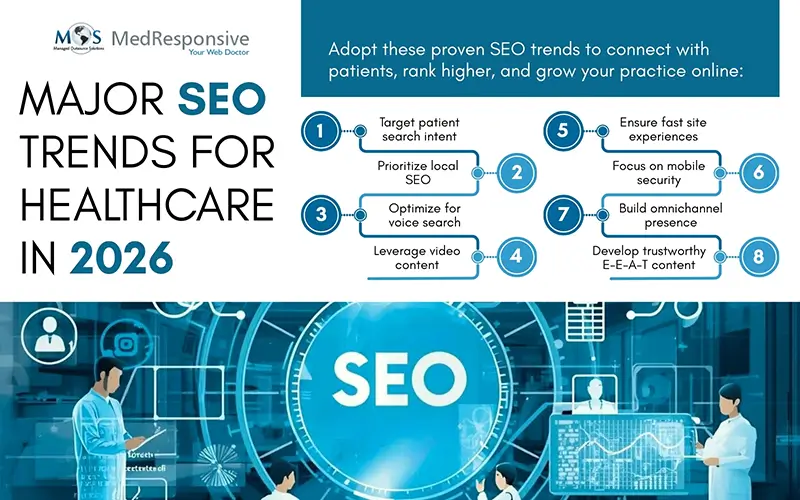
This guide explains eight key SEO trends that healthcare organizations should focus on in 2026. Each point includes simple ideas and actions that marketing teams can use, even if they do not have a large technical staff. The goal is to help any healthcare website become more visible, more useful, and more patient-friendly.
Healthcare SEO Trends That Drive Visibility and Trust
- Understand and Target Patient Intent
Search is more about intent than simple keywords; today, patients type or speak full questions while AI systems deliver direct, informative answers. Since healthcare affects people’s health and money, search engines expect information that is accurate and easy to understand.
Rather than targeting broad terms like “cardiologist” or “diabetes,” successful healthcare websites address real patient questions and everyday situations. For example:
- “I get mild chest discomfort after eating or when lying down. Is this acid reflux or something more serious?”
- “What is the recovery time after knee replacement?”
- “Pediatrician accepting new patients near me”
When healthcare organizations turn these questions into useful content on service pages, FAQs, and blogs, they are more likely to appear in Google results and AI overviews.
Practical actions:
- Ask front desk staff and nurses to list the most common patient questions.
- Turn each question into a short FAQ or page section in plain, simple language.
- Group related questions into topics such as joint pain, pregnancy care, or mental health support.
- Link related pages together so search engines see complete topic clusters.
A women’s health clinic, for example, can create a “perimenopause” hub with doctor-reviewed articles, symptom checklists, and treatment options. This hub can rank for many detailed searches, not just one competitive keyword.
- Make Local SEO Your Priority
Most patients prefer healthcare providers near their home, workplace, or school. Local SEO is still one of the best ways for hospitals, clinics, and doctors to reach nearby patients.
Local SEO is no longer just about an address and phone number. Search engines look at the full local footprint and how consistent the information is across the web.
Key elements include:
- A complete and accurate Google Business Profile
- The same name, address, and phone on all directories
- Real patient reviews with specific comments
- Location pages that explain services, parking, hours, and accessibility
Many practices do not use all the features in Google Business Profile. Simple updates such as adding appointment links, listing services, posting photos, and sharing regular updates can improve visibility, especially on mobile.
To make results more consistent, a practice can create an internal checklist on how to optimize Google Business Profile and use it for every new location.
Practical actions:
- Claim and complete Google Business Profiles for each location.
- Add real photos of the building, team, and waiting areas.
- Ask satisfied patients for honest reviews at discharge or during follow up.
- Reply to all reviews in a professional and compliant way.
- Create a separate page on the website for each location with directions and a map.
A dental group with several offices that treats each branch as its own “microsite,” with detailed profiles and local content, ranks higher than general directories in that area.
- Prepare for Voice and Conversational Search
Voice search continues to grow as patients use smartphones to find care while they are busy or commuting. Instead of typing “dermatologist NYC,” patients might ask, “find a skin specialist near me who treats acne scars.”
Voice searches are usually:
- Longer
- More conversational
- Question-based
- Location-based
Healthcare websites that answer natural language questions and structure content clearly are more likely to show up in voice results and AI answers.
Practical actions:
- Add FAQ sections to major service pages, with each question written as a full sentence and each answer in 2 to 4 short sentences.
- Use headings like “What are the symptoms of…?”, “How is this treated?”, and “When should a patient see a doctor?”
- Include conversational long-tail phrases in the main content, not only in metadata.
- Use structured data like FAQ schema and LocalBusiness schema so search engines can read the content easily.
For example, a pulmonary clinic that publishes a clear Q&A page about “when to see a doctor for a persistent cough” appears when patients ask a voice assistant about that symptom, even if the patient never types the clinic’s name.
- Optimize Video for Maximum SEO Impact
Video is now a key channel for helping patients learn about conditions, procedures, and providers. Short videos can help patients feel more comfortable and build trust faster than text alone.
Search engines and social platforms treat video as an important engagement signal. Well optimized videos can rank on YouTube, appear in Google search results, and send visitors to the website.
Useful healthcare video types include:
- Short explainer videos about common procedures or conditions
- Doctor introductions and “meet the team” clips
- Patient education on preparation and recovery
- Virtual tours of clinics, imaging centers, or operating rooms
- Recorded webinars or Q&A sessions on a core topic
Practical actions:
- Turn existing patient education materials into simple video scripts.
- Ask doctors or nurses to record clear 1 to 3 minute videos in plain language.
- Upload videos to YouTube with descriptive titles, strong thumbnails, and links back to related pages.
- Embed videos near the top of related service or blog pages.
- Add transcripts for accessibility and indexable text.
A gastroenterology practice will see more colonoscopy appointment requests after adding a short, reassuring video about “what to expect before, during, and after your procedure” to its service page.
- Deliver Fast, Accessible Patient Experiences
Search engines reward websites that offer a fast, smooth, and safe experience. Patients expect the same. They want pages that load quickly, are easy to read, and make booking simple.
Key user experience areas include:
- Page speed on mobile and desktop
- Stable content while pages load
- Clear navigation and menus
- Readable text on different devices
- Accessibility features for users with disabilities
Poor experience shows up as high bounce rates, short visits, and low conversion from organic traffic. Search engines treat this as a sign that the site is not meeting user needs.
Practical actions:
- Use tools like PageSpeed Insights to check Core Web Vitals and fix the issues.
- Compress large images, especially on the homepage and banners.
- Remove or limit heavy pop ups that block the main content.
- Use clear call-to-action buttons such as “Book Appointment,” “Call Now,” or “Find a Doctor.”
- Follow basic accessibility checks such as strong contrast, labeled form fields, keyboard navigation, and alt text for images.
A neurology center that simplified its menu, removed heavy sliders, and moved booking links higher on each page saw more visitors from organic search complete appointment forms, even without a rise in traffic.
- Mobile-First SEO with Strong Security
Most healthcare searches now happen on mobile devices. Search engines index and judge websites mainly on their mobile version. Patients also care about privacy and security, especially when they fill forms or sign into portals.
Technical SEO creates the base that helps content rank and makes patients comfortable using the site.
Core technical areas include:
- Mobile-friendly, responsive design
- Fast load times on common mobile networks
- Clean URL structure and helpful internal links
- Secure HTTPS across the entire site
- Clear separation between the public marketing site and secure patient portals
Practical actions:
- Test key pages on several phone sizes and browsers to make sure menus, forms, and buttons work properly.
- Remove old plugins and heavy scripts that slow down pages.
- Check that every page redirects to HTTPS and that certificates are valid.
- Work with compliance teams to set up analytics and tracking.
- Run regular technical SEO audits to find broken links, duplicate content, and indexing issues.
When a regional hospital moved from a slow, non-responsive site to a fast, mobile-first design with proper redirects, organic search traffic increased and more visitors completed appointment requests on mobile devices.
- Meet Patients Where They Search
Patients discover providers across multiple channels such as search engines, maps, review sites, social media, video platforms, and AI chat tools. For healthcare marketers, this means SEO now touches many channels at once.
A strong healthcare SEO program supports a consistent presence across:
- Organic search and maps
- Google Business Profile and other local listings
- YouTube and other video platforms
- Social media search on Instagram, Facebook, LinkedIn, or TikTok
- Niche forums and Q&A communities where health topics appear
The goal is not to copy the same generic message everywhere. It is to keep key details, brand voice, and quality standards consistent wherever a patient first meets the organization.
Practical actions:
- Use the same core descriptions, contact details, and branding across listings and profiles.
- Reuse strong content in different formats, such as:
- Turn a blog post into a short video summary.
- Share a clinic tour video as a YouTube upload and a social media reel.
- Watch for common questions or myths on social channels and answer them with clear on-site content.
- Track which channels actually lead to appointment requests.
A fertility clinic that combined educational blogs, short medical videos, Google Business Profile posts, and doctor Q&A sessions on YouTube built a stronger overall presence than rivals that depended only on paid search ads or basic organic rankings.
- Create Clinician-Reviewed, E-E-A-T Content
Content quality in healthcare is now central to safe SEO. Google looks for:
- Experience
- Expertise
- Authoritativeness
- Trustworthiness
This E-E-A-T framework is critical for topics that affect diagnosis, treatment, or financial decisions.
Healthcare websites that publish shallow or unreviewed content risk lower rankings. Sites that show clear medical authorship and review steps usually perform better over time.
Strong content programs include:
- Clear bylines with author credentials on clinical pages
- Review notes such as “Medically reviewed by Dr. …, MD, on [date]”
- Updates when guidelines, procedures, or policies change
- Plain language that patients can understand
- Honest details about risks, benefits, and when to seek urgent care
A healthcare system that aligned its editorial process with best SEO strategies, including clinician review and dated updates on all condition pages, improved organic rankings and reduced complaints about outdated information.
Practical actions:
- Create content guidelines for sources and review steps.
- Involve clinicians as reviewers or co-authors for condition and treatment pages.
- Maintain a content inventory and update high-traffic pages on a schedule.
- Avoid exaggerated claims, unproven treatments, and misleading headlines.
- Use schema markup to identify medical content types, authors, and FAQs.
Over time, this kind of disciplined, trustworthy content helps a healthcare organization stand out in search results and AI summaries, where accuracy and reliability matter most.
Turning SEO Strategy into Patient Trust
SEO for healthcare in 2026 is not about tricks or shortcuts. It is about matching a healthcare organization’s online presence with how real patients search, compare, and choose care.
Organizations that develop a clear strategy for digital marketing in healthcare are better placed to reach the right patients, provide clear guidance, and support safe, timely care. With steady work on these eight trends, any healthcare organization can transform its website into a trusted resource that guides patients to timely, appropriate care.
Ready for the next step in patient growth?
Let us guide you to the right moves that build your online presence and draw in more patients.
Contact Us