Traditional advertising has become insufficient for many healthcare organizations. The digital landscape is much more complex, and this is where medical PPC optimization plays a vital role. With Pay-Per-Click advertising, healthcare providers can track and manage advertising costs while attracting the right kind of patients to their sites.
The biggest problem facing healthcare marketers isn’t creating ads, but finding the most efficient way possible to create ads that work. Without some form of optimization, even the best funded ads will continue to burn through funds without acquiring the expected number of patients. Being able to consistently cut the cost of advertising while increasing the number of conversions separates successful healthcare marketing from unsuccessful efforts.
What Is Medical PPC Optimization?
Medical PPC optimization is an overarching strategy for planning and executing paid advertising campaigns within the healthcare market. While the general principles of PPC apply across a wide range of industries, there are specific issues, regulations, and search behavior of healthcare consumers that require specialized knowledge and expertise.
Medical PPC optimization primarily focuses on the optimal management of keywords, ad copy, landing pages, bidding, and targeting. For example, if a patient searches for “diabetes treatment” or “emergency clinic near me,” then the optimized campaign will position the healthcare organization as one of the top choices in the search results — at a price point that allows the organization to make money.
When discussing the healthcare PPC working mechanism, one can provide the following simple outline. The PPC advertisers place bids to specific keywords and every time a potential customer types in those specific keywords, the ad of the advertiser will be shown among the results. The advertiser pays solely for the click by the consumer on the ad, unlike traditional advertisement where the advertiser has to pay no matter if the consumer is interested in the ad or not.
ROI and Cost Savings
While the raw numbers for ROI of medical PPC optimization may be compelling — a reported average return of $3 for every $1 invested — they do not tell the full story of the variations that exist between each campaign. There may be a campaign with poor keyword targeting that achieves a $2 return per dollar spent, and another campaign with the exact same budget using the same keywords but properly optimized that achieves a $5 return per dollar spent. This represents the tangible value of the optimization.
There are two objectives that healthcare PPC advertisers must meet: reducing CPC while increasing conversion rates. While many healthcare advertisers believe that these are mutually exclusive goals, achieving one goal does not mean that the other cannot be achieved simultaneously. Effective healthcare PPC advertising strategies attract relevant traffic at lower CPC and convert that traffic at higher conversion rates.
Keyword Research: The Path to Cost Efficiency
Keyword research is the first step in successful medical PPC optimization. It defines which search terms trigger ads and affect both the cost of the campaign and the conversion rate.
To develop effective keyword lists for the healthcare industry, multiple research tools should be used together to provide a comprehensive view of the keyword space. These tools include:
- Google Ads Keyword Planner: Provides the most accurate search volume estimates available
- SEMrush: Offers competitive PPC analysis and helps determine which keywords are most likely to produce revenue
- Ahrefs: Provides information about backlinks to help identify potential link-building opportunities
- Ubersuggest: Generates additional keyword ideas
Each of these tools provides a unique perspective of the keyword space that helps to inform better bidding decisions.
There are two primary types of keywords that have a huge impact on medical PPC campaigns. Generic keywords such as “doctor” or “dentist” attract a large amount of traffic that has low conversion intent and high CPC. On the other hand, long-tail keywords such as “Pediatric Dentist in [City]” attract a high degree of specific traffic from consumers who clearly understand what they want. Long-tail keywords generally have lower competition, lower CPC, and higher conversion rates.
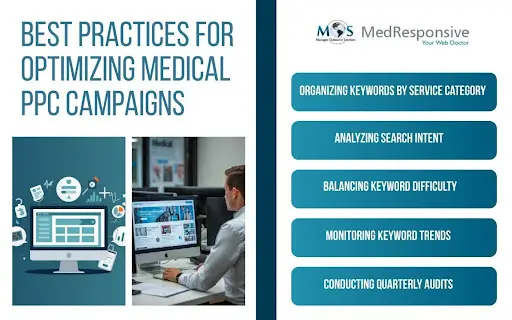
Some best practices for optimizing medical PPC campaigns include:
- Organizing Keywords by Service Category: Grouping keywords into categories such as “Cosmetic Dentistry,” “Orthodontics,” and “Emergency Dental Services” enables the use of customized ad copy and landing page design
- Analyzing Search Intent: Differentiating between informational searches (which are ideal for providing education) and transactional searches (which are ideal for conversion focused campaigns)
- Balancing Keyword Difficulty: Combining easy-to-rank keywords for quick wins with moderately competitive keywords for longer-term growth
- Monitoring Keyword Trends: Utilizing Google Trends to discover emerging search terms in the consumer’s healthcare specialty and capitalizing on growing demand before competition increases
- Conducting Quarterly Audits: Regularly reviewing keyword performance data to remove poorly performing terms and find new opportunities
The foundation established by this research-driven approach to keyword selection has a direct effect on the campaign’s economic viability. The selection of keywords that precisely convey the intent of the consumer reduces the chances of wasting money on clicks that are of no relevance, and at the same time enhances the quality of the traffic that is directed to the landing page.
Platform Selection for Medical PPC Services
All platforms do not treat healthcare equally. Selecting the correct medical PPC services platform determines both the scope and quality of the consumer audience, as well as the cost-effectiveness of the campaign.
| Platform | Average CPC | Key Strengths | Best For | Limitations |
|---|---|---|---|---|
| Google Ads | $2.62 | 3.5 billion daily searches; diverse campaign types (search, display, video, app); advanced demographic/geographic/interest segmentation; AI-powered automated bidding | Diversified campaigns with broad reach; patients actively seeking healthcare | High competition on medical keywords; elevated costs for competitive terms |
| Microsoft Ads (Bing) | $1.54 | Lower competition than Google; higher-income audience (50% aged 25-44); easy Google campaign import for multi-platform management | Budget-conscious campaigns; affluent audiences; cost optimization | Lower search volume; limited total reach compared to Google |
| Facebook Ads | $1.72 | Precise interest, behavior, demographic targeting; multiple visual formats (videos, carousels, images, stories); high social engagement rates | Visual campaigns; brand awareness and visibility; patient engagement | Stricter healthcare content regulations; ad saturation and audience fatigue |
| LinkedIn Ads | $5.26 | Targets healthcare professionals and decision-makers; advanced professional/industry/experience segmentation; B2B reach | B2B healthcare services; peer professional targeting; organizational decision-makers | Significantly higher costs; smaller audience reach compared to other platforms |
Most strategically thinking healthcare organizations will utilize multiple platforms simultaneously and allocate their budget based on the performance data for each practice.
Optimization Methods to Reduce Expenses
Reducing advertising expenses while increasing conversion rates requires a methodical optimization strategy that includes multiple campaign components:
Keyword bid optimization represents the most direct technique in reducing advertising expense. While earlier keyword bids were applied equally to every keyword, today’s advanced campaign optimization strategies adjust keyword bids based upon keyword performance data. The keywords that bring in the most conversions are given a higher bid so as to ensure the best position and to maximize conversions, while the weaker keywords would either be assigned lower bids or completely removed. Device-based bids indicate that mobile and desktop users generally have different conversion rates and so the bid is adjusted accordingly. Finally, location-based bids take advantage of variations in performance by location.
Increasing quality score directly reduces advertising expense in Google Ads. The quality score (rated from 1 to 10) represents Google’s evaluation of the ad, the user’s search and the landing page. A higher quality score results in a lower cost-per-click and a better ad position. Improving quality score requires:
- Using primary keywords in the headlines of your ads
- Creating compelling ad copy that directly addresses the intent of the search term
- Ensuring that the landing page and the advertisement contain matching content
- Improving the landing page’s load time and mobile responsiveness
- Elevating click-through-rates to demonstrate ad relevance
Increasing quality score from 6 to 8 routinely generates reductions in cost-per-clicks while generating the same amount of traffic.
Including negative keywords helps eliminate wasted advertising spend from irrelevant searches. They prevent your ads from showing for terms that may trigger clicks but are unlikely to convert into qualified patients. For example, a cosmetic surgery practice might add negative keywords such as “free,” “volunteer,” or “training.” These terms are commonly used by people looking for unpaid services, volunteer opportunities, or educational programs—not paid cosmetic procedures. By excluding these searches, the practice can ensure its ads reach only high-intent prospects and potentially reduce monthly advertising spend by 10–15%.
Landing page optimization is a core factor that has a direct impact on conversion rates and finally on the cost of advertising. Conversion rates to a great extent fall if ads bring the audience to the landing pages that are not related. It also leads to a reduction in quality score. Conversely, a relevant landing page with clear calls-to-action, mobile optimization, and minimal form fields convert traffic efficiently. A well-optimized landing page can achieve higher conversion rates if it demonstrates faster load time, clear value proportions and simplified conversion process.
Audiences segmentation allows advertisers to allocate their budgets towards the most responsive patient demographics. Instead of showing the same ad to all, Segmentation allows you to create separate campaign for every demographic segment. For example, a pediatric practice can target a specific audience by age (parents of young children), geography (local neighborhoods), or device (to cater mobile and/or desktop users). Audience segmentation minimizes waste in impressions and enhances total campaign efficiency.
Healthcare PPC advertising expenses can be kept to a minimum if advertising continues to convert web visitors into patient appointments. The reduction in expenses does not imply a decrease in the acquisition of new patients. The most effective campaign optimization strategy is the one that through careful adjustments manage to meet both goals, not by just cutting back on the budgets.
Conversion Optimization through Strategic Implementation
While minimizing advertising expenses is important, the ultimate goal of a medical PPC campaign is to turn website visitors into patient appointments. Conversion optimization requires a methodical approach to multiple factors outside of the advertisement itself.
- Design and Content of Landing Pages: It plays a significant role in determining conversion rates. Patients who view a healthcare advertisement want to arrive at a landing page that directly answers their search query. For example, a patient searching for “ATFL surgery recovery time” wants to see a landing page about ATFL surgery recovery time and protocols, and not just a landing page about the surgical services offered by the practice. This relevancy directly increases conversion rates.
- Elements of effective healthcare landing pages include:
- Clear, compelling headlines that match the language used in the search query
- Brief descriptions of services, procedures or treatments
- Patient testimonials or success metrics demonstrating positive outcomes
- Multiple, clear calls-to-action
- Mobile optimization to ensure quick loading and ease of navigation
- Trust indicators such as credentials, certifications, and patient reviews
- Fewer form fields that ask only necessary patient information
- Call-to-action Optimization: Optimizing calls-to-action significantly increases conversion rates. Healthcare campaigns need to be more explicit and action-oriented in their CTAs by incorporating phrases such as “Schedule Your Consultation,” “Book Your Appointment,” and “Call Our Specialists,” instead of resorting to a conventional label “Learn More.”
- A/B Testing: This test systematically increases conversion rates. Instead of opting default campaign settings, A/B testing can offer different variables to implement winning alternatives:
- Test different versions of headlines to determine which message resonates best
- Test different versions of call-to-action phrases to determine which phrase produces the most clicks
- Experiment with different landing page layouts and visual hierarchy
- Test different versions of form fields to determine the least invasive version of collecting necessary patient information
- Compare ad extensions to determine which information types produce more conversions
- Small improvements compound greatly. Increasing conversion rate from 2% to 2.5% represents a 25% improvement in patient acquisitions from the same traffic volume.
- Retargeting Visitors: Patients may have to be exposed to the ads several times before they finally make a decision. Retargeting campaign aims to target previous website visitors by delivering a better or refined message. A first time user visiting your site might require more information about your practice through content. The site visitors who have already been to your site and have not scheduled an appointment may require content that addresses their concerns about making an appointment. Retargeting audiences receive more refined messaging that helps guide hesitant prospects toward conversion.
- Utilizing Ad Extensions: This provides additional information within search ads which can improve both click-through-rate and conversion rate. Healthcare specific ad extensions include providing location information which allows for map integration, phone extensions which allow for direct calling, and structured snippets which highlight specific services or specialties.
Tracking Ad Campaign Performance Metrics
Healthcare organizations have to measure and analyze the performance of their advertising campaigns by tracking key performance indicators (KPIs). The data can be used to make informed decisions about the direction and focus of future optimization initiatives.
- Click-Through Rates (CTRs): It defines the percentage of users who clicked on an advertisement after seeing it. Average CTRs in Healthcare are approximately 3.27%. A CTR above this number is indicative of effective messaging and relevance. Conversely, declining CTRs may indicate the need to refresh your advertisement or adjust your keyword targeting strategy.
- Conversion Rates: It specifies the proportion of visitors to your website who perform the intended action such as booking a consultation or submitting a form. Conversion rates in healthcare usually differ according to the service or treatment being promoted and can range from 2% to 4%.
- Cost-per-Acquisition (CPA): This specifies the average expenditure for acquiring one patient. This metric helps to determine the ROI for the campaign. The patient lifetime value being higher than the CPA indicates that the campaign is producing positive returns. On the other hand, a lower CPA indicates that the ad campaign requires optimization and reallocation of budget.
- Return on Investment (ROI): This metric is basically the indicator of the financial performance of your campaigns. The healthcare benchmark, which amounts to $3 return for every $1 investment, implies a 200% ROI. The campaigns that are giving less returns should be optimized.
- Quality Score (Google Ads Metric): It has a direct impact on the amount you pay per click (CPC) and the positioning of your ad. The quality score is rated from 1 to 10, with lower CPC and better ad placement corresponding to higher scores. Keeping an eye on Google Ads quality score is a way of checking whether your optimization actions are making your ads more relevant.
- Cost-Per-Click (CPC): CPC is an ad benchmark for the actual price at which created ads are clicked. The benchmark for health is approximately set at $2.62. Analyzing CPC trends helps you understand if your optimization efforts are reducing your advertising costs.
- Bounce Rate: It is the ratio of non-interacting visitors to total visitors. High bounce rates may suggest that the landing page is not really delivering what is promised, or that the site is difficult to navigate. Improving bounce rates means that your messages and landing pages are now more closely aligned.
In order to successfully implement systematic medical PPC optimization, healthcare organizations must continuously monitor these KPIs to identify trends and implement necessary optimization adjustments.
Success Stories
The successful execution of healthcare PPC advertising strategies has been clearly demonstrated through examples that highlight the great impact of systematic optimization.
- Biotech Cancer Research Organization: A biotech company focused on developing new cancer treatments launched targeted PPC campaigns with solution-based messaging and patient testimonials. By optimizing the landing pages and segmenting their target audience within the oncology research space, the company was able to:
- Increase monthly sales by $900,000 (from $5 million to $5.9 million)
- Increase marketing qualified leads by 20% (from 500 to 600)
- Increase monthly website traffic by 35% (from 10,000 to 13,500)
- Health Supplement Market Leader: A health supplement company became a recognized authority in the Czech and German markets by means of PPC campaigns that were well-planned and executed.
After conducting extensive A/B testing and optimizing individual pages of their website, the company:
- Reached 25,000 monthly traffic
- Exceeded 100,000 total page views with a 15% increase in engagement
- Converted 2.5% of visitors into customers, resulting in over 15,000 conversions
Building Long-term Success with Medical PPC Strategies
Medical PPC optimization represents a complex and multi-faceted approach to digital marketing in healthcare that simultaneously reduces advertising spending and increases the number of new patients acquired. The implementation of medical PPC optimization combines three primary components: strategic keyword research, platform selection, and optimization of ad copy and landing pages. Additionally, medical PPC optimization includes the process of continuous measurement of campaign performance.
Healthcare organizations looking to gain long-term competitive advantage in the acquisition of new patients should consider partnering with a company providing medical PPC services or a healthcare SEO agency that has an understanding of healthcare marketing best practices, regulatory compliance issues, and search behavior of patients looking for healthcare services.
Let our healthcare SEO agency handle your medical PPC optimization.