

Over the past two decades, healthcare marketing trends transformed from localized outreach to highly targeted digital engagement. What once depended on physician referrals and community relationships has expanded into a sophisticated ecosystem driven by digital visibility, patient expectations, and measurable outcomes. Healthcare organizations now face intense competition. They must also navigate numerous communication channels and strict compliance standards. This environment has forced marketing teams to rethink how they connect with patients while maintaining accuracy, trust, and regulatory alignment.
The pace of change matters more now than at any point in the past. Patients rely on online information before choosing providers, evaluate organizations through reviews and content, and expect personalized experiences across platforms. Healthcare organizations must respond quickly, manage large volumes of information, and coordinate messaging across multiple channels.
This post examines how healthcare marketing evolved from traditional outreach to digital engagement, explores the key challenges that shaped this transformation, reviews the rise of data-driven and AI-assisted strategies, and highlights future developments that will define the next phase of healthcare marketing.
Healthcare Marketing Trends That Defined the Early Years
The earliest healthcare marketing trends centered on relationship-building and community presence. Hospitals and clinics relied on visibility within their immediate geographic regions, and patient acquisition depended largely on referrals, trust, and familiarity. Marketing during this period focused less on data and more on reputation.
Traditional outreach methods included:
- Print advertisements in local newspapers and health magazines
- Informational brochures distributed through clinics
- Sponsorship of community events and wellness programs
- Physician referral networks serving as the primary source of patient flow
- Local radio and television messaging aimed at brand recognition
Healthcare organizations invested heavily in trust-building rather than broad-scale promotion. Reputation was shaped through consistent patient experiences and professional relationships rather than targeted messaging strategies.
However, this approach had limitations. Geographic reach remained restricted, performance measurement was minimal, and communication methods lacked flexibility. Healthcare providers had limited visibility into patient behavior, making it difficult to evaluate campaign effectiveness or adjust messaging strategies. These limitations prompted transformation as technology advanced and patient expectations shifted.
Key Challenges Driving Change in Healthcare Marketing
Healthcare marketing evolved not only through technological innovation but also in response to operational and regulatory pressures that forced organizations to communicate differently with patients. Several persistent challenges forced healthcare providers to move beyond traditional marketing methods.
Regulatory Compliance
Healthcare organizations operate under strict regulatory frameworks that govern communication practices, patient data usage, and advertising claims. Marketing teams must ensure that messaging remains accurate, ethical, and compliant with privacy regulations. As digital platforms expanded, maintaining compliance across multiple channels became more complex and resource-intensive.
Volume of Communication Channels
The growth of digital platforms introduced a significant increase in communication touchpoints. Websites, social media platforms, mobile applications, and messaging systems created new opportunities for engagement but also introduced coordination challenges. Managing content across these channels required standardized processes and centralized oversight.
Data Fragmentation
Healthcare organizations generate large volumes of data across electronic health records, scheduling systems, and marketing platforms. Integrating these data sources into a unified system presented technical and operational difficulties. Fragmented data prevented healthcare teams from gaining actionable insights and slowed decision-making.
Time Pressure and Operational Complexity
Marketing teams faced growing demands to produce high-quality content within tight timelines. Campaign launches, seasonal promotions, and service announcements required rapid execution without compromising accuracy. This pressure increased the need for streamlined workflows and systematic planning.
Rising Patient Expectations
Modern patients seek immediate answers, transparent pricing information, and accessible healthcare content. They expect seamless interactions across digital platforms and evaluate providers based on online experiences. Meeting these expectations required healthcare organizations to adopt more responsive and adaptive marketing practices.
These challenges collectively created a strong foundation for digital transformation and encouraged healthcare organizations to adopt more measurable and technology-driven approaches.
The Shift Toward Digital Healthcare Marketing
The introduction of digital technologies marked a turning point in healthcare marketing. Organizations began developing websites to provide service information, publish educational content, and support appointment scheduling. This transition expanded reach beyond local communities and created opportunities to engage patients at earlier stages of their healthcare journeys.
Search engines became an essential gateway for patient discovery. Patients increasingly searched for symptoms, treatment options, and nearby providers before making healthcare decisions. As a result, visibility in search results became a strategic priority. Many organizations collaborated with a specialized healthcare SEO agency to strengthen online visibility, optimize service pages, and improve discoverability in competitive markets.
Digital marketing practices introduced new capabilities, including:
- Search engine optimization to improve website rankings
- Email campaigns targeting existing patients
- Online directories listing healthcare providers
- Website analytics tracking visitor behavior
- Content marketing through blogs and informational resources
This phase marked the beginning of performance-driven marketing. Unlike traditional outreach, digital platforms provided measurable insights into user engagement. Healthcare marketers gained access to metrics such as page views, click-through rates, and conversion patterns. These insights made it possible to refine strategies based on real data rather than assumptions.
However, the rapid growth of digital channels also increased complexity. Organizations needed structured content management systems and trained professionals capable of maintaining consistent messaging across platforms. The foundation established during this period prepared healthcare providers for the next major shift toward data-driven marketing.
The Rise of Data-Driven Healthcare Marketing
As digital engagement expanded, healthcare organizations began focusing on data as a strategic asset. Marketing decisions shifted from intuition-based planning to measurable analysis supported by analytics platforms and customer relationship management systems. This transition marked a critical stage in the evolution of healthcare marketing.
Data-driven marketing enabled healthcare providers to segment audiences based on demographic characteristics, behavioral patterns, and service history. Instead of delivering uniform messaging, organizations developed targeted campaigns designed to address specific patient needs.
Healthcare organizations increasingly relied on integrated healthcare marketing services to manage data workflows, coordinate campaigns, and track performance indicators. These services supported systematic campaign execution and helped marketing teams maintain consistency across multiple channels.
Key advancements during this phase included:
- Adoption of customer relationship management systems to centralize patient data
- Use of analytics tools to monitor campaign performance
- Audience segmentation based on behavioral insights
- Development of dashboards to visualize marketing outcomes
- Integration of scheduling and communication systems
The availability of measurable insights transformed marketing from a support function into a strategic driver of organizational growth. Healthcare providers gained visibility into patient acquisition patterns, enabling more precise allocation of marketing resources.
Despite these improvements, data management introduced new operational challenges. Healthcare organizations needed skilled professionals capable of interpreting complex datasets and maintaining data integrity. Security concerns also intensified, requiring strict safeguards to protect sensitive patient information.
Patient-centric strategies emerged from this phase, focusing on experience rather than exposure alone.
The Emergence of Patient-Centric Marketing Strategies
Healthcare marketing entered a new phase when organizations recognized the importance of patient experience as a defining factor in brand reputation. Marketing strategies expanded beyond visibility and engagement to emphasize trust, accessibility, and relevance.
Patient-centric marketing placed the individual at the center of communication planning. Instead of delivering broad messages, healthcare providers developed content tailored to patient concerns, treatment journeys, and information preferences.
This transformation introduced several notable developments:
- Personalized communication based on patient interests
- Educational content addressing specific medical conditions
- Reputation management through patient reviews and testimonials
- Multi-channel messaging across websites, email platforms, and social networks
- Content strategies focused on preventive care and wellness education
Patient-centric approaches strengthened relationships between healthcare providers and their communities. Organizations recognized that informed patients were more likely to participate actively in treatment decisions and maintain long-term engagement with healthcare services.
However, personalization required closer coordination across departments. Marketing teams needed collaboration with clinical staff, administrative personnel, and technology specialists to maintain consistent messaging and accurate information. This collaboration increased organizational complexity but improved communication quality.
The demand for responsive engagement eventually led to the integration of advanced technologies designed to enhance efficiency and precision.
The Integration of AI-Driven Healthcare Marketing Technologies
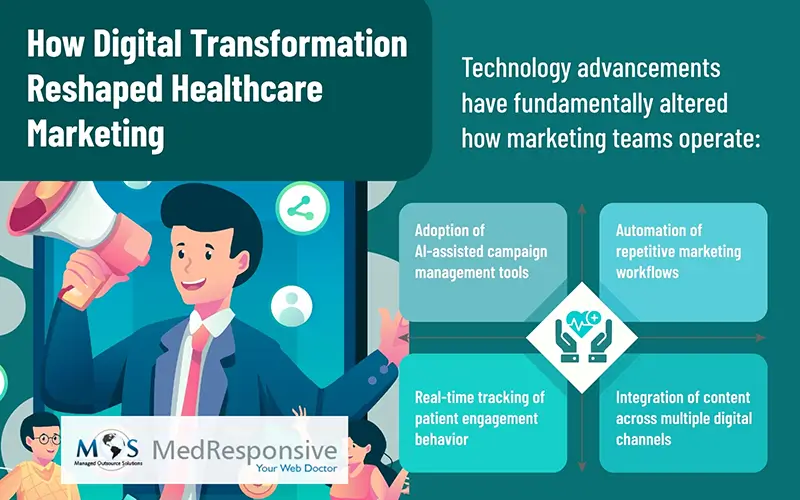
The adoption of AI-driven technologies introduced a new level of sophistication in healthcare marketing. AI-assisted tools improved efficiency, supported predictive insights, and reduced manual workload across marketing operations. These technologies became particularly valuable as campaign complexity increased and data volumes expanded.
AI-driven marketing systems analyze large datasets to identify patterns that human analysts might overlook. These insights support more accurate targeting and improve communication relevance.
Key AI-related developments include:
- AI-assisted audience segmentation based on behavioral patterns
- AI-enabled chatbots providing instant responses to patient inquiries
- Predictive analytics forecasting patient engagement trends
- Automated content scheduling across multiple platforms
- Real-time performance optimization adjusting campaigns dynamically
AI technologies improved operational speed while maintaining consistency in communication. Marketing teams could respond to patient inquiries more quickly and refine campaigns based on real-time feedback.
Despite the advantages, organizations encountered significant implementation challenges. Integrating AI-driven systems required technical expertise, workflow restructuring, and staff training. Healthcare organizations also needed to ensure that AI-generated outputs remained compliant with regulatory standards and aligned with organizational values.
AI integration complemented human expertise, providing actionable insights and reducing repetitive tasks. This collaborative model strengthened efficiency and optimized outcomes.
Emerging Trends in Healthcare Marketing
Healthcare marketing continues to evolve as new technologies and patient expectations redefine engagement strategies. The next decade will involve the use more advanced tools designed to improve accuracy, responsiveness, and personalization across communication channels.
Several forward-looking developments are expected to shape the future of healthcare marketing.
Predictive Personalization
Marketing systems will increasingly anticipate patient needs based on historical data and behavioral signals. Predictive models will support timely outreach, improving patient engagement and satisfaction.
Privacy-Centered Marketing Frameworks
As regulatory requirements become stricter, healthcare organizations will adopt privacy-first communication strategies. Transparent data practices will strengthen patient trust and protect sensitive information.
Integrated Communication Ecosystems
Healthcare organizations will unify multiple communication channels into centralized platforms. This integration will improve coordination and reduce inconsistencies across messaging systems.
Real-Time Decision Support
Advanced analytics platforms will provide immediate insights into campaign performance. Marketing teams will adjust strategies dynamically, reducing delays and improving response accuracy.
Expansion of AI-Driven Workflows
AI-driven technologies will continue to support operational efficiency by automating repetitive tasks and improving predictive accuracy. These workflows will enhance productivity while maintaining compliance with regulatory standards.
These developments show that healthcare marketing will continue to adapt rapidly. Organizations that invest in scalable infrastructure and data integration will be better positioned to respond to changing market conditions.
Adapting to the Next Era of Healthcare Marketing
Healthcare marketing has progressed through multiple stages, each shaped by technological innovation, operational challenges, and evolving patient expectations. From community-based outreach to digital engagement and AI-assisted strategies, the discipline has transformed into a highly specialized function that supports both organizational growth and patient communication.
Examining the evolution of healthcare marketing trends provides valuable insights into current practices and future opportunities. Organizations that recognize the significance of historical transitions can make informed decisions about resource allocation, technology adoption, and strategic planning.
As healthcare systems continue to expand and patient expectations rise, marketing teams must remain adaptable and forward-thinking. Success in modern healthcare marketing depends on integrating analytics-driven campaigns, navigating multi-channel compliance, and delivering personalized patient communications informed by data. The next phase of evolution will depend not only on technological advancement but also on the commitment to delivering meaningful, accurate, and patient-focused communication.
Want to Attract More Qualified Patients?
Develop strategic campaigns supported by data insights, audience segmentation, and focused messaging.
Contact Us