

The true measure of an effective healthcare system isn’t evaluated only by technology or budget. It also depends on how accessible healthcare is to the public, regardless of patient backgrounds. According to CDC data, over 61 million adults, or 1 in 4, live with a disability in the U.S. This figure highlights the importance of prioritizing healthcare website accessibility to provide equal opportunities for better health outcomes. Besides inclusivity needs, medical organizations are also mandated by healthcare regulations to meet accessibility standards.
Despite legal efforts, nearly 80% of digital healthcare platforms still fail to meet accessibility requirements, leaving disabled users behind. Without accessible healthcare websites, disabled patients struggle to book appointments, view test results, and pay online medical bills. By implementing inclusivity features into their websites, healthcare providers can demonstrate commitment to ethical care and regulatory responsibility. As practices may not have the internal resources needed to incorporate this feature, partnering with expert healthcare SEO services is an alternative, strategic choice.
Key Benefits of Accessible Medical Websites for Hospitals
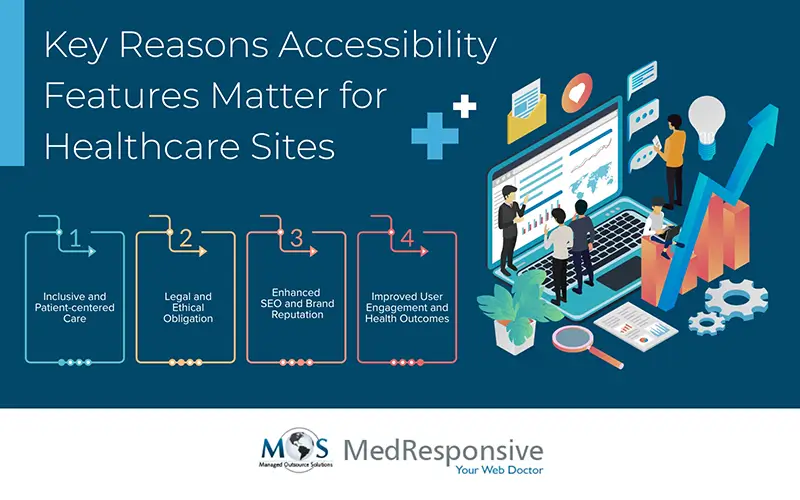
A well-developed, inclusive website that works for every user is no longer an optional choice for medical practices, but a necessity. Disabled patients face various challenges when it comes to browsing websites, such as navigating complex menus to filling out forms. Creating disability-friendly health portals can significantly reduce barriers, improve usability, and deliver better user experience. Let’s explore the key reasons why inclusive medical websites are a necessity in this patient-first digital era:
- Inclusive and Patient-centered Care
An inclusive digital healthcare website ensures that all patients, including those with visual, auditory, or cognitive impairments can easily navigate and use digital services. Features such as screen reader compatibility, clear headings, and keyboard-friendly navigation allow patients to access information independently.
An inclusive website attracts a diverse audience and strengthens trust, fostering equitable experience for every visitor. For example, older individuals relying on assistive technologies can schedule appointments or review medical records without assistance.
- Legal and Ethical Obligation
Healthcare organizations must comply with regulations such as ADA, Section 504, and WCAG to avoid legal consequences and protect patients’ rights. Non-compliance with accessibility laws can result in penalties, lawsuits, and reputational damage, thus reducing patient confidence.
Beyond legal requirements for healthcare websites, accessible design reflects ethical responsibility, demonstrating commitment to equitable care. For instance, providing closed captions on video tutorials allows hearing-impaired patients to better understand complex health content. Meeting these obligations not only safeguards the practice from costly lawsuits but also reinforces professional integrity and credibility.
- Enhanced SEO and Brand Reputation
Accessibility improvements, such as descriptive alt text, structured headings, and clear content hierarchy, also enhance search engine indexing. Well-optimized accessible content reaches broader audiences, including individuals who may not rely on assistive tools. This increases visibility for your site while signaling authority to both search engines and users.
For example, a post with properly tagged images and headings performs better on search results, attracting more traffic organically. Accessible design thus strengthens both brand reputation and digital presence.
- Improved User Engagement and Health Outcomes
With nearly all major sources of traffic being mobile devices, accessibility features improve navigation, readability, and mobile-responsiveness, allowing patients to find information quickly. Simplified layouts, high-contrast visuals, and intuitive interfaces reduce user frustration and encourage longer, repeated visits. For instance, inclusive elements such as screen readers enable visually-impaired users to complete online forms and upload insurance details without delays or errors.
By enhancing usability, accessible design directly contributes to better engagement, adherence to care plans, and overall health outcomes. Well-designed accessibility features therefore create measurable benefits for patients and providers alike.
Demystifying WCAG Standards
The Web Content Accessibility Guidelines (WCAG) provides a roadmap for designing inclusive websites. The standards are organized into three levels:
- Level A: Basic features that address critical accessibility barriers. Examples include text alternatives for non-text content and clear form labels.
- Level AA: Intermediate, recommended features of a medical website that improve usability. This includes adequate color contrast, resizable text, and consistent navigation.
- Level AAA: Represents the highest accessibility standard, focused on creating an optimal and fully inclusive user experience. Examples include sign language interpretation for videos, enhanced contrast modes, and advanced navigation aids.
Top Tips for Creating Inclusive Healthcare Websites
Let’s explore the key inclusivity features that practices can implement to enhance user experience, ensure compliance and make your website accessible for all:
- Clear and Consistent Navigation
A predictable and organized structure helps users quickly locate important information like services, insurance details, or contact options. Incorporate breadcrumb trails and a well-labeled menu that follows a logical hierarchy, making it easier for users with screen readers or cognitive disabilities to navigate. Use descriptive link text instead of vague terms like “click here” so users know exactly where each link leads. Additionally, ensure that interactive elements such as buttons, forms, and dropdowns are keyboard-accessible, with visible focus indicators. Consistency across all pages helps patients maintain orientation and reduces confusion during their visit.
- Readable Design and Content
Readable websites improve comprehension for users with visual, cognitive, or learning impairments. Maintain adequate color contrast between text and background, and allow users to adjust font sizes without breaking the layout. Avoid long paragraphs or technical jargon, and use headings and bullet points to improve scannability. Implement scalable typography and responsive layouts to ensure readability across all devices, including smartphones and tablets. Providing a dark mode or high-contrast viewing option can further enhance usability for those with low vision.
- Assistive Technology Compatibility
Your website must function smoothly for users navigating via assistive devices such as keyboard, screen readers or voice commands. Interactive elements such as menus, forms, buttons, and links must be operable without a mouse. For instance, an online bill payment form should allow complete submission using a tab and enter keys alone. Compatibility with assistive technology ensures equitable access for all patients, reinforcing inclusivity.
- Alternative Text and Media Accessibility
Images, infographics, and videos must include descriptive alt text, captions, and transcripts to provide equal access for patients relying on assistive technologies. For example, a video explaining post-operative care should have closed captions for hearing-impaired users and a transcript for those who prefer reading. Include playback controls such as pause, volume, and speed adjustments. Infographics must be paired with explanatory text for users unable to perceive visuals. Incorporating audio descriptions or sign language interpretation for complex educational content can further improve user-friendliness.
- Accessible Forms and Interactive Elements
Online forms are critical for booking appointments, requesting prescriptions, or submitting medical queries. Ensure each form field has clear labels and instructions, and avoid relying on color alone to indicate errors or required fields. Provide descriptive error messages and allow users to review inputs before submission. Interactive elements like chat bots or feedback widgets should support screen readers and voice navigation. Implement auto-fill and voice input options to enhance ease of use for patients with motor impairments.
- Mobile Responsiveness and Voice Compatibility
Many patients now access healthcare sites from mobile devices, making responsiveness essential. A fully responsive design ensures that navigation, images, and content automatically adjust to any screen size. Avoid hover-based features that are difficult for touch users and ensure buttons are large enough for accurate tapping.
As voice assistants and screen readers become more common, optimizing websites for voice-based navigation is also vital. Voice-enabled and touch-based navigation options enhance convenience for users with limited dexterity, enabling hands-free appointments scheduling. Incorporate ARIA (Accessible Rich Internet Applications) attributes to improve compatibility with assistive technologies. By implementing mobile-responsiveness, websites can improve usability while ensuring smooth patient interaction with healthcare services.
Elevate Your Practice with Inclusive, Expertly Built Website
Creating an accessible healthcare website is not only about meeting technical requirements and compliance standards. It’s about ensuring that every patient can engage with your digital space confidently and independently. However, developing a technically robust medical website requires specialized skills, coding and expertise that fall outside the scope of healthcare providers. Partnering with professional healthcare website development experts can help bridge this gap. These external specialists ensure inclusive design principles are applied consistently, transforming your site into a digital extension of patient care. By prioritizing accessibility, your practice can not only enhance patient trust but also strengthen its digital reputation and long-term growth.